What Is Autonomic Neuropathy?
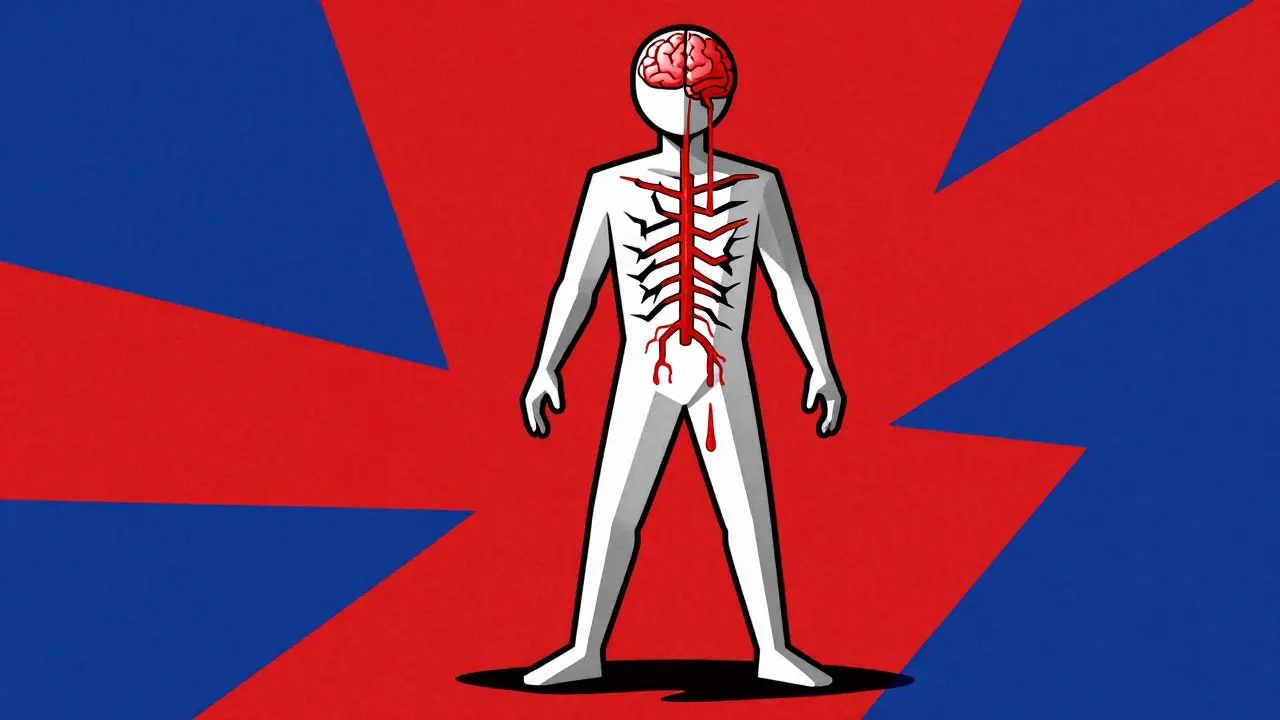
Autonomic neuropathy isn't just a side effect of diabetes-it's a serious breakdown in the body's automatic systems. These are the functions you don't think about: heart rate, digestion, blood pressure, sweating, and bladder control. When the nerves that manage these tasks get damaged, your body starts to misfire. The most common cause? Long-term high blood sugar. About 85-90% of cases happen in people with diabetes, especially those who've had it for more than 10 years. But it can also come from autoimmune diseases, certain chemotherapy drugs, or rare neurological disorders like Parkinson's.
Here's the hard truth: many people don't know they have it until they faint standing up or can't keep food down. The National Institute of Diabetes and Digestive and Kidney Diseases says 60-70% of diabetics show nerve damage on tests-but only about 20% feel symptoms early on. That means hundreds of thousands of people are walking around with a ticking time bomb in their nervous system.
Why Your Blood Pressure Drops When You Stand Up
Standing up should be simple. Your body instantly tightens blood vessels and speeds up your heart to keep blood flowing to your brain. In autonomic neuropathy, that signal doesn't get through. The result? Orthostatic hypotension-a sudden drop in blood pressure when you rise. The medical definition is clear: systolic pressure falls by 20 mmHg or more, or diastolic by 10 mmHg or more, within three minutes of standing.
In real life, that looks like dizziness, blurred vision, or blacking out. Studies show about 30% of people with diabetic autonomic neuropathy experience this. Some patients see their systolic pressure plunge from 120 to 85 in under 30 seconds. One patient described it as "feeling like the floor pulled out from under me."
It's not just about standing. Even walking can trigger it. During a 6-minute walk test, these patients only reach 55-65% of their expected heart rate-compared to 85-90% in healthy people. Their baroreflex, the body's natural blood pressure regulator, is broken. Normal values are 10-30 ms/mmHg. In severe cases, it's under 3 ms/mmHg.
And then there's POTS-Postural Orthostatic Tachycardia Syndrome. It's not the same as orthostatic hypotension, but it often shows up alongside it. With POTS, your blood pressure doesn't crash, but your heart races-30 beats per minute faster than normal within 10 minutes of standing. It hits 120 bpm or higher. Mostly seen in women aged 15-50, it affects 1-3 million Americans. Many think they have anxiety. They don't. Their nerves are firing wrong.
What’s Going On Inside Your Stomach?
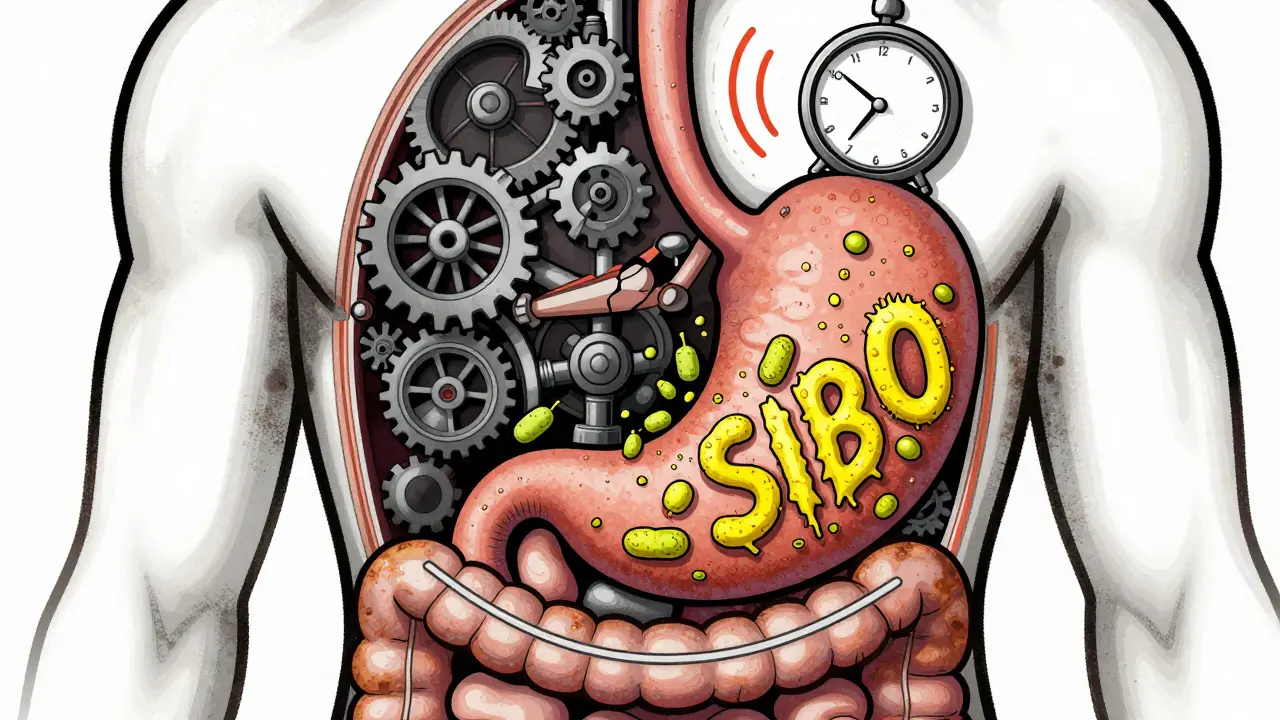
While blood pressure drops get attention, the gut problems are just as crippling-and often ignored. Gastroparesis, the delayed emptying of the stomach, affects about 30% of people with autonomic neuropathy. It's not just "slow digestion." It means food sits in your stomach for hours, rotting. Scintigraphy tests show over 10% of food still in the stomach after four hours. That’s abnormal.
People with gastroparesis vomit, often at night. Nearly 80% report nighttime vomiting. Almost half have symptoms every day. Bloating, early fullness, and nausea become constant companions. Some patients lose weight because they can’t eat without getting sick.
Constipation hits 60% of patients. Instead of going daily, they go once or twice a week. Meanwhile, 25% get diarrhea-usually at night. And it’s not just one or the other. Many alternate between constipation and diarrhea, making it impossible to predict what the day will bring.
Behind the scenes, something worse is happening: small intestinal bacterial overgrowth, or SIBO. In healthy people, it’s rare. In autonomic neuropathy, it shows up in over half of those with GI symptoms. Bacteria that should be in the colon creep into the small intestine, fermenting food before it’s absorbed. The result? Gas, bloating, and diarrhea. It’s why diets alone often fail.
How Doctors Diagnose It
There’s no single blood test. Diagnosis relies on watching how your body reacts under stress. The 10-minute active stand test is the first step. You lie down, then stand. Your blood pressure and heart rate are tracked every minute. A drop of 20 mmHg systolic or 10 mmHg diastolic? That’s a red flag.
Heart rate variability during deep breathing is next. Breathe in for five seconds, out for five. Repeat for a minute. In a healthy person, your heart speeds up when you inhale and slows when you exhale. In autonomic neuropathy, that difference shrinks to less than 1.1. That’s abnormal.
The Valsalva maneuver-bearing down like you’re having a bowel movement-tests how well your nerves respond to pressure changes. If your blood pressure doesn’t recover properly, your autonomic nerves are damaged.
For GI issues, gastric emptying scintigraphy is still the gold standard. You eat a meal with a tiny bit of radioactive tracer. A camera tracks how fast it leaves your stomach. If more than 10% remains after four hours, you have gastroparesis. Newer tools like the wireless motility capsule are just as accurate and less invasive.
Questionnaires help too. The COMPASS-31 scores your symptoms from 0 to 100. Above 30? You have significant dysfunction. It’s not perfect, but it’s reliable-and it’s how doctors measure improvement.
Treatment: What Actually Works
There’s no cure. But there are ways to take back control.
For low blood pressure, fludrocortisone helps by making your body hold onto salt and water. It works for 60% of people. But it can cause high blood pressure when lying down-something dangerous for older adults. Midodrine tightens blood vessels. It’s effective for 70% of users, but you have to time your doses carefully. Take it too late in the day, and you won’t be able to sleep because your blood pressure stays high.
Ivabradine is a newer option for POTS. It doesn’t raise blood pressure. It just slows the heart. In studies, it cuts heart rate by 15-25 beats per minute in two-thirds of patients. That’s life-changing for someone who feels like their heart is pounding out of their chest every time they stand.
For the gut, metoclopramide is often prescribed. It helps food move faster. But it carries a black box warning: after 12 weeks, it can cause irreversible movement disorders. Erythromycin works fast, but the body gets used to it in weeks. That’s why many doctors now turn to pyridostigmine. It’s not a miracle drug, but it improves symptoms in 55% of patients with few side effects.
Non-drug treatments are just as important. Compression stockings (30-40 mmHg) reduce orthostatic symptoms by 35%. Abdominal compression garments help with bloating and nausea. Eating six small meals a day instead of three big ones cuts vomiting episodes in half. Cutting fat under 25 grams and fiber under 10 grams per meal makes a huge difference. One patient said it cut her vomiting from five times a day to once every three days.
Increasing salt and water intake helps too. Most patients need at least 2-3 grams of extra salt daily. It’s not the old advice to "drink more water." It’s about keeping blood volume up so your body can push blood to your brain when you stand.

Living With It: Real Stories, Real Adjustments
Reddit’s r/dysautonomia has 35,000 members. Scroll through it, and you’ll see the same patterns. Eighty-two percent say standing up is their biggest struggle. Sixty-five percent describe "brain fog" when their blood pressure drops-like their mind is underwater.
Seventy-three percent changed their entire lifestyle. Eighty-nine percent avoid hot rooms-showers, saunas, even summer days. Seventy-six percent wear compression gear daily. Sixty-eight percent add salt to every meal.
For GI symptoms, 62% say their diet ruined their social life. Fifty-five percent avoid restaurants because they can’t predict when they’ll get sick. One person wrote: "I used to love brunch. Now I eat at home at 7 a.m. and never leave the house after that."
But there’s hope. In a 2023 survey, 78% of POTS patients on ivabradine said their quality of life improved. Fecal microbiota transplants are being tested now-early results show a 40% drop in GI symptoms after six months. New blood tests measuring neurofilament light chain levels might soon let doctors catch nerve damage before symptoms start.
What’s Next?
The American Diabetes Association is changing its guidelines. Starting in 2024, all diabetics with more than seven years of disease will get a simple 3-minute stand test every year. That could catch 500,000 new cases early.
The American College of Cardiology is lowering the diagnostic threshold for orthostatic hypotension-from a 20 mmHg drop to 15 mmHg. That means earlier treatment. Earlier intervention. Fewer fainting episodes. Fewer falls. Fewer hospital visits.
But awareness is still the biggest barrier. A 2021 audit found primary care doctors missed autonomic neuropathy in 70% of cases. Patients see three or more specialists before getting diagnosed. On average, it takes 4.7 years.
If you have diabetes and you’re fainting when you stand, or you’re vomiting every night, or you’re constipated and bloated all the time-don’t wait. Ask your doctor for an autonomic test. It’s not a last resort. It’s the missing piece.






Mario Bros January 10, 2026
Just started wearing compression socks after reading this. Made a huge difference in my dizziness. No more midday faceplants. Seriously, if you're standing up and seeing stars, don't ignore it.
Ted Conerly January 11, 2026
This is one of the clearest breakdowns of autonomic neuropathy I've ever seen. The stats on gastroparesis and SIBO are eye-opening. Most doctors treat the symptoms like isolated issues-vomiting, constipation, fainting-but they're all connected. The body's not broken, it's just miswired. And yeah, the salt thing? Real. I go through a full shaker a day now. No shame.
Also, the part about ivabradine for POTS? That’s the quiet hero. No adrenaline spikes, no jitters. Just a steady heartbeat when you need it most. Wish more neurologists knew about it.
And let’s talk about the 4.7-year diagnosis delay. That’s not negligence-it’s systemic ignorance. We need screening protocols baked into primary care, not left to desperate Reddit threads.
For anyone reading this and thinking "it’s just aging" or "I’m just clumsy"-get tested. You’re not imagining it.
Lisa Cozad January 12, 2026
I’ve been living with this for 9 years. The worst part isn’t the fainting or the vomiting-it’s the loneliness. People think you’re lazy or dramatic when you can’t go to a birthday dinner or take a shower without needing to lie down for an hour. This post? It’s the first time I felt seen.
Compression garments saved me. Not the cute ones. The medical-grade, ugly-as-sin, 30-40 mmHg ones. I wear them under jeans. I don’t care what people think anymore.
Dwayne Dickson January 13, 2026
While the clinical utility of this exposition is commendable, one must interrogate the epistemological underpinnings of its reliance on patient-reported outcomes. The COMPASS-31, while statistically robust, remains a subjective instrument susceptible to affective bias. Furthermore, the normalization of salt supplementation-despite its potential to exacerbate endothelial dysfunction in hypertensive cohorts-represents a troubling reductionist paradigm in autonomic management. One might posit that the current therapeutic framework prioritizes symptomatic palliation over neurorestorative intent. The absence of discussion regarding mitochondrial support, NAD+ precursors, or neurotrophic factors is, frankly, disconcerting.
Faith Edwards January 14, 2026
How utterly *ordinary* that yet another medical article reduces human suffering to a checklist of symptoms and pharmaceutical bandaids. Did you know that in 2023, a peer-reviewed study showed that chronic autonomic dysfunction correlates strongly with emotional suppression and unprocessed trauma? No? Of course not. Because your ‘evidence-based’ approach ignores the soul. You prescribe salt and compression socks while the body screams for meaning. This isn’t a neurological disorder-it’s a cry for a world that doesn’t treat the body like a broken machine.
And please. Don’t tell me to ‘ask my doctor.’ My doctor told me to ‘try yoga.’
Saumya Roy Chaudhuri January 15, 2026
Everyone’s missing the real point. The gut issues? It’s not SIBO. It’s fungal overgrowth-Candida albicans, specifically. The bacteria are just secondary. You’re all treating the symptom, not the root. I’ve been researching this for 14 years. I’ve read every paper from Johns Hopkins to the Mayo Clinic. The answer is antifungals, not pyridostigmine. And yes, I’ve cured myself. You’re welcome.
Jay Amparo January 17, 2026
I’m from India, and I’ve seen this in my uncle with type 2 diabetes-no one ever connected his nausea and fainting to nerves. He thought it was just ‘bad digestion.’ This post made me cry. Thank you for explaining it like someone who’s been there. I’m sharing this with my family. Maybe we can get him tested before it’s too late.
And yes, the salt. We add it to everything here anyway-chai, rice, even fruit. Turns out, it’s medicine.
chandra tan January 18, 2026
My dad’s been on midodrine for 3 years. He takes it at 8 a.m., 12 p.m., and 4 p.m. No dinner. No TV after 7. He sleeps like a baby. But he’s alive. He walks the garden. He plays with his grandkids. This isn’t a cure. But it’s enough. Don’t give up.