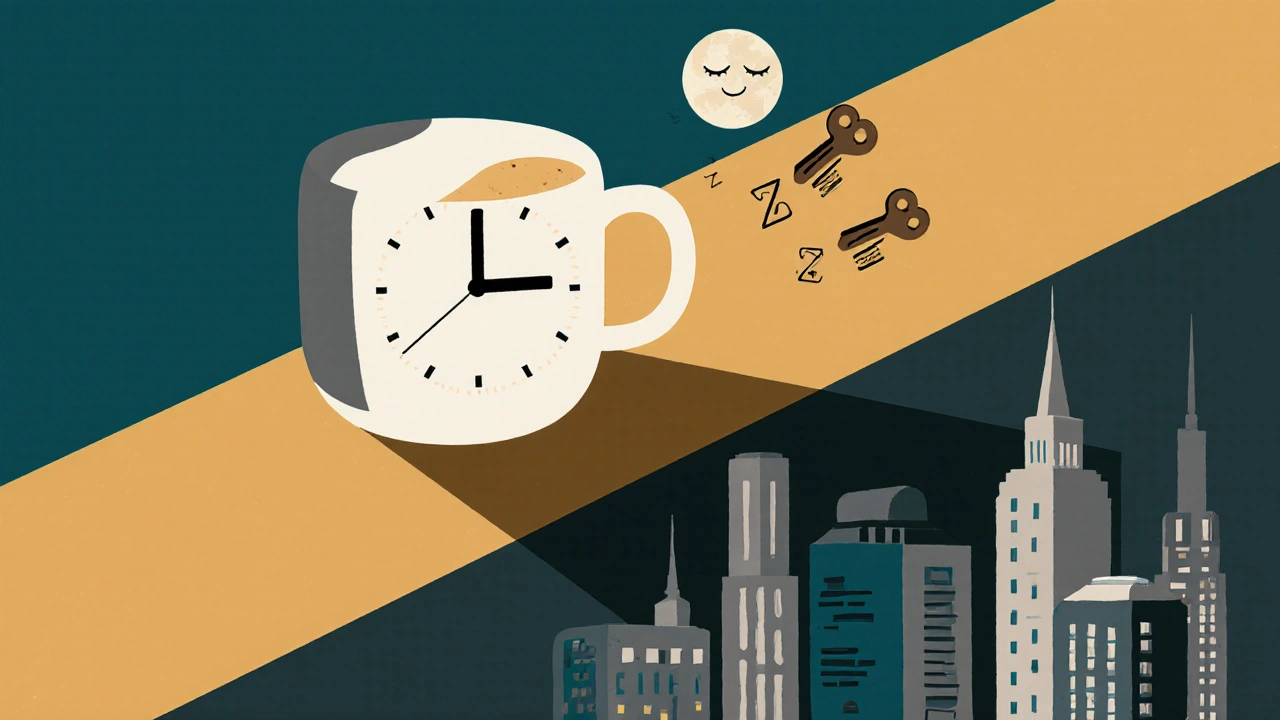
Most people know caffeine can mess with sleep-but few realize how late it’s still working in their system. You might think having a cup of coffee at 4 p.m. is fine if you don’t fall asleep until 11 p.m. But here’s the truth: that coffee is still active in your brain at midnight. And it’s stealing deep sleep you didn’t even know you needed.
Why Caffeine Doesn’t Just Keep You Awake
Caffeine doesn’t just make you feel alert. It physically blocks the sleep signal in your brain. Adenosine is the chemical that builds up the longer you’re awake, telling your body it’s time to rest. Caffeine looks so much like adenosine that it latches onto the same receptors, like a fake key in a lock. Your brain thinks it’s getting the signal to stay awake-even when it’s not.That’s why you can fall asleep after coffee but still feel exhausted the next day. You didn’t just delay sleep-you disrupted the quality of every sleep cycle after it. Studies show caffeine reduces total sleep time by 45 minutes, cuts sleep efficiency by 7%, and adds 9 extra minutes to how long it takes you to fall asleep. Even if you don’t toss and turn, your brain never fully shuts down into deep rest.
The 8-Hour Rule Isn’t Just a Suggestion
You’ve probably heard "don’t drink caffeine after 2 p.m." But that’s not the full story. The real cutoff depends on how much caffeine you’re consuming.A standard 8-ounce cup of coffee has about 107 mg of caffeine. Based on research from 24 studies reviewed in Sleep Medicine Reviews, you need to stop that cup 8.8 hours before bed to avoid measurable sleep disruption. That means if you go to sleep at 11 p.m., your last coffee should be no later than 2:12 p.m.
But here’s where people get tripped up. A double espresso? Around 126 mg. That’s a 10.4-hour cutoff. A 16-ounce energy drink? Up to 217 mg. That requires a 13.2-hour cutoff-meaning if you’re sleeping at midnight, you’d need to stop by 10:48 a.m. Most people don’t realize how fast those numbers climb.
Black tea? It’s different. With only 25-48 mg per cup, it doesn’t trigger the same sleep disruption in most people. There’s no clear cutoff time for tea-unless you’re drinking five cups in a row.
Age Changes Everything
Your body’s ability to clear caffeine slows as you get older. A 2025 study in Nature Communications found that adults between 41 and 58 years old are significantly more sensitive to caffeine’s effects than those in their 20s. Even small amounts consumed in the afternoon can reduce deep sleep by up to 15% in middle-aged adults.That’s why someone who could drink coffee at 5 p.m. at 25 might now be wide awake at 1 a.m. at 45. It’s not laziness. It’s biology. Your liver enzymes that break down caffeine-mainly CYP1A2-become less efficient over time. And if you’ve noticed your sleep getting worse after 40, caffeine timing might be the missing piece.
Genetics Play a Bigger Role Than You Think
Not everyone metabolizes caffeine the same. About 50% of people have a gene variant called CYP1A2 that makes them slow metabolizers. For them, caffeine’s half-life isn’t 4-6 hours-it’s 8-12 hours. That means a cup at noon could still be active at midnight.Companies like 23andMe now offer genetic tests that include caffeine metabolism results. If you’ve tried cutting caffeine to 3 p.m. and still can’t sleep, your genes might be the culprit. You might need to stop by 1 p.m. or earlier. No amount of willpower fixes a slow metabolism.
Hidden Sources Are Sneaky
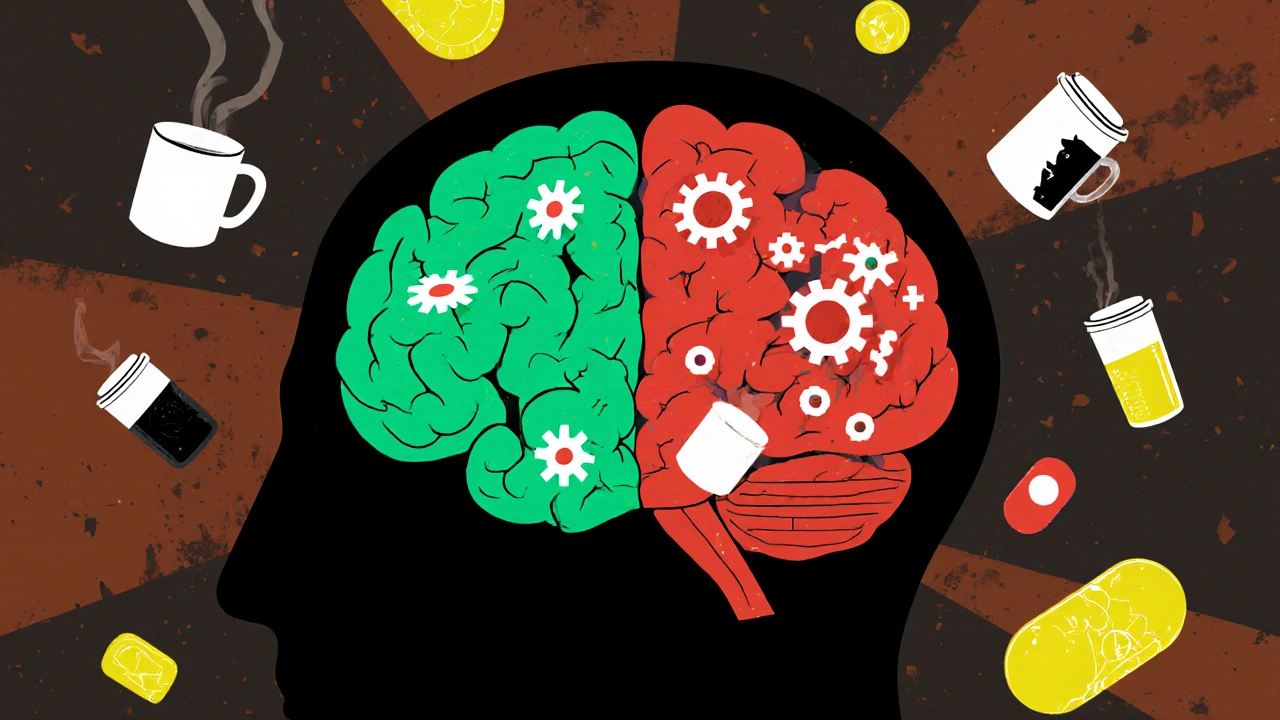
Coffee isn’t the only problem. Energy drinks, pre-workout powders, chocolate, and even some painkillers like Excedrin contain caffeine. A single Red Bull has 80 mg. One Excedrin tablet has 65 mg. Many people don’t realize they’re consuming caffeine from these sources.A 2023 Sleep Foundation survey found that 68% of people underestimate caffeine in medications and energy drinks. That’s why someone might think they’re following the rules-no coffee after 2 p.m.-but still wake up at 3 a.m. because they had a protein bar with added caffeine at 4 p.m.
Real People, Real Results
Reddit users in r/sleep reported that 78% of those who drank coffee within 6 hours of bedtime struggled to fall asleep. But when they switched to a 2 p.m. cutoff, 63% said their sleep quality improved-even if they didn’t fall asleep any faster.One user, u/CaffeineStruggles, wrote: “I switched from 4 p.m. to 2 p.m. and gained almost an hour of sleep quality. Eye-opening.” A 2022 survey by Sleepopolis of over 2,000 people showed those who stopped caffeine by 2 p.m. got 47 more minutes of sleep and 8% higher sleep efficiency than those who drank until 4 p.m.
And it’s not just anecdotal. A 2022 analysis of 15,328 sleep logs from the Sleep Cycle app found that people who followed an 8-hour cutoff reported 82% satisfaction with their sleep. Those sticking to a 4-hour cutoff? Only 47% satisfied.
What About Decaf?
Decaf coffee still has 2-5 mg of caffeine per cup. For most people, that’s harmless. But if you’re a slow metabolizer or extremely sensitive, even that small amount can add up. If you drink three decaf coffees after 3 p.m., you’re getting 15 mg-enough to affect some people.Starbucks noticed this trend. In 2022, they launched “Evening Brew,” a decaf blend specifically marketed for after-4 p.m. consumption. It captured 15% of the after-4 p.m. coffee market in six months. People aren’t just drinking less caffeine-they’re switching to smarter options.
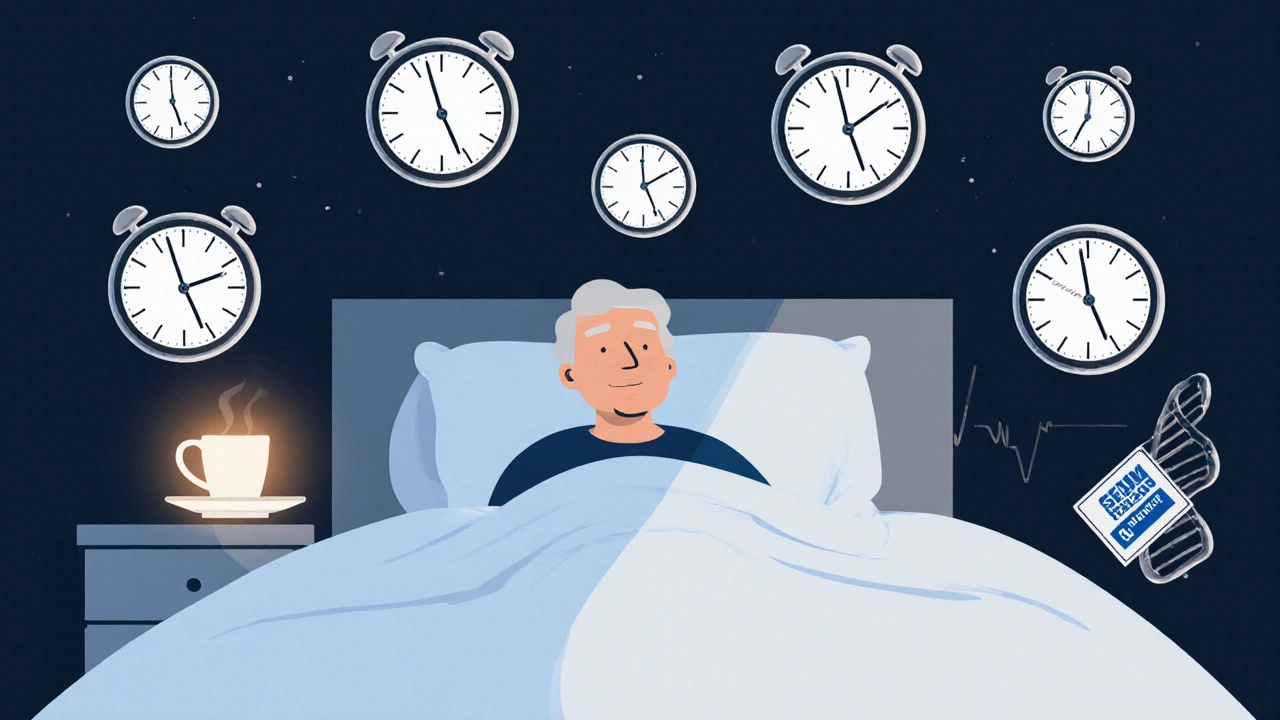
How to Find Your Personal Cutoff
You don’t need to guess. Here’s how to find your sweet spot:- Track your caffeine intake for a week. Note the time, type, and amount (use apps like Caffeine Zone or MyFitnessPal).
- Set a fixed bedtime and wake time. Don’t vary it more than 30 minutes.
- Start cutting off caffeine at 6 p.m. for 3 nights. Note how you feel in the morning.
- Move it to 4 p.m. for 3 more nights. Then 2 p.m.
- Look for patterns: Did you fall asleep faster? Wake up less? Feel more rested?
Most people find their ideal cutoff between 2 p.m. and 3 p.m. If you’re over 40, lean toward 2 p.m. If you’re under 30 and feel fine with 4 p.m., you might be a fast metabolizer. But test it anyway-sleep quality isn’t always obvious.
What If You Can’t Quit Afternoon Coffee?
If you rely on that 3 p.m. pick-me-up, don’t go cold turkey. Try half-caf. Mix regular and decaf. Studies show this cuts sleep disruption by 32% compared to full-strength coffee.Or switch to green tea. It has less caffeine than coffee and contains L-theanine, an amino acid that promotes calm focus without drowsiness. You get the ritual without the crash.
And if you’re a night owl who goes to bed at midnight? Your cutoff might be 3:30 p.m. But don’t assume. Track it. Your body’s rhythm isn’t the same as your neighbor’s.
What’s Changing in 2025
The American Academy of Sleep Medicine is updating its guidelines this year-for the first time in nearly a decade. Instead of saying “avoid caffeine late in the day,” they’ll now give specific cutoff times based on beverage type: coffee, energy drinks, tea, and supplements.Wearables are catching up too. Oura Ring and Fitbit now use your sleep data to suggest personalized caffeine cutoffs. If your sleep efficiency drops after afternoon caffeine, your ring will nudge you to cut it earlier next week.
And in the future? Expect smart homes to adjust lighting and temperature based on your caffeine habits. Philips SmartSleep is already testing systems that detect caffeine intake via wearable data and auto-adjust your bedroom environment to compensate.
The Bottom Line
Caffeine isn’t evil. But it’s not harmless either. If you’re struggling to fall asleep or waking up tired, your last cup of coffee might be the reason-even if it was hours ago.Stop guessing. Start measuring. Cut off caffeine by 2-3 p.m. if you sleep at 11 p.m. If you’re older, sensitive, or genetically slow, aim for 1-2 p.m. Track your sleep for two weeks. You’ll know faster than you think whether this change makes a difference.
Sleep isn’t about willpower. It’s about chemistry. And you can’t outwill a molecule.



Sara Shumaker November 30, 2025
It’s wild how we treat caffeine like it’s just a mood booster, not a neurochemical saboteur. I used to drink espresso at 5 p.m. and blame my insomnia on stress-turns out my brain was just holding onto a fake sleep signal for hours. Once I switched to 2 p.m. and started tracking with an app, my deep sleep jumped 20%. It’s not about willpower. It’s about respecting your biology. And yeah, even decaf adds up if you’re sipping three cups after dinner. We need to stop romanticizing the ‘I need coffee to function’ narrative-it’s just a crutch for poor sleep hygiene.
Scott Collard December 2, 2025
You’re all wrong. The 8-hour rule is a myth peddled by sleep influencers. I’ve been drinking coffee at 6 p.m. since 2010 and sleep like a baby. Your data is cherry-picked. Real men don’t stop at 2 p.m.-they drink when they want.
Steven Howell December 2, 2025
While the empirical data presented is both compelling and methodologically sound, one must also consider the sociocultural dimensions of caffeine consumption. In many Mediterranean and East Asian societies, afternoon coffee rituals are deeply embedded in social cohesion and temporal rhythm. To impose a rigid cutoff based on Western sleep science may inadvertently pathologize culturally normative behaviors. The biological imperative does not exist in a vacuum-it interacts with identity, tradition, and community. Perhaps the solution lies not in eradication, but in calibrated adaptation.
Robert Bashaw December 3, 2025
MY BRAIN IS A WAR ZONE AND CAFFEINE IS THE ENEMY WITH A FAKED IDENTITY. I thought I was just tired-turns out my neurons were being hijacked by a molecule that looks like sleep’s doppelgänger. I used to wake up at 3 a.m. like a ghost haunting my own bed. Then I stopped coffee after 1:30 p.m. and suddenly I was sleeping like a baby who just got a lullaby from the gods. I cried. Not because I was sad. Because I remembered what rest felt like. And now I’m preaching from the mountaintop: if you’re still drinking coffee after 2 p.m., you’re not a coffee lover-you’re a sleep thief.
Brandy Johnson December 5, 2025
This article is a classic example of American wellness overreach. We have become a nation obsessed with quantifying every biological function while ignoring systemic factors like work hours, screen exposure, and chronic stress. The 8-hour rule is a distraction. The real issue is that Americans are overworked and under-rested-caffeine is merely the symptom, not the disease. Blaming coffee while ignoring 60-hour workweeks and blue light pollution is intellectual cowardice.
Geoff Heredia December 6, 2025
Did you know the FDA and WHO are secretly funded by Big Coffee to suppress the truth? Caffeine is a controlled psychoactive substance disguised as a beverage. The real cutoff time is 10 a.m.-because that’s when the government’s sleep surveillance drones start scanning your pupils for caffeine residue. They’ve been tracking your coffee habits since 2018 through your smart fridge. You think you’re choosing your drink? You’re being programmed.
Andrew Keh December 6, 2025
Good post. I tried cutting caffeine after 3 p.m. last month. Didn’t feel a huge difference at first. But after two weeks, I noticed I wasn’t reaching for sugar at 4 p.m. anymore. My energy felt steadier. I didn’t need to force myself awake. It’s not about perfection-just a little shift. Worth trying if you’re tired all the time.
Peter Lubem Ause December 8, 2025
As someone who grew up in Nigeria where tea is sipped slowly after lunch and dinner, I can say this: culture shapes our tolerance. In my village, we drink strong black tea at 8 p.m. and sleep like logs by 9. Why? Because we don’t consume caffeine in isolation-we pair it with community, silence, and rhythm. Here in the U.S., people gulp espresso while scrolling TikTok at 4 p.m. and wonder why they’re wired. It’s not the caffeine-it’s the chaos around it. Slow down. Breathe. Let your body catch up. And yes, genetics matter-but so does your environment. Try switching to green tea with honey after 3 p.m. and sit quietly for 10 minutes. Your nervous system will thank you.
Sullivan Lauer December 8, 2025
I used to think I was a night owl because I was cool. Turns out I was just chronically sleep-deprived and lying to myself. I followed the 2 p.m. rule for two weeks. I didn’t just sleep better-I stopped having panic attacks at 2 a.m. I started dreaming again. Real, vivid dreams. Like my brain finally got a vacation. I cried the first morning I woke up without an alarm. I didn’t know I’d forgotten what it felt like to wake up rested. This isn’t just about coffee. It’s about reclaiming your body from the grind. If you’re reading this and still drinking coffee at 4 p.m.-please, for your own sake, just try it. One week. No excuses. Your future self is begging you.