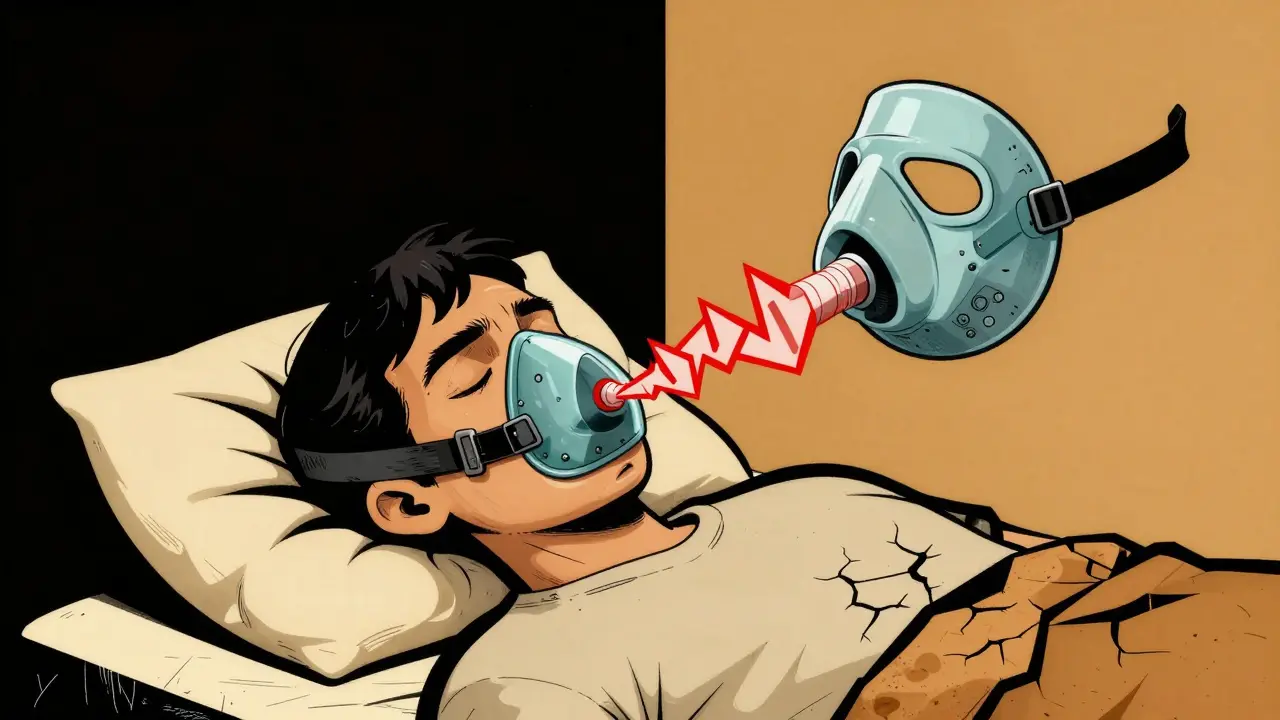
Why Your CPAP Isn’t Working (And How to Fix It)
You’re using your CPAP machine every night. You’ve followed the instructions. But you still wake up with a dry mouth, hear air hissing around your mask, or feel like the pressure is too high-or too low. You’re not alone. About 42% of CPAP users deal with dry mouth. Over half report mask leaks. And nearly one in three say pressure settings feel off. These aren’t just annoyances-they’re reasons people quit therapy.
The good news? Most of these problems have simple, proven fixes. You don’t need to buy a new machine. You don’t need to give up. You just need to know where to look.
Dry Mouth? It’s Probably Not the Humidifier
Most people assume dry mouth means their humidifier isn’t working hard enough. So they crank up the heat. That often makes things worse-condensation builds up in the tube, you wake up with water in your mask, and your skin gets irritated.
The real culprit? Mouth breathing. When you breathe through your mouth during sleep, the pressurized air dries out your throat and tongue. No amount of humidity can fully fix that.
Here’s what actually works:
- Switch to a full-face mask. These cover both nose and mouth. One Reddit user, u/SleepSeeker2020, said his dry mouth vanished in three nights after switching.
- Use a chin strap. It’s a simple fabric strap that holds your jaw closed. About 45% of mouth breathers use one successfully.
- Check your humidifier settings. Set it to level 3 or 4 on a 0-6 scale. Too high (level 5 or 6) causes rainout. Too low (level 1 or 2) won’t help.
- Try heated tubing. It keeps warm air from cooling down before it reaches your face. Philips’ 2022 trial showed a 32% reduction in dry mouth with heated tubing.
If you’re still waking up with a parched throat after trying these, talk to your sleep specialist. You might have a nasal obstruction-like a deviated septum-that’s forcing you to breathe through your mouth.
Mask Leaks: The Silent Killer of CPAP Therapy
A mask leak sounds like a soft hiss. It’s easy to ignore. But Dr. David White from Harvard says leaks over 24 L/min cut your treatment effectiveness in half. That’s not just uncomfortable-it’s dangerous.
Leakage happens for three main reasons:
- Wrong mask size. If the cushion is too big or too small, it won’t seal. Try different sizes-even within the same mask model.
- Worn-out cushion. Silicone cushions break down after 3 months of daily use. Replace them every 90 days, no exceptions.
- Loose headgear. Too tight? It digs into your face. Too loose? Air escapes. The fix? Do the airflow test: Turn on your machine, then gently pull and adjust each strap until the hissing stops. Most people need 3-5 tweaks to get it right.
Don’t just rely on your machine’s leak readings. Those can be inaccurate. Listen. Feel. Look in the mirror. If you see air puffing out around your cheeks or nose bridge, it’s not sealed.
Pro tip: Wash your face before bed. Oil, lotion, or even sweat can break the seal. A clean face = better seal.

Pressure Too High? Too Low? Here’s How to Tell
Pressure is the most misunderstood part of CPAP therapy. Many users think higher pressure = better results. It doesn’t. Too much pressure causes chest discomfort, bloating, or even aerophagia (swallowing air). Too little, and your apneas come back.
Signs your pressure is off:
- Too high: You wake up gasping, your chest feels tight, you feel like you’re breathing against a wall. One user on Reddit, u/ExhaustedEngineer, had his pressure set at 14 cm H₂O. He felt awful. After his sleep doctor dropped it to 9 cm H₂O with expiratory pressure relief (EPR), he slept like a baby.
- Too low: You still snore. Your AHI (apnea-hypopnea index) stays above 5. You feel tired even after 7 hours in bed.
Auto-CPAP machines (like ResMed AirSense 11 or Philips DreamStation 2) adjust pressure automatically. But they need good data to work. If your mask leaks constantly, the machine thinks you’re having more apneas than you are-and ramps up pressure unnecessarily.
Don’t adjust pressure yourself. Most machines lock settings to prevent this. Going beyond ±2 cm H₂O voids your warranty. Talk to your sleep specialist. Bring your machine’s usage data. They can check your AHI trends and make a real adjustment.
And if you’re on a fixed-pressure machine? Ask about switching to an APAP model. They’re more forgiving and adapt to your night-to-night needs.
What You’re Not Doing (But Should Be)
Most people treat their CPAP like a one-time setup. It’s not. It’s a living system that needs care.
- Change your filter every 30 days. Dust and allergens clog it. ResMed’s manual says this affects airflow and increases noise.
- Clean your mask daily. Soap and water. No alcohol wipes-they dry out silicone.
- Replace tubing every 6 months. Cracks and stiffness create leaks you can’t see.
- Use distilled water in your humidifier. Tap water leaves mineral deposits that breed mold.
Also, give yourself time. It takes 2-4 weeks to adjust. Most people master basic fixes within 14 days. If you’re still struggling after a month, reach out to your DME provider. ResMed’s 2023 data shows 89% of users succeed after watching their manufacturer’s video tutorials.
When to Call Your Sleep Doctor
Not every problem is DIY. Call your provider if:
- Your dry mouth or leaks don’t improve after trying all the fixes above.
- You’re still having 5+ apneas per hour despite using the machine nightly.
- You feel dizzy, nauseous, or have headaches every morning.
- Your machine shows frequent leaks or events even after replacing the mask and cleaning everything.
These could mean your diagnosis needs re-evaluation. Maybe you have central sleep apnea instead of obstructive. Maybe you need a different type of therapy-like BiPAP or an oral appliance.
And if you’ve given up? You’re not alone. About 30-45% of people quit CPAP in the first year. But those who stick with it reduce their risk of heart attack by 30% over five years, according to Mayo Clinic. It’s worth the effort.
What’s New in CPAP Tech (2025)
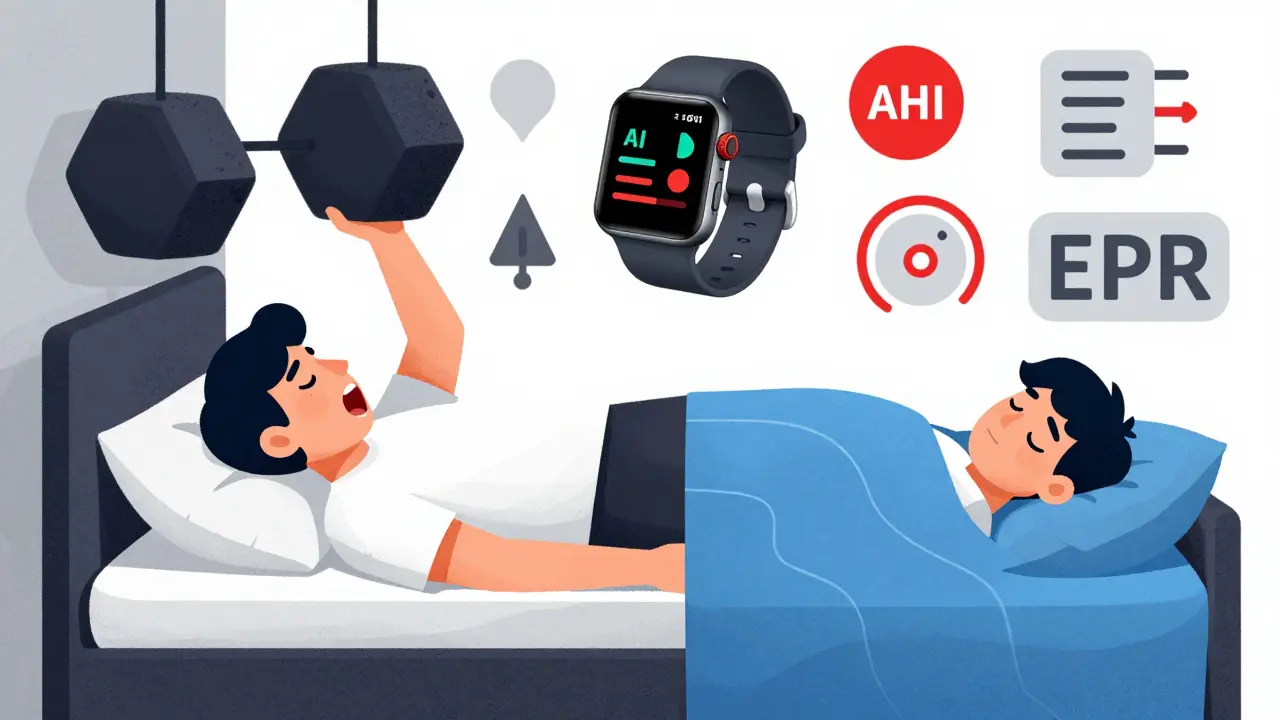
CPAP machines are smarter than ever. The ResMed AirSense 11, released in 2022, detects leaks as small as 12 L/min with 92% accuracy. Philips’ DreamMapper app now gives personalized pressure tips based on 30 days of your usage. And by 2027, nearly half of all CPAPs will connect to smartwatches to track sleep quality in real time.
These features help-but they don’t replace good habits. No algorithm can fix a cracked mask cushion. No app can stop you from breathing through your mouth if your jaw isn’t supported.
The best tech in the world won’t work if you’re not using it right. Focus on the basics: clean mask, proper fit, right pressure, and breathing through your nose.
Final Thought: It’s Not About the Machine. It’s About the Fit.
CPAP isn’t one-size-fits-all. What works for your neighbor might not work for you. That’s why the best therapy isn’t the most expensive machine. It’s the one you’ll actually wear night after night.
Start small. Fix one thing this week. Change your cushion. Adjust your headgear. Try a chin strap. Track how you feel in the morning. Small wins build confidence. And confidence builds compliance.
You don’t need to be perfect. You just need to be consistent. Your heart, your brain, and your future self will thank you.
Why does my mouth get dry even with a humidifier?
Dry mouth from CPAP is usually caused by mouth breathing, not insufficient humidity. When air escapes through your mouth, it dries out your throat. A humidifier helps, but won’t fix the root cause. Solutions include switching to a full-face mask or using a chin strap to keep your jaw closed during sleep.
How do I know if my CPAP mask is leaking?
Listen for a hissing sound near your face. Look in the mirror while the machine is running-air puffing from your cheeks, nose bridge, or forehead means a leak. Your machine may show a leak alert, but those aren’t always accurate. The best test: adjust your headgear straps until the noise stops. A good seal should be quiet and snug, not tight.
Can I adjust my CPAP pressure myself?
Most CPAP machines lock pressure settings to prevent unsafe changes. Even if you can adjust it, going beyond ±2 cm H₂O usually voids your warranty. Pressure needs to be set based on your sleep study results and nightly data. Always consult your sleep specialist before changing pressure settings.
How often should I replace my CPAP mask cushion?
Replace your mask cushion every 3 months. Silicone breaks down from oils on your skin, cleaning products, and daily use. A worn cushion won’t seal properly, leading to leaks and reduced therapy effectiveness. Most DME providers recommend replacement every 90 days-don’t wait until it cracks.
Is it normal to still snore with CPAP?
No. If you’re still snoring regularly with your CPAP on, your therapy isn’t working properly. It could mean your pressure is too low, your mask is leaking, or your machine needs recalibration. Check your machine’s data for apnea events. If your AHI is above 5, contact your sleep doctor. Snoring while using CPAP is a red flag.
Why do I feel worse after starting CPAP?
It’s common to feel worse at first. Your body is adjusting to pressurized air, a new mask, and disrupted sleep patterns. This usually improves within 2-4 weeks. But if you feel chest pain, bloating, dizziness, or severe dryness after a month, something’s wrong. It could be pressure too high, mask fit issues, or an underlying condition. Don’t ignore it-talk to your provider.




suhani mathur December 23, 2025
I swear, the chin strap was a game-changer. I was using a full-face mask but still waking up with a cotton mouth. Thought my humidifier was broken. Turned out I was just a mouth breather with zero self-awareness. Chin strap for life. No more 3 a.m. throat screaming.
Also, distilled water. Non-negotiable. Tap water in the humidifier is basically mold smoothie. I learned that the hard way.
Adarsh Dubey December 24, 2025
The claim that 42% of CPAP users experience dry mouth is statistically misleading without specifying the sample size or study methodology. Many studies conflate subjective reports with clinical measurements. Furthermore, the assertion that heated tubing reduces dry mouth by 32% in Philips’ 2022 trial lacks a peer-reviewed citation. Anecdotes from Reddit users are not data.
Bartholomew Henry Allen December 25, 2025
Americans think they can fix everything with gadgets. You don't need a heated tube or a fancy mask. Just tape your mouth shut. Works better than any tech. Stop wasting money. Just breathe through your nose or don't sleep. Simple. No apps. No sensors. Just discipline.
bharath vinay December 25, 2025
They don't want you to know the truth. The CPAP machine is designed to keep you dependent. The air pressure is calibrated to induce mild hypoxia so you keep coming back. The 'dry mouth' is a side effect of the government's sleep control program. The humidifier? It's just a cover for the sodium fluoride dispersion system. They don't want you to breathe naturally. They want you docile. Look up Project Somnus.
Dan Gaytan December 27, 2025
This is so helpful!! 🙌 I was about to give up until I tried the chin strap + daily mask wash. My AHI dropped from 12 to 3 in two weeks. I feel like a new person. Seriously, if you're struggling - don't quit. Just tweak one thing at a time. You got this! 💪🌙
Usha Sundar December 28, 2025
I tried everything. Chin strap. Full face. Heated tube. Distilled water. Still woke up like a camel that ran through the desert. Then I realized - I was wearing the mask too tight. Like, 'trying to crush my skull' tight. Loosened it. Silence. Peace. Sleep. Sometimes the answer is less pressure. Not more.
Steven Mayer December 30, 2025
The physiological mechanism underlying oropharyngeal collapse during REM sleep is not adequately addressed by passive mechanical interventions such as chin straps. The autonomic dysregulation induced by chronic nasal obstruction necessitates a neurorespiratory recalibration protocol. The cited 32% reduction in dry mouth with heated tubing lacks control for confounding variables including ambient humidity and patient hydration status.
Charles Barry December 31, 2025
You people are sheep. They sell you machines, then sell you $200 replacement cushions every three months. The real fix? Sleep on your side. Or stop eating carbs after 6pm. Or just die quietly. CPAP is a scam designed to keep the medical-industrial complex rich. You're not sick. You're being exploited.
Rosemary O'Shea January 1, 2026
Honestly? I don't even use a CPAP anymore. I went to this $5,000 holistic sleep clinic in Dublin. They did a 7-day biofeedback reset with crystal frequency tuning and organic chamomile-infused oxygen. I haven't snored since. You're all using 2015 tech. The future is vibrational sleep architecture. But of course, you wouldn't understand - you're still stuck on silicone cushions.