You stare at your monthly budget, then at the prescription refill notice. The math doesn't add up. You know that generic drugs are supposed to be cheaper than brand names, but the price tag at the local counter still stings. So, you look online. It seems logical: buy it on the internet, skip the drive, and save some cash. But here is the catch-does your health insurance actually cover those online purchases?
The answer isn't a simple yes or no. It depends entirely on whether you are using an insurance-approved mail-order service or an independent online retailer. Mixing these two up can cost you hundreds of dollars in out-of-pocket expenses. Let’s break down how insurance works with online pharmacies, where the traps are, and how to actually get that low generic price without breaking the bank.
Mail-Order vs. Independent Online Pharmacies: Know the Difference
This is the biggest point of confusion for most patients. When people say "online pharmacy," they usually mean one of two very different things. Understanding this distinction is the key to unlocking lower costs.
First, there are mail-order pharmacies. These are not random websites you find via Google Ads. They are specific services integrated directly into your health plan’s network. Often managed by big players like Express Scripts, CVS Caremark, or Optum Rx, these services operate under strict rules set by your insurer. If your plan offers mail-order benefits, you fill your prescription through their portal, and your insurance processes it just like a walk-in visit-but often with a lower copay for a 90-day supply.
Second, there are independent online pharmacies. Think of sites like Amazon Pharmacy (outside of its specific insurance partnerships), Cost Plus Drugs, or various international retailers. These operate more like e-commerce stores. While convenient, they often do not accept traditional insurance cards directly at checkout. If you buy from them, you might pay cash upfront and hope for reimbursement later-a process that is messy, slow, and often denied if the pharmacy wasn't "in-network."
| Feature | Insurance Mail-Order | Independent Online Pharmacy |
|---|---|---|
| Insurance Acceptance | Direct integration; automatic copay calculation | Often cash-only; reimbursement required |
| Typical Supply Size | 90 days (maintenance meds) | 30, 60, or 90 days |
| Delivery Time | 5-7 business days | 1-3 business days (often faster) |
| Best For | Chronic conditions (blood pressure, diabetes) | Acute needs or uninsured medications |
| Cost Predictability | High (fixed copay per plan) | Variable (market pricing) |
How Formularies Dictate Your Generic Copay
Your insurance plan has a secret list called a formulary. This is the catalog of drugs your plan covers. Not all generics are treated equally here. Most plans use a tiered system to encourage you to pick the cheapest option.
Generic drugs almost always sit at Tier 1-the lowest cost tier. In many federal and commercial plans, this means a fixed copay, such as $5 for a 30-day supply at a retail pharmacy or $10 for a 90-day supply via mail-order. Compare that to brand-name drugs, which might sit at Tier 3 or 4, requiring you to pay 30% to 50% of the drug's cost, capped at amounts like $200 per prescription. That is why insurers push so hard for generics.
However, not every generic is created equal in the eyes of your insurer. Some plans have "preferred" generics and "non-preferred" generics. A preferred generic might cost you $5, while a non-preferred one could trigger a coinsurance rate of 20%. Always check your plan’s formulary tool before switching to a new online provider. If the generic you want isn’t on the preferred list, your savings might vanish.
The Rise of Subscription Models: RxPass and Beyond
In 2026, the landscape is shifting again. Traditional insurance isn't the only way to get cheap generics online. Enter subscription models like Amazon RxPass. This program allows Prime members to access a wide range of common generic medications for a flat fee of $5 per month, regardless of how many prescriptions they need.
This model bypasses the insurance copay structure entirely. If you take three different generic medications for blood pressure, cholesterol, and acid reflux, you pay $5 total instead of three separate $10 copays. It’s a game-changer for polypharmacy patients (those taking multiple meds). However, it has limits. RxPass only covers specific generics. If you need a specialty medication or a brand-name drug due to medical necessity, this model won’t help. It’s an alternative, not a replacement for comprehensive insurance coverage.
When Cash Price Beats Insurance Coverage
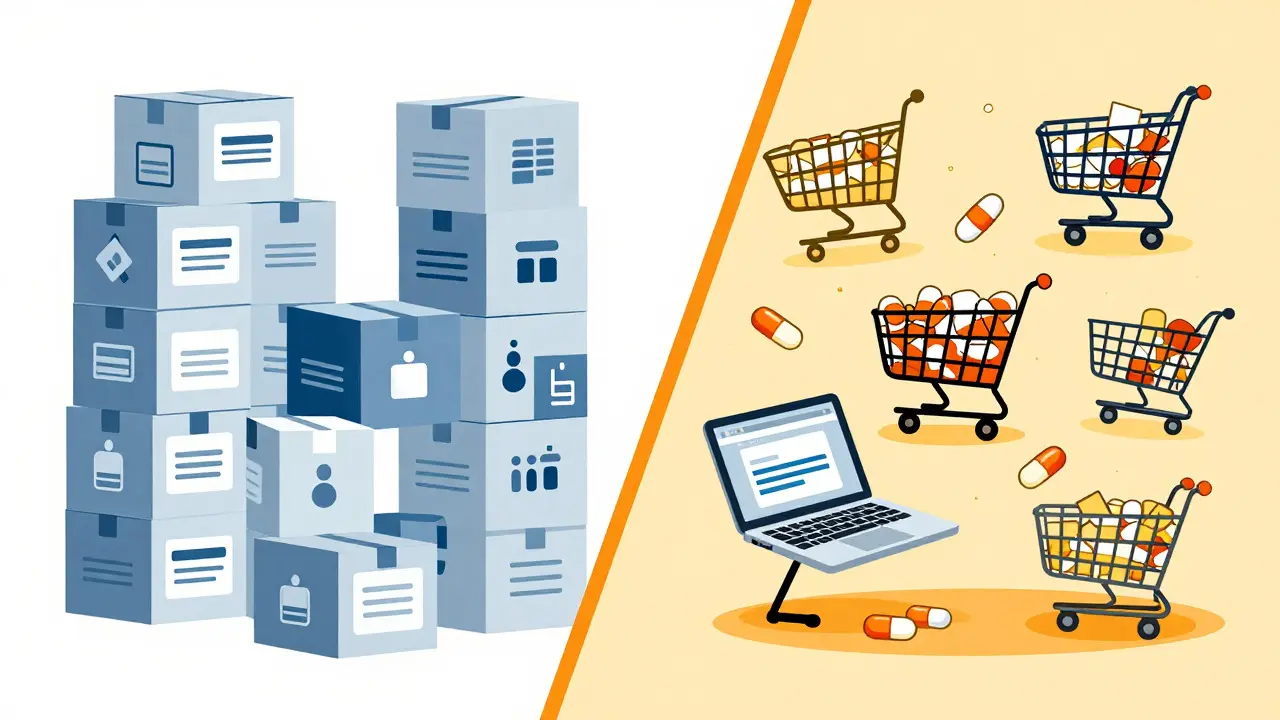
Here is a counterintuitive tip: sometimes, paying cash at an independent online pharmacy is cheaper than using your insurance. This happens frequently if you have a high-deductible health plan (HDHP).
If you haven't met your deductible yet, your insurance might require you to pay the full negotiated rate for a generic, which could be $30 or $40. Meanwhile, programs like Walmart’s $10 generic list or Costco’s similar offerings provide 90-day supplies of dozens of common generics for exactly $10, no insurance needed. Independent online pharmacies often match these prices. Before you submit your insurance card, calculate the cash price. If the cash price is lower, pay out of pocket. Just keep the receipt; you may be able to apply that payment toward your annual deductible.
Navigating Non-Medical Switching and Prior Authorization
Insurers love saving money, sometimes at the expense of patient preference. This leads to "non-medical switching," where your insurer automatically substitutes a brand-name drug with a generic, even if your doctor prescribed the brand. While generics contain identical active ingredients, some patients experience different side effects due to inactive binders or fillers.
If you are forced onto a generic via an online mail-order service and it doesn’t work for you, you aren't stuck. You can request a "formulary exception." This requires your doctor to submit a prior authorization (PA) explaining why you medically need the brand name or a specific generic manufacturer. It adds paperwork, but it preserves your health. Be aware that once approved, your copay for the brand name will likely increase significantly.
Step-by-Step: Verifying Coverage Before You Click Buy
To avoid surprise bills, follow this checklist before ordering any generic medication online:
- Check Your Plan Documents: Look for a section titled "Pharmacy Benefits" or "Mail-Order Options." Does your plan explicitly offer a 90-day mail-order service? If not, using a third-party site means you’re likely paying cash.
- Use the Insurer’s Tool: Log in to your insurer’s portal (e.g., Aetna, UnitedHealthcare, Blue Cross). Use their "Drug Search" feature. Type in your medication. Note the tier and the specific copay for "Mail Order" vs. "Retail."
- Contact the Pharmacy Directly: If using an independent site, call their customer service. Ask: "Do you accept [Your Insurance Name] directly at checkout, or do I need to file for reimbursement?" If they say reimbursement, ask for the average approval rate. Low approval rates mean you’ll likely eat the cost.
- Compare Cash Prices: Check discount cards like GoodRx or single-use coupons. Sometimes a $4 cash price beats a $10 insurance copay, especially if you don’t mind paying out of pocket.
- Verify Legitimacy: Ensure the online pharmacy is verified by the National Association of Boards of Pharmacy (NABP) via the VIPPS seal. Avoid sites that sell prescription drugs without a valid prescription.
Common Pitfalls to Avoid
One major trap is assuming all online pharmacies are part of your PBM (Pharmacy Benefit Manager) network. PBMs like Express Scripts and Optum Rx negotiate rates with insurers. If you buy from a pharmacy outside this network, your insurer may deny the claim entirely. Another pitfall is ignoring delivery times. Mail-order generics often take 5-7 days to arrive. Do not use mail-order for acute issues like antibiotics for an infection or post-surgery pain management. Keep a 30-day supply at a local retail pharmacy for emergencies, and use mail-order for maintenance drugs like statins or antidepressants.
Finally, watch out for "hidden" fees. Some independent online pharmacies charge shipping fees that erase the savings from a lower drug price. Always look at the final cart total, including tax and shipping, before comparing it to your insurance copay.
Does my insurance cover generic drugs bought from Amazon Pharmacy?
It depends on how you buy them. If you use Amazon Pharmacy’s insurance-integrated checkout and your plan accepts Amazon as an in-network provider, yes, your standard copay applies. However, if you use the RxPass subscription model, you pay a flat $5/month fee regardless of insurance. Always verify if your specific plan lists Amazon Pharmacy as an accepted vendor in their network directory.
Why is my mail-order copay higher than my local pharmacy copay?
Usually, mail-order copays are lower for 90-day supplies. If yours is higher, check your formulary tier. Some plans penalize mail-order for certain drug classes or if the generic is "non-preferred." Additionally, if you haven't met your deductible, you might be paying the full negotiated rate rather than a fixed copay. Contact your insurer’s pharmacy benefit line to clarify your specific plan’s mail-order pricing structure.
Can I switch from a brand-name drug to a generic online without talking to my doctor?
Technically, pharmacists can often substitute generics automatically due to state laws allowing "generic substitution." However, if your doctor wrote "Dispense as Written" (DAW) on the prescription, the pharmacist must give you the brand. For online orders, the system may auto-switch unless you specify otherwise. It is always safer to consult your doctor first, especially for narrow-therapeutic-index drugs like warfarin or levothyroxine, where small changes matter.
What if the online pharmacy charges me more than my insurance copay?
If you paid cash because the pharmacy didn't accept insurance, you can file a reimbursement claim with your insurer. Submit the itemized receipt, proof of payment, and the prescription label. However, reimbursement is typically based on the insurer's "allowed amount," which might be less than what you paid. You also need to ensure the pharmacy was in-network; otherwise, the claim will likely be denied.
Are generic drugs from online pharmacies as safe as brand names?
Yes, provided the pharmacy is legitimate. The FDA requires generics to have the same active ingredient, strength, dosage form, and route of administration as the brand name. They must demonstrate bioequivalence. The risk lies in buying from unverified international sites. Stick to NABP-accredited (VIPPS) online pharmacies or those directly affiliated with major US chains (CVS, Walgreens, Amazon) to ensure safety and quality control.




Gary Browne August 4, 2026
Look, I just checked my portal and the math is still garbage. The article says mail order is cheaper but for my specific blood pressure med, the 90-day supply via their 'preferred' vendor costs me $15 more than picking it up at CVS twice a month because of some weird tier adjustment nobody explains until you see the bill. It feels like they are just moving numbers around to make the spreadsheet look green while we pay the difference. I ended up using GoodRx anyway because at least that price is static and doesn't change based on which PBM algorithm decided to hate me that week.
Christina Thygesen August 4, 2026
i totally get why people are frustrated with this system it really does feel like a maze designed to confuse us rather than help us save money i have been paying cash for years now because dealing with the reimbursement paperwork was just too much stress for my mental health especially when you are already worried about staying healthy and managing chronic conditions without adding administrative headaches on top of it all
Minal Aditi August 4, 2026
Oh, how delightful. Another guide telling us that the system is rigged if you don't read the fine print in triplicate. Truly inspiring. So let me get this straight, the 'solution' is to become a part-time actuary just to afford aspirin? Because I noticed my existential dread isn't covered by any formulary tier. Thanks for the tip on checking the VIPPS seal, I'll be sure to verify my sanity alongside my pharmacy credentials.
Diane Nash August 6, 2026
It is imperative that individuals recognize the structural nuances presented herein. The distinction between mail-order integration and independent retail arbitrage is not merely semantic; it is foundational to financial prudence in healthcare consumption. One must diligently audit their formulary tiers prior to engagement. Furthermore, the emergence of subscription models such as RxPass represents a paradigm shift in cost containment strategies for polypharmacy patients. Let us proceed with rigorous verification protocols to ensure optimal economic outcomes.
Alli Crumley August 7, 2026
You guys are missing the big picture here 🤯 It’s all about the PBM rebates and the opaque rebate clawbacks that happen post-dispensing. When you use an independent site, you bypass the PBM’s negotiated rate entirely, which sounds good until you realize you’re paying the list price minus whatever discount card you found. Real pros know to check the GPO contracts. Also, have you considered the bioequivalence variance in inactive fillers? It’s a whole different ballgame. 📉💊
Marc H August 9, 2026
Brilliant. Absolutely brilliant. So the advice is essentially 'do your homework or die poor.' Just what I needed after a twelve-hour shift. I suppose I should also learn quantum physics before buying a loaf of bread to ensure I’m getting the best deal. The sarcasm is palpable, even through the screen, and I am drinking it in like fine wine. Cheers to us, the consumers who are expected to be pharmacists, accountants, and detectives all rolled into one.
Chris McQuaid August 9, 2026
Actually, the article glosses over the fact that many HDHP plans have embedded minimums that make the deductible calculation irrelevant for small claims. You aren't just comparing cash vs copay; you're comparing cash vs full negotiated rate. I’ve seen cases where the 'cash' price at Cost Plus Drugs is actually higher than the insurer's allowed amount if you had met your deductible, so the advice to always check cash prices is slightly misleading without context. It’s a nuanced landscape, not a simple binary choice.
sam howard August 11, 2026
just pay cash stop complaining most insurance plans are scams anyway the deductibles are sky high and the coverage is trash i switched to ahsa last year and saved thousands by just buying generics online directly no forms no waiting no nonsense