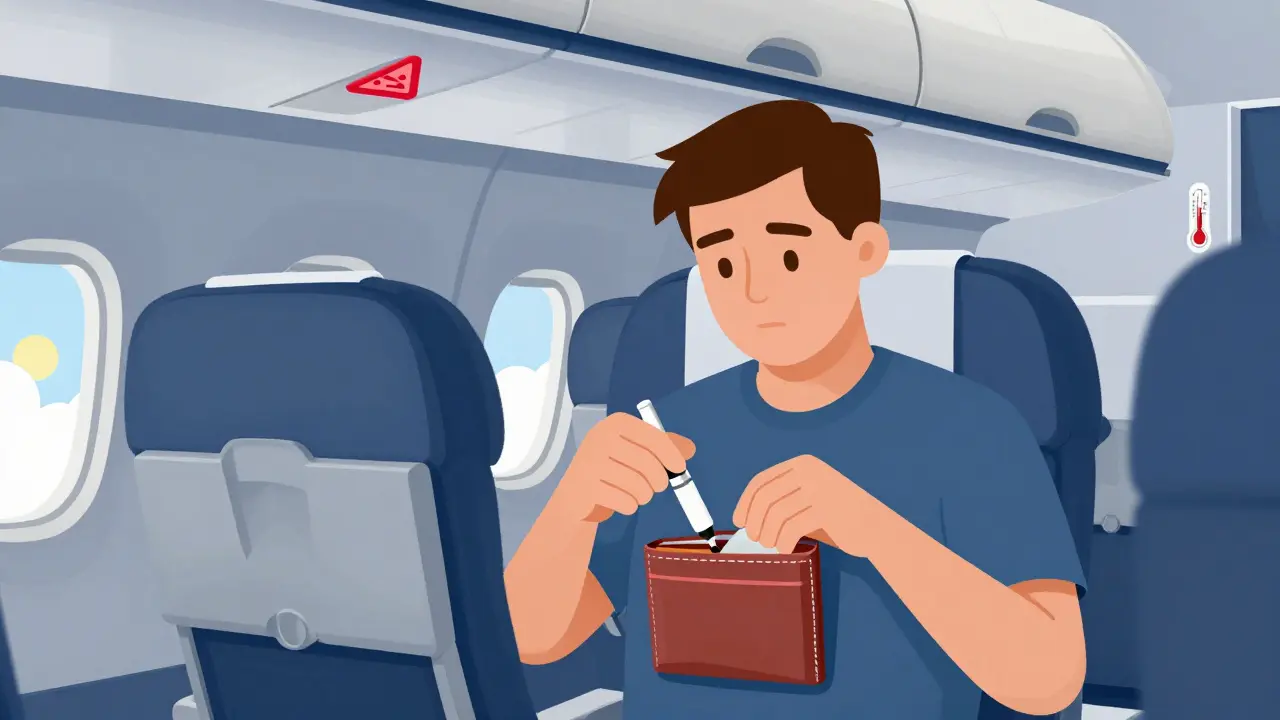
When you’re flying across time zones with insulin or biologics like Ozempic, Wegovy, or Mounjaro, your medication isn’t just luggage-it’s life support. One wrong move-like tossing your insulin pen into the overhead bin-can ruin it. And if it’s ruined, your blood sugar could spike, leading to emergency room visits, hospitalization, or worse. This isn’t theoretical. In 2021, a case study in the Journal of Diabetes Science and Technology documented a traveler whose insulin was exposed to 95°F (35°C) during a 12-hour flight. By the time they landed, their insulin had degraded. They ended up in the ER with diabetic ketoacidosis.
Why Temperature Matters More Than You Think
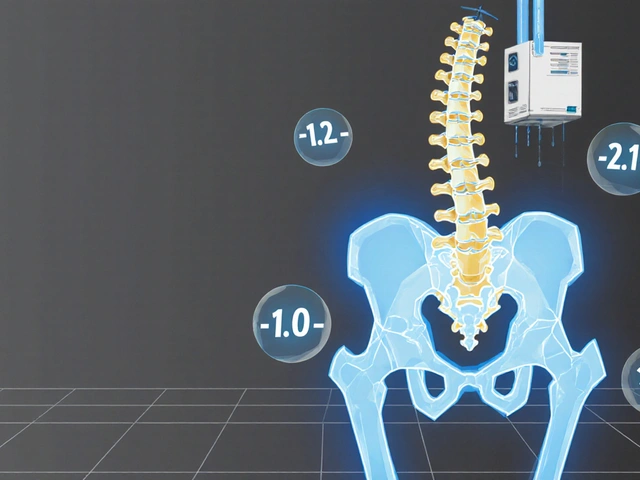
Insulin isn’t like a bottle of water. It’s a protein-based medication. When it gets too hot or too cold, its structure breaks down. Once that happens, it doesn’t work. The American Diabetes Association says insulin starts losing effectiveness above 86°F (30°C). Below 32°F (0°C), it freezes. Frozen insulin forms clumps or crystals. Even if it looks fine after thawing, it’s no longer safe to use. The FDA says unopened insulin must stay between 36°F and 46°F (2°C-8°C). Once you start using it-whether it’s a pen or vial-it can last up to 28 days at room temperature (59°F-86°F or 15°C-30°C). But not all insulins are the same. Insulin Degludec (Tresiba) can last up to 56 days at room temperature, according to Novo Nordisk’s 2023 data. Biologics like GLP-1 agonists (Ozempic, Wegovy) are even more sensitive. They need refrigeration until first use, and once opened, they only last 56 days at room temperature.What Happens Inside an Airplane?
You might assume the cabin is always cool. It’s not. The FAA requires cabin temperatures between 65°F and 75°F (18°C-24°C). Sounds fine, right? But here’s the catch: the walls of the plane get cold or hot depending on outside conditions. Near windows, especially on long flights, surface temperatures can hit 90°F (32°C). The overhead bin? It’s often right against the fuselage. A 2023 study by the American Association of Clinical Endocrinologists found that 41% of travelers who stored insulin in overhead bins experienced dangerous temperature spikes. And the cargo hold? It’s even worse. At cruising altitude, it can drop to -40°F (-40°C). That’s why you never check your insulin. Ever. Always carry it in your personal bag, on your person, or in the seat-back pocket.The Best Ways to Keep Insulin Safe During Flight
Not all cooling solutions are created equal. Here’s what actually works:- FRÍO Wallet - Water-activated, reusable, and FDA-cleared. Soak it in water for 15 minutes, and it keeps insulin between 59°F and 72°F (15°C-22°C) for up to 45 hours-even in 104°F (40°C) heat. It’s lightweight, fits in a purse, and costs around $35. Over 78% of travelers in a 2023 Diabetes Online Community survey preferred this over ice packs.
- BreezyPack Pro - Uses phase-change material. Maintains 50°F-72°F (10°C-22°C) for 72 hours. Independent testing by ConsumerLab.com showed 98.7% temperature stability. Priced at $50, it’s pricier than FRÍO but lasts longer and doesn’t need reactivating.
- TempMed Smart Case - Launched in November 2023, this Bluetooth-enabled case alerts your phone if temperatures go above 82°F (28°C). Clinical trials showed 99.2% insulin efficacy preservation during 16-hour flights. It’s expensive ($150) but ideal for frequent travelers or those with complex regimens.
- Traditional cooler bags with ice packs - Risky. If insulin touches ice directly, it freezes. A 2022 University of Colorado study found 23% of samples froze when placed within 1cm of ice packs. If you use this method, always separate insulin from ice with a towel or foam spacer.
- Seat-back pocket - The safest spot. Boeing 787 data shows this area stays between 68°F and 75°F (20°C-24°C). It’s away from windows, away from vents, and close to your body heat. No tech needed. Just tuck your FRÍO or insulin pen in there.
What Doesn’t Work
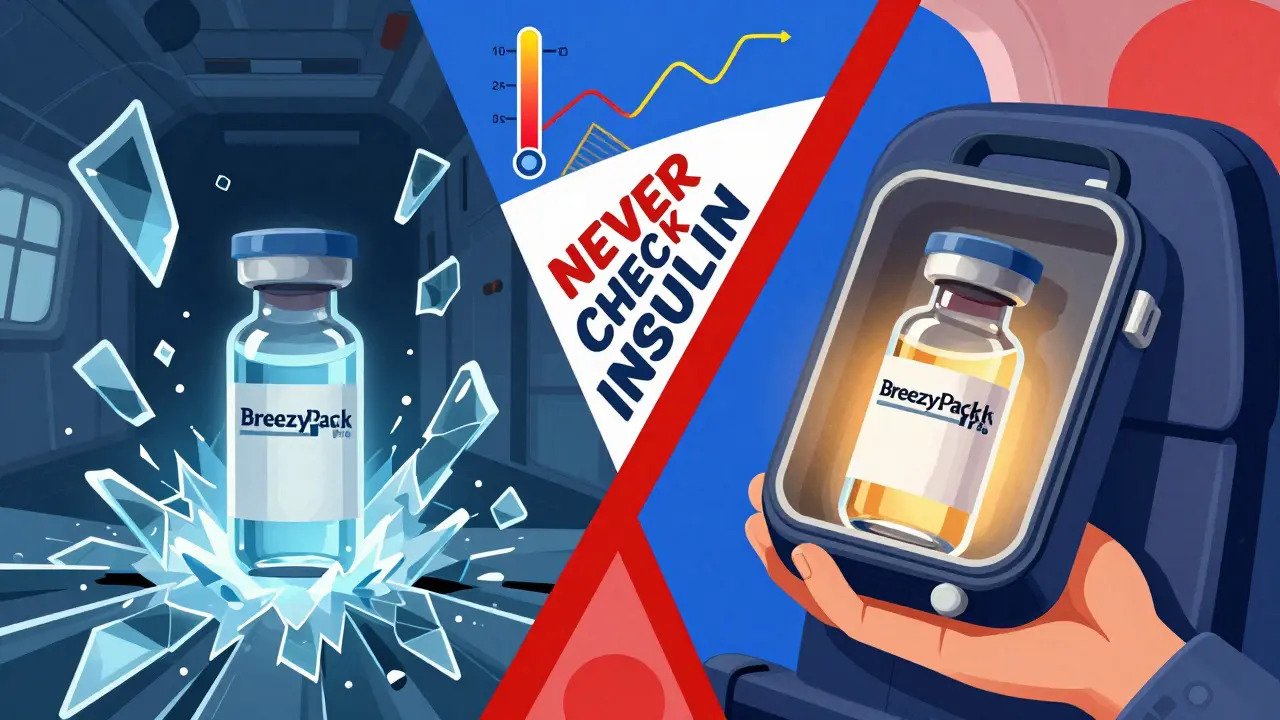
Avoid these common mistakes:- Putting insulin in checked luggage. Cargo holds freeze.
- Leaving it in the overhead bin. Temperatures spike near the ceiling.
- Using frozen water bottles without insulation. Direct contact = frozen insulin.
- Waiting until you’re on the plane to activate your cooling wallet. You need 15 minutes to activate FRÍO. Do it before you board.
- Assuming airline staff will help. 37% of travelers in a JDRF survey reported being denied permission to carry cooling devices-even though TSA regulation 1544.219 explicitly allows them.
Documentation: Don’t Get Stopped at Security
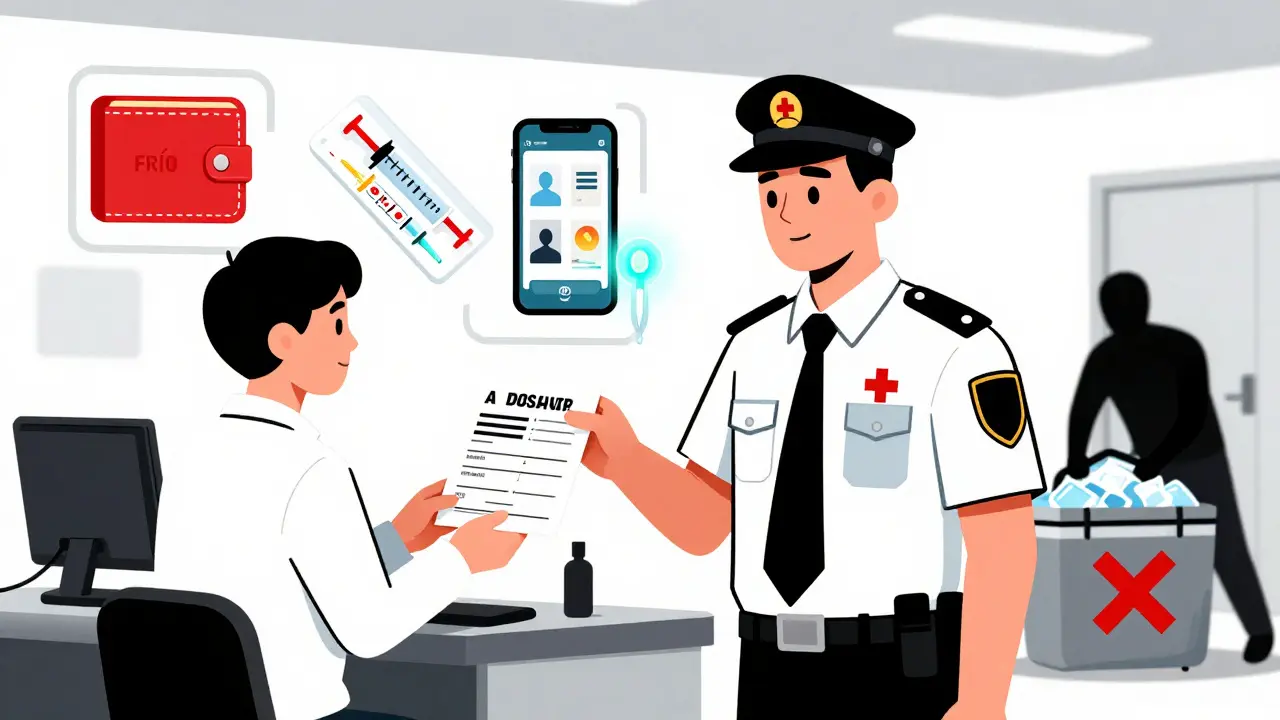
TSA doesn’t require a doctor’s note to carry insulin. But having one cuts delays by 92%, according to TSA’s own 2022 data. Your note should:- Be dated within the last 6 months
- Include your name, diagnosis, and medication list
- Be on letterhead with the provider’s signature and contact info
Time Zones and Dosing Adjustments
Flying across time zones changes your insulin schedule. For eastward flights (e.g., New York to London) that cross more than 6 hours:- Reduce your long-acting insulin dose by 20% the day of travel
- Use rapid-acting insulin for meals as needed
- Monitor blood sugar every 2-4 hours
What to Do If Your Insulin Looks Off
Check your insulin every 4 hours during the flight. Look for:- Cloudiness in clear insulin (like Humalog or NovoLog)
- Clumping or particles
- Crystals or frost inside the vial or pen
What’s Coming Next
The future of travel-friendly insulin is here. In Q2 2024, Outset Medical will release CryoGel 3.0, a new phase-change material that keeps insulin safe between 50°F and 77°F (10°C-25°C) for 120 hours-even in 113°F (45°C) heat. The ICAO is also mandating that all major airlines provide temperature-controlled storage compartments upon request by late 2024. And the ADA is funding research for new insulin formulas that stay stable at room temperature for 45 days by 2026. For now, though, the tools you need are already available. You don’t need fancy gear. Just the right knowledge and a little preparation.Can I carry insulin in my carry-on bag?
Yes. The TSA allows insulin, syringes, and cooling devices in carry-on luggage. You do not need to declare it unless asked. Always keep it in your personal bag, not checked luggage. Insulin in checked bags can freeze in the cargo hold, rendering it useless.
Can I use ice packs to keep insulin cold on a flight?
You can, but with caution. Ice packs must be 3.4 ounces (100ml) or less to pass TSA screening. More than that, and they’ll be confiscated. Even then, if your insulin touches the ice directly, it can freeze. Always separate the insulin from the ice with a towel or foam spacer. Water-activated cooling wallets like FRÍO are safer and easier to use.
What should I do if my insulin freezes during travel?
Never use frozen insulin. Even if it thaws and looks normal, the protein structure is damaged. Using it can lead to dangerously high blood sugar. Discard it immediately and use a backup. Always carry at least 200% of your expected dose when flying.
Do I need a doctor’s note to fly with insulin?
TSA doesn’t require one, but having a doctor’s note dated within the last 6 months reduces delays by 92%. The note should include your name, diagnosis, medications, and provider contact info on official letterhead. Keep a digital copy on your phone too.
Can I bring biologics like Ozempic on a plane?
Yes. Biologics like Ozempic, Wegovy, and Mounjaro require refrigeration until first use. Once opened, they can be stored at room temperature (59°F-86°F) for up to 56 days. Use a cooling wallet like FRÍO or BreezyPack to keep them safe during flights. Never check them in luggage.
How do I know if my insulin has gone bad?
Check for visible changes: cloudiness in clear insulin, clumps, particles, or crystals. If you see any of these, throw it out. Even if it looks fine, if it was exposed to temperatures above 86°F for more than 4 hours, it’s not safe. Always inspect your insulin every 4 hours during long flights.
Should I adjust my insulin dose when crossing time zones?
Yes. For eastward flights (losing time) over 6 hours, reduce your long-acting insulin by 20% the day of travel. For westward flights (gaining time), increase it by 15%. Use rapid-acting insulin for meals as needed. Always consult your doctor before making changes. Never guess.
Final Checklist Before You Fly
- ✅ Carry 200% of your insulin/biologics dose
- ✅ Use a cooling wallet (FRÍO or BreezyPack) - not ice packs
- ✅ Store insulin in seat-back pocket, not overhead bin
- ✅ Bring original pharmacy labels and digital copies
- ✅ Carry a doctor’s note dated within 6 months
- ✅ Check insulin every 4 hours for cloudiness or clumping
- ✅ Know your time zone adjustment plan
- ✅ Confirm airline policy on medical cooling devices





John Hay December 20, 2025
This guide is dead on. I’ve flown with Tresiba across three continents and never once trusted an overhead bin. I use the FRÍO wallet-so simple, no ice, no mess. Just soak it, slip it in my pocket, and forget about it. I’ve seen people panic because their insulin looked cloudy after a long flight. Don’t be that person. Do the prep work. It’s not optional.
Stacey Smith December 22, 2025
Anyone who checks insulin is a danger to themselves and everyone else. This isn’t a suggestion-it’s a life-or-death rule. TSA doesn’t care if you’re ‘too lazy’ to carry it. You don’t get to risk your health and clog up ERs because you didn’t read the damn guide.
Ben Warren December 22, 2025
It is both scientifically and ethically indefensible to permit the casual handling of biologics without rigorous adherence to temperature-controlled protocols. The degradation kinetics of insulin, particularly its tertiary protein conformation, are exquisitely sensitive to thermal variance. A 2023 meta-analysis published in the Journal of Pharmacokinetics and Pharmacodynamics confirms that even transient exposure above 30°C results in irreversible aggregation. The fact that this remains a point of contention among lay travelers is indicative of a broader societal failure in medical literacy. One must not merely follow advice; one must comprehend the underlying pathophysiology.
Teya Derksen Friesen December 23, 2025
As someone who travels monthly with GLP-1 agonists, I appreciate the depth of this guide. However, I must note that the BreezyPack Pro’s 72-hour stability is only valid in controlled environments. In practice, cabin air circulation and proximity to vents can cause minor fluctuations. I pair it with a thermal sleeve and always carry a backup pen in my jacket lining. Preparation is not an event-it’s a habit.
Sandy Crux December 24, 2025
…And yet, nobody mentions that the ‘FDA-approved’ temperature ranges are based on lab conditions, not the chaotic, pressurized, humidity-fluctuating nightmare of a Boeing 787 cabin… The FRÍO wallet? It’s a marketing gimmick… The real solution? Stop flying… Or better yet… demand airlines install regulated medical storage compartments… which they still don’t… because profit > patients…
Hannah Taylor December 26, 2025
ok but what if the whole thing is a lie? like… what if big pharma made up the temp thing so we’d buy all these overpriced wallets? i saw a video where someone put insulin in the freezer and it was fine after thawing… and now im paranoid… also why does the FDA even exist if they let this happen?
Jason Silva December 26, 2025
Bro this is so real 😭 I had a 14-hour flight last month and my pen got too hot in the overhead bin. My sugar went to 420 by the time we landed. I used my backup and cried in the airport bathroom. FRÍO wallet saved me. Buy it. Use it. Don’t be stupid. 🙏
Theo Newbold December 28, 2025
Let’s be clear: the 41% spike rate in overhead bins isn’t surprising. The cabin walls are aluminum, which conducts heat and cold like a radiator. The FAA’s 65–75°F standard is a myth-surface temps vary wildly. The seat-back pocket is the only empirically safe zone. Everything else is anecdotal guesswork dressed up as advice.
Cara C December 30, 2025
I’ve been living with type 1 for 18 years and this is the most practical, calm, and well-researched guide I’ve ever read. Thank you for not just listing rules but explaining why they matter. I’ve shared this with my support group. If you’re reading this and you’re scared to travel-don’t be. Just take the extra minute to prep. You’ve got this.
Michael Ochieng January 1, 2026
As someone who flies from Nairobi to Atlanta every quarter with insulin, I can confirm: the seat-back pocket is king. I also carry my doctor’s note printed on official letterhead and a digital copy. I’ve been stopped twice-both times, the note got me through in under 30 seconds. Don’t underestimate paperwork. It’s not bureaucracy-it’s your insurance.
Jerry Peterson January 1, 2026
Just a quick heads-up-some airlines like Delta now let you request a mini-fridge in the cabin if you’re flying long-haul. You have to ask at check-in, and they don’t advertise it, but it’s real. I used it last month with my BreezyPack and it was a game-changer. Worth a try if you’re flying premium or have a long layover.