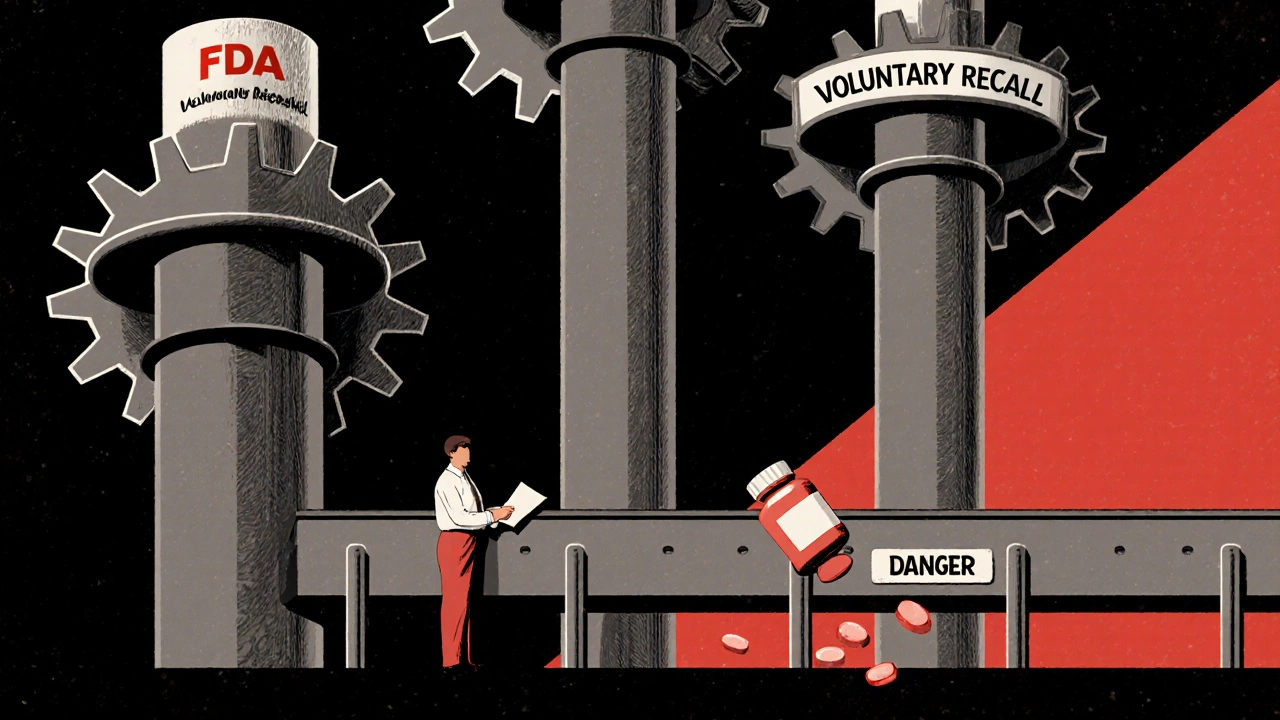
Many people assume the FDA can just pull a dangerous drug off the shelves the moment it’s found to be harmful. That’s not how it works. In reality, the FDA can’t force a drug company to recall a medication. It can only ask. And that small distinction has major consequences for patient safety.
How the FDA Actually Removes Unsafe Drugs
The FDA doesn’t have the legal power to order a drug recall. That’s not a mistake-it’s the law. Under the Federal Food, Drug, and Cosmetic Act (FD&C Act), the agency can only request that a manufacturer voluntarily remove a drug from the market. This applies to nearly every prescription and over-the-counter medication in the U.S.
When the FDA identifies a problem-whether through its own monitoring systems like MedWatch, reports from doctors, or lab tests-it contacts the company. It doesn’t issue a command. It issues a request. The company then decides whether to act. In over 99% of cases, they do. But the legal reality is that if a company refuses, the FDA can’t just step in and seize the product.
What happens then? The FDA has to go to court. Under Section 304 of the FD&C Act, it can ask a federal judge to issue an injunction to stop the drug from being made or sold. That process takes time. Days. Sometimes weeks. And during that time, the unsafe drug can still be in circulation.
Why the System Works-Most of the Time
Despite the legal limits, the system rarely fails. In 2022, there were over 4,300 drug recalls in the U.S. Only 13 of them required the FDA to take legal action. That’s less than 0.3%. Most companies comply quickly. Why? Because the cost of defiance is too high.
Imagine you’re a pharmaceutical company and the FDA tells you your blood pressure pill contains a carcinogen. If you refuse to recall it, you face public outrage, lawsuits from injured patients, investigations from Congress, and permanent damage to your brand. The financial and reputational risk makes voluntary recalls the smartest move.
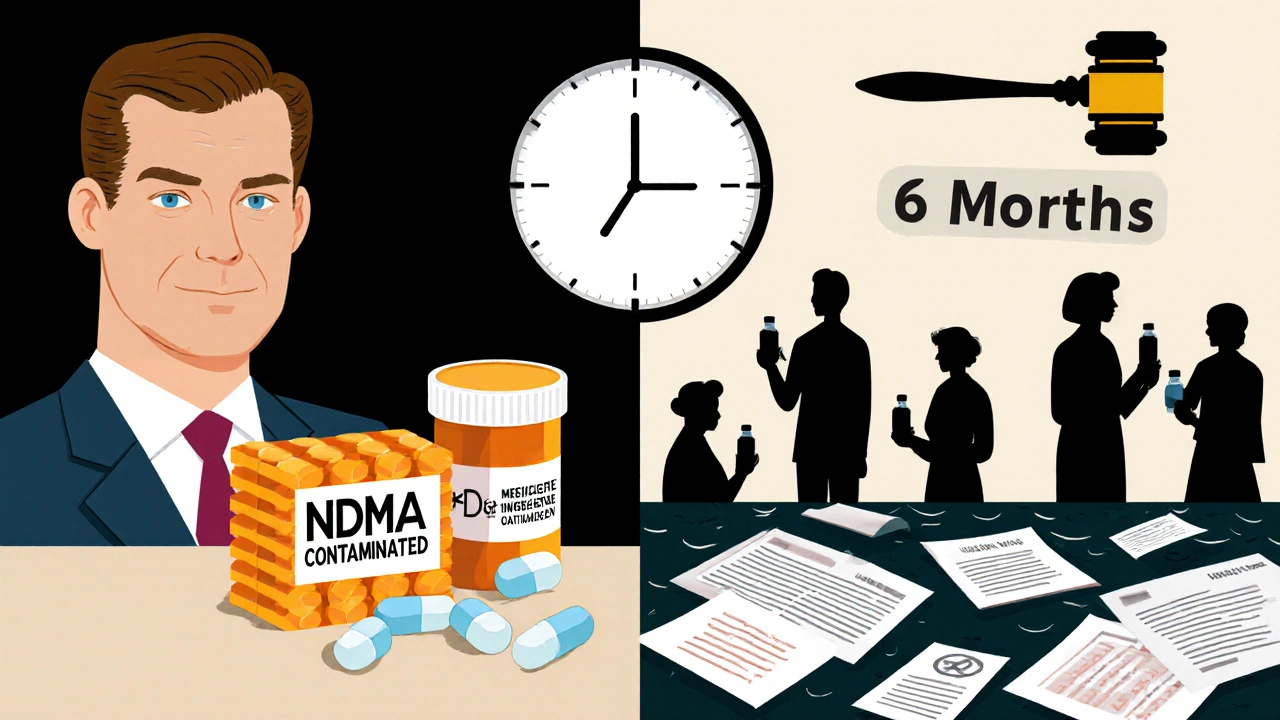
Take the 2018 valsartan recall. When contamination with NDMA-a known cancer-causing chemical-was found in a common blood pressure drug, the FDA issued its first alert on June 8. By June 29, every major manufacturer had recalled affected lots. It wasn’t because the FDA forced them. It was because the pressure was too great to ignore.
The Three Levels of Drug Recalls
Not all recalls are created equal. The FDA classifies them into three categories based on how dangerous the product is:
- Class I: The most serious. Use of the drug could cause serious harm or death. These are rare-only about 2% of all recalls. Examples include pills with the wrong active ingredient or contamination with bacteria or toxins.
- Class II: The most common. The drug might cause temporary or reversible health problems. About 69% of recalls fall here. Think: labeling errors, missing instructions, or potency issues that aren’t life-threatening.
- Class III: The least serious. The drug won’t harm you, but it violates FDA rules. Maybe the bottle says “100 pills” but only has 98. These make up about 29% of recalls.
The classification determines how fast and how far the recall must go. A Class I recall might require pharmacies to notify every patient who got the drug. A Class III might just need a notice to distributors.
Where the System Breaks Down
Even with a 99.7% voluntary compliance rate, the system has dangerous gaps.
One problem is timing. In 2019, a contaminated generic antibiotic took six months to fully disappear from the market. Why? Because the manufacturer dragged its feet. The FDA could only wait and plead. By the time a court order came, hundreds of patients had already taken the drug.
Another issue is supply chains. Many drugs are made in parts-active ingredients in China, packaging in India, final assembly in the U.S. When contamination is found, foreign manufacturers often delay cooperation. In the valsartan case, Chinese suppliers took 17 days to respond to the FDA’s request. That delay meant more patients were exposed.
Hospitals and pharmacies also struggle. A 2022 survey found that 68% of hospital pharmacists had trouble tracking which specific lots of a drug were affected. Lot numbers aren’t standardized. Some are printed in tiny fonts. Others are buried on the side of the box. Without clear labeling, it’s hard to know who got the bad batch.
Why Medical Devices Are Different
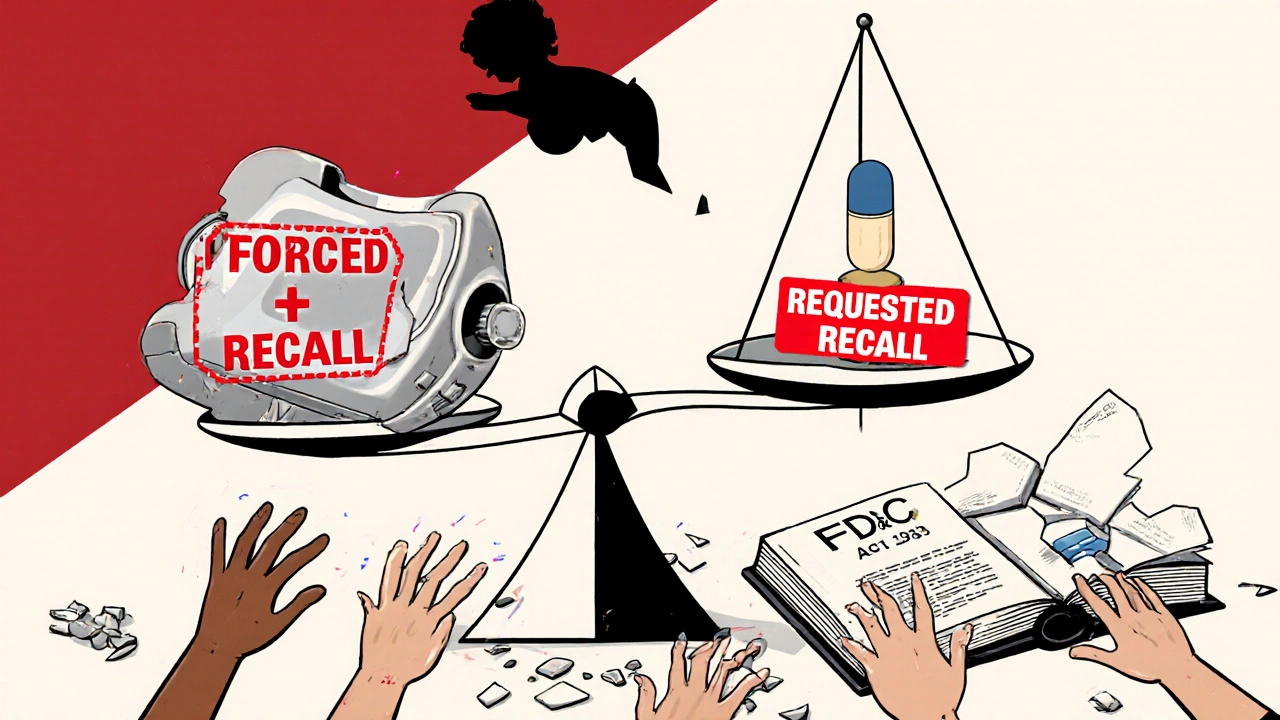
Here’s the twist: the FDA can force a recall of medical devices. That’s because of a different law-the Medical Device Amendments of 1976. Under 21 CFR 810, if a device poses a serious health risk, the FDA can legally order its removal. No court needed. No request. Just a direct order.
Why the difference? It comes down to history. When the FD&C Act was written in 1938, drugs were simpler. Devices weren’t a big concern. By 1976, when devices like pacemakers and insulin pumps became common, Congress gave the FDA stronger tools to protect patients.
That creates a strange imbalance. A faulty heart valve can be pulled off the market in days. But a contaminated blood pressure pill? It might take months. Critics call it a loophole. The FDA’s own former deputy commissioner, Dr. Sidney Wolfe, testified in Congress that this gap puts patients at risk.
What’s Changing? The Push for Mandatory Recall Power
For years, patient safety advocates have pushed for the FDA to get mandatory recall authority for drugs. In 2022, Congress considered a bill-the FD&C Modernization Act-that would have given the FDA that power. Section 604 would have allowed the agency to order recalls without going to court.
It was removed during committee review. Why? Lobbying. The pharmaceutical industry spent over $8 million in just one quarter of 2023 to fight the change. PhRMA, the industry’s main lobbying group, argues that the current system works. They point to the 99.98% voluntary recall rate over the past decade.
But experts like Dr. Peter Lurie of the Center for Science in the Public Interest say that’s not enough. “We don’t need 99.98% to work,” he wrote in 2023. “We need 100%. One delay, one refusal, one contaminated batch-that’s one too many.”
There’s still hope. The proposed PREVENT Pandemics Act, introduced in late 2023, includes a section that would grant the FDA explicit authority to order drug recalls in public health emergencies. If passed, it would be the biggest change to drug safety law in decades.
What Patients and Providers Should Do
Until the law changes, everyone needs to be proactive.
Patients: Check the FDA’s recall list weekly. It’s free and public. If you take a medication regularly, write down the lot number and expiration date. If a recall happens, you’ll know instantly if yours is affected.
Pharmacists and doctors: Don’t wait for a recall notice. Set up automated alerts from the FDA’s MedWatch system. Train your staff to check lot numbers before dispensing. Have a clear plan for notifying patients-don’t rely on paper mail. Texts and phone calls are faster.
Hospitals: Use recall tracking services. The market for these tools is growing fast-$287 million in 2023. Companies like Recall Masters and Recall Index help hospitals match recalled lots to patient records. It’s not cheap, but it’s cheaper than a lawsuit.
The Bottom Line
The FDA’s ability to remove unsafe drugs is limited-not because it’s incompetent, but because the law says so. The system works well most of the time, but it’s built on trust, not power. And trust can break.
When a drug is recalled, it’s not the FDA pulling it off the shelf. It’s the manufacturer. The FDA just makes sure they have no choice but to say yes.
Until Congress gives the FDA real authority, patients will always be one step behind. And in medicine, that’s a dangerous gap.




ariel nicholas December 1, 2025
So let me get this straight-the FDA can’t even *force* a recall? That’s not a regulatory gap-it’s a national embarrassment. We let corporations decide whether your child’s medicine will kill them? In China, they’d execute the CEO. In Russia, they’d nationalize the company. Here? We send a polite email and hope for the best. This isn’t capitalism-it’s corporate feudalism, and we’re all serfs with a prescription bottle.
amit kuamr December 2, 2025
in india we dont even have proper drug regulation yet but still we dont have this much drama. companies just do what they are told or get shut down. here its all about lawsuits and lawyers. the system is broken not because of law but because of culture.
Scotia Corley December 3, 2025
It is imperative to note that the absence of mandatory recall authority does not constitute regulatory failure. The voluntary compliance rate exceeds 99.7%, which is statistically significant and operationally robust. To advocate for increased regulatory power without evidence of systemic dysfunction is to confuse ambition with efficacy.
elizabeth muzichuk December 3, 2025
Did you know that the FDA is secretly controlled by Big Pharma through a backdoor deal signed in 1983? They’ve been burying recall data for decades. The ‘voluntary’ system? It’s a smokescreen. The real reason they don’t want mandatory power is because they’re scared the public will find out how many people died because the FDA was too scared to act. They’re not just negligent-they’re complicit.
Debbie Naquin December 5, 2025
The epistemological framework of pharmaceutical regulation is predicated on institutional trust rather than coercive authority. The FD&C Act reflects a Lockean model of consent-based governance-where market actors are presumed rational actors unless proven otherwise. But when the cost of noncompliance is lower than the reputational risk of compliance, the model collapses. We’re witnessing the failure of neoliberal regulatory theory in real time.
Karandeep Singh December 6, 2025
why cant they just take the drug off the shelf like in other countries?? this is so american. so much paperwork for nothing
Mary Ngo December 7, 2025
They’re not just delaying recalls-they’re hiding them. I’ve seen it. My cousin got cancer after taking a recalled drug. The FDA knew for months. The lot number was printed in a font so small you needed a magnifying glass. That’s not incompetence. That’s intentional. They want people to die quietly so they don’t have to pay.
James Allen December 8, 2025
Look, I get it. The system’s flawed. But let’s not turn this into a villain origin story. Most companies do the right thing. The 0.3% that don’t? They’re the outliers. We don’t need more power-we need better enforcement. And maybe a little less fearmongering. The FDA’s doing its best with broken tools. Let’s fix the tools, not burn the house down.
Kenny Leow December 9, 2025
Interesting perspective. In Japan, recalls are handled with extreme precision-every lot is tracked via blockchain-like systems. The FDA could learn a lot from global models. Maybe it’s not about power… but about infrastructure. 🤔
Kelly Essenpreis December 9, 2025
so the fda can force recalls on devices but not drugs?? that makes zero sense. why is a heart valve more important than a blood pressure pill? this is just corporate lobbying at work. we need to defund pharma and give the fda teeth
Alexander Williams December 11, 2025
The regulatory asymmetry between drugs and devices reflects a structural misalignment in risk taxonomy. Medical devices are classified under 21 CFR 810 as Class I–III risk-based interventions with direct mechanical or electrical interaction, whereas drugs are pharmacokinetic agents subject to metabolic variability. The legal distinction is not arbitrary-it’s rooted in differential risk vectors. Mandatory recall authority for drugs introduces a new variable: liability cascade, which is not yet quantifiable at scale.
Suzanne Mollaneda Padin December 13, 2025
As a pharmacist for 18 years, I’ve seen how messy recalls are. Lot numbers? Often handwritten on labels. Pharmacies don’t have the software to track them. Patients don’t know what to look for. The FDA’s website is hard to navigate. We need standardized digital lot tracking-QR codes on every bottle, synced to patient portals. It’s doable. It’s cheap. It’s just not a priority. If we fix the logistics, we don’t need more power-just better tools.