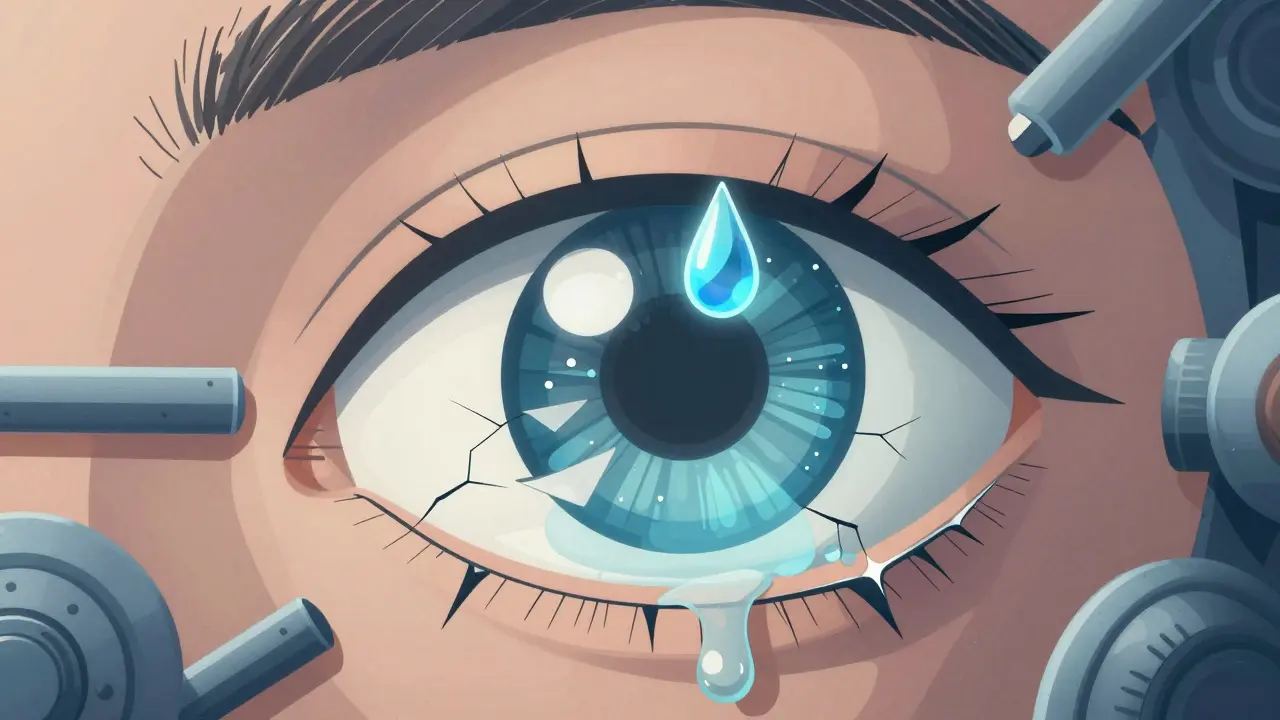
When your eyes feel gritty, burning, or watery all at once, it’s not just irritation - it’s likely dry eye syndrome. This isn’t just about being tired or staring at a screen too long. It’s a real medical condition where your tear film breaks down, leaving your eyes exposed, inflamed, and uncomfortable. And while many people reach for artificial tears, not all drops work the same - and some don’t work at all if you’re using the wrong kind.
What Exactly Is Dry Eye Syndrome?
Dry eye syndrome, now more accurately called dry eye disease (DED), isn’t simply lacking tears. It’s a breakdown in the tear film - the thin, multi-layered shield that coats your eye every time you blink. This film has three parts: an oily layer on top to stop tears from evaporating, a watery middle layer that hydrates and nourishes, and a mucin layer underneath that helps the tears stick to your eye surface. When any of these layers fail, your eyes suffer.
There are two main types. The first is aqueous tear-deficient dry eye (ADDE), where your lacrimal glands don’t make enough watery fluid. This affects about 10-15% of people with dry eye and is often linked to autoimmune conditions like Sjögren’s syndrome, aging, or medications like antihistamines. The second, and far more common type, is evaporative dry eye (EDE), caused by blocked or oily meibomian glands in your eyelids. This accounts for up to 86% of cases. Even if your body makes plenty of tears, they evaporate too fast - sometimes over 16 nanoliters per minute - because the oily seal is missing.
Normal tear break-up time is 15-35 seconds. In dry eye, it drops below 10. Tear osmolarity - a measure of salt concentration - jumps from a healthy 300 mOsm/L to 316-360 mOsm/L. That’s like pouring salt water into your eye. This triggers inflammation, damages the surface of your cornea, and creates a cycle: more damage → more inflammation → worse symptoms.
Why Artificial Tears Don’t Always Work
Most people start with over-the-counter artificial tears. And yes, they help - but only if they match your type of dry eye. For ADDE, where you’re missing water, saline-based drops with electrolytes close to natural tear composition (sodium 130-150 mM, potassium 5-10 mM) can refill the missing layer. But if you have EDE - which most people do - you need something that replaces the missing oil, not more water.
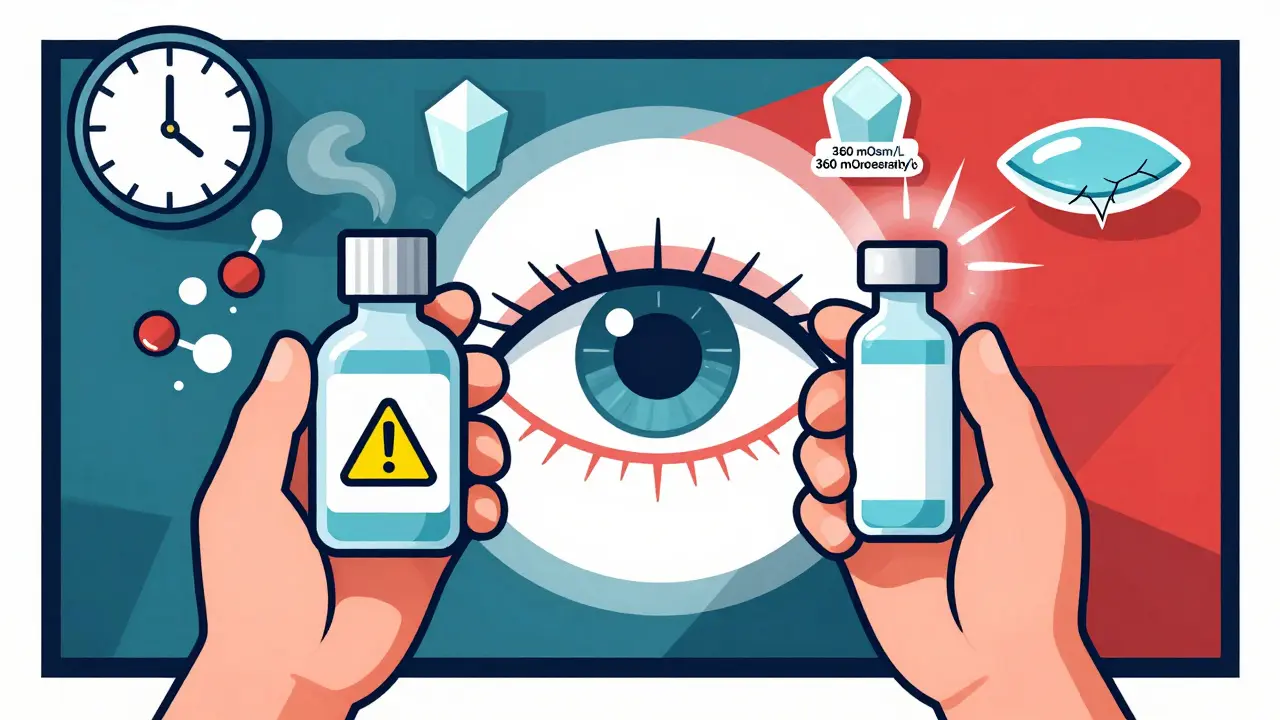
Many popular drops contain preservatives like benzalkonium chloride (BAK), which can irritate your eye if used more than 4-5 times a day. Studies show BAK causes epithelial damage after 11+ daily uses. That’s why preservative-free single-dose vials are recommended for frequent users. One Reddit user, u/DryEyeWarrior, said switching to preservative-free Refresh Relieva turned their post-LASIK dryness from unbearable to manageable - even though it cost $45 a month out of pocket.
Not all formulas are equal. A 0.15% sodium hyaluronate drop can last 4.2 hours. A basic saline solution? Maybe 2.5 hours. That’s why some people use artificial tears five times a day and still feel dry. Amazon reviews of Systane Hydration show 68% of users get relief - but 29% say it wears off in just 1-2 hours. Blurred vision after application? That’s common. It’s the thickening agents temporarily clouding your vision before they settle.
How to Use Artificial Tears Right
Using them wrong makes them useless. Most people squeeze out two or three drops at once - but you only need one. Too much just overflows and gets wasted. The correct way: tilt your head back, gently pull down your lower eyelid, and hold the bottle 1 cm above your eye. Let one drop fall in. Don’t let the tip touch your eye - it can contaminate the bottle.
Wait five minutes between different eye drops. If you’re using prescription drops like Restasis or Xiidra, artificial tears can dilute them if applied too soon. Also, refrigerating your drops can help. Cold drops are thicker and stay on the eye longer - studies show a 22% increase in residence time. For nighttime relief, ointments (like petroleum-based Vaseline alternatives) last 6-8 hours and are far better than liquid drops for overnight protection.
And here’s something most don’t know: if you wear contacts, some artificial tears make them feel gritty. Switching to Retaine HPMC, which is designed for contact lens wearers, let one user go from 2-hour wear to 8 hours daily. Compatibility matters.
When Artificial Tears Aren’t Enough
Here’s the hard truth: artificial tears treat symptoms, not the root cause. If your dry eye is caused by inflammation - and most chronic cases are - drops won’t fix it. That’s why 28% of patients stop using them within six months. They don’t work well enough.
Signs you need more than drops: corneal staining (Oxford scale Grade 3 or 4), vision that fluctuates more than half a diopter, or symptoms that don’t improve after 4-6 weeks of consistent use. At that point, you need prescription treatments. Cyclosporine (Restasis) and lifitegrast (Xiidra) reduce inflammation and can increase natural tear production. A 2022 survey found 68% symptom reduction with these, compared to just 41% with artificial tears alone.
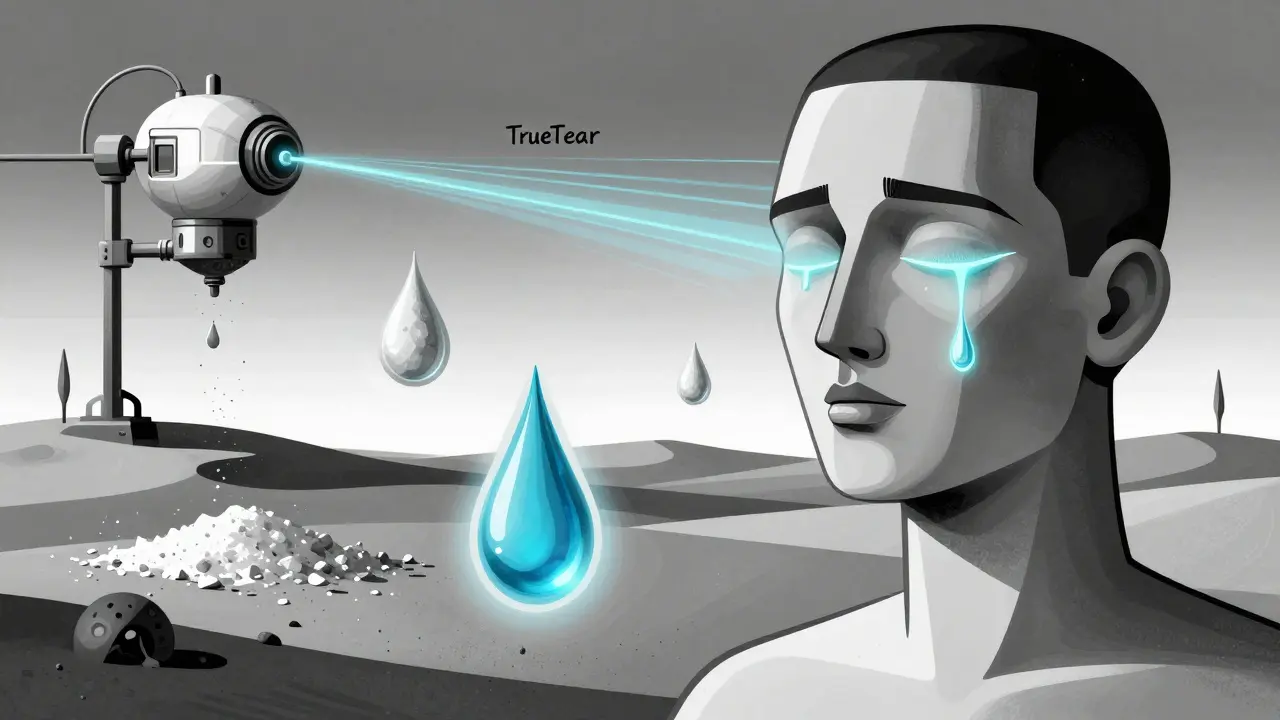
Even newer options are emerging. In 2023, the FDA approved Eysuvis (ketotifen), a drop that reduces flare-up symptoms in just 15 minutes. TrueTear, a handheld neurostimulator, triggers your body’s own tear production - boosting it by 31.2% in ADDE patients. And research is underway on lacritin protein therapy and hydrogel inserts that release moisture for 12 hours straight.
Who’s Most at Risk?
Women over 50 are the most affected group. Nearly 70% of dry eye patients are female. Hormonal changes, especially after menopause, reduce tear production. Age plays a big role too: while only 7.4% of people aged 20-30 have dry eye, that jumps to 18.6% for those over 70. Screen time doesn’t help - average daily use is now 7.4 hours, and each hour increases dry eye risk by 4%.
If you have autoimmune conditions - like rheumatoid arthritis, lupus, or thyroid disease - your risk is even higher. Medications like antihistamines, antidepressants, and blood pressure drugs also contribute. And if you’ve had LASIK or other eye surgery, your tear production can be permanently altered.
The Bigger Picture
The global dry eye market is worth over $4 billion and is expected to hit $8 billion by 2030. Artificial tears make up more than half of that - but the fastest-growing segment is prescription drugs and devices. Ophthalmologists are now using tear osmolarity tests (like TearLab) in clinics to pinpoint your exact tear chemistry. By 2025, 73% of eye care providers will have this tool.
What’s clear is that dry eye isn’t one-size-fits-all. You can’t just grab the cheapest bottle off the shelf. You need to know whether you’re missing water, missing oil, or both. And if your symptoms persist, don’t keep reaching for the same drops. Talk to your eye doctor. There are better options now than just hoping a saline solution will fix a chronic problem.
Can artificial tears cure dry eye syndrome?
No, artificial tears only manage symptoms. They replace missing tear components temporarily but don’t fix the underlying inflammation or gland dysfunction causing dry eye. For long-term relief, especially in moderate to severe cases, prescription anti-inflammatory drops like cyclosporine or lifitegrast are needed.
Are preservative-free artificial tears better?
Yes, if you use drops more than four times a day. Preservatives like benzalkonium chloride can damage the eye’s surface over time, especially with frequent use. Preservative-free single-dose vials eliminate this risk and are often more effective for severe dry eye, with studies showing 37.2% greater symptom improvement.
Why do my eyes water if I have dry eye?
It sounds confusing, but it’s common. When your tear film is unstable, your eyes send a distress signal - triggering reflex tearing. These tears are mostly water and lack the proper balance of oil and mucus, so they don’t coat the eye properly. That’s why you feel dry even though you’re crying.
Can I use artificial tears with contact lenses?
Yes, but not all types. Some drops contain ingredients that make lenses feel gritty or stick to the eye. Look for formulas labeled "for contact lens wearers," like Retaine HPMC or Systane Ultra. These are designed to be compatible and won’t cloud your vision or damage your lenses.
When should I see a doctor for dry eye?
If your symptoms last more than 4-6 weeks despite using artificial tears, or if you notice blurred vision, pain, redness, or corneal staining, it’s time to see an eye specialist. About 89% of optometrists recommend referral at this stage. You may need testing for tear osmolarity, meibomian gland evaluation, or prescription medication.




Casey Tenney March 22, 2026
Most people think artificial tears are a cure. They’re not. They’re a Band-Aid on a gunshot wound. If you’re still using BAK-laden drops after 4x a day, you’re not managing dry eye-you’re accelerating corneal damage. Stop being lazy. Get preservative-free. Period.
And no, refrigerating them isn’t ‘extra’-it’s science. Cold = longer residence. Simple.
Timothy Olcott March 23, 2026
lol u think u r so smart with ur 16 nanoliters per min stuff 😂 i just use blink and it works 4 me 🤷♂️
Desiree LaPointe March 24, 2026
Oh, so you’re one of those people who thinks ‘artificial tears’ are a one-size-fits-all solution? How quaint. You might as well be slathering Vaseline on your face and calling it a moisturizer. The fact that you’re still using saline drops while your tear osmolarity is at 350 mOsm/L is like using a toothbrush to unclog a sewer.
And let’s not forget the 29% who say it wears off in two hours. Two hours. That’s not relief. That’s a placebo with a price tag.
Also, if you’re not using Retaine HPMC or a hydrogel insert, you’re not even playing the game. You’re just spectating from the cheap seats.
Shaun Wakashige March 25, 2026
i just use the 3 dollar ones and it's fine lol
Paul Cuccurullo March 25, 2026
Thank you for this comprehensive breakdown. It’s rare to see such a well-researched, compassionate explanation of a condition that so many dismiss as ‘just eye strain.’
For those feeling overwhelmed, please know: you’re not alone. The journey to relief may be long, but with the right tools and a knowledgeable eye care provider, improvement is absolutely possible.
Small steps matter. Consistency matters more.
Allison Priole March 26, 2026
Okay so I’ve been using Systane for like 3 years and I thought I was doing great until I read this and realized I’ve been using 3 drops at a time and not waiting 5 mins between meds and my contacts were probably getting ruined and I didn’t even know it.
Also I never knew cold drops last longer? That’s wild. I’m gonna start putting mine in the fridge like a wine bottle. Also I think I have EDE because my eyes feel dry but I cry all the time? Like I’m crying at movies and then my eyes are still dry? That’s so weird but now it makes sense. I’m switching to Retaine HPMC tomorrow. I feel like a new person already.
Also I’m gonna start doing warm compresses. I’ve been too lazy but now I’m motivated. Thanks for the kick in the pants. 💪
Sandy Wells March 27, 2026
Preservative free is better but expensive and not covered by insurance and most people can't afford it so stop pretending everyone has access to $45 monthly drops
Bryan Woody March 28, 2026
You think you’re being clever with your 16 nanoliters per minute stat? Cute. But here’s the truth: 86% of dry eye cases are evaporative. That means your eyelids are clogged with grease, not your tear ducts. You’re not hydrating-you’re cleaning. You need heat, pressure, and a lid scrub-not another drop.
And yes, artificial tears are a band-aid. But guess what? The FDA didn’t approve Eysuvis because it’s ‘cool’-it’s because the inflammation is the root. You can’t pour water into a leaking boat and call it a fix.
Stop treating symptoms. Start treating the cause. Or keep wasting $45/month on saline that evaporates faster than your motivation.
Chris Dwyer March 30, 2026
You got this. Seriously. It’s not easy, but you’re already ahead just by reading this. Most people don’t even know what meibomian glands are. You’re learning. That’s huge.
Start with the warm compresses. Do them for 10 minutes before bed. Then one drop of preservative-free. No more than one. And if you wear contacts? Try Retaine. I switched last year. Went from 2 hours to 10. Life-changing.
You’re not broken. You just need the right system. And you’re on it.
Natali Shevchenko March 31, 2026
It’s funny how we treat our eyes like disposable machines. We stare at screens for 7.4 hours a day, then expect a drop to fix the damage. But the eye is not a phone. You can’t reboot it. You can’t update its firmware. It’s a living tissue, constantly renewing, constantly suffering.
The tear film isn’t just lubrication-it’s a biological interface between you and the world. When it fails, you’re not just dry-you’re exposed. Vulnerable. Unprotected.
And yet we treat it like a leaky faucet. We keep turning the knob. We don’t fix the pipe.
Maybe the real cure isn’t more drops. Maybe it’s less screen. Less haste. More blinking. More stillness.
Johny Prayogi March 31, 2026
I use the preservative free ones and they changed my life 🙌 I was so skeptical but now I’m hooked. Also try the gel at night! 🌙
Nicole James April 1, 2026
You know who benefits the most from this $4 billion market? Big Pharma. They don’t want you to heal. They want you to keep buying drops forever. The FDA approved Eysuvis? That’s not a cure-it’s a profit model. And don’t get me started on TrueTear-why does a handheld device that ‘stimulates nerves’ cost $1,200? Coincidence? I think not. They’re selling dependency. Not solutions.
Nishan Basnet April 2, 2026
This is one of the clearest explanations of dry eye I’ve ever read. As someone from India where air quality and screen exposure are worsening, I see this daily. The lack of awareness is staggering.
But the real tragedy? People think it’s ‘just dryness’ and ignore it until the cornea is scarred. I’ve seen patients with Grade 4 staining who thought ‘eye drops’ would fix it. They didn’t know about meibomian gland expression or tear osmolarity testing.
Thank you for highlighting that this is a systemic issue-not a pharmacy aisle fix. We need public health campaigns, not just product ads.
Jackie Tucker April 3, 2026
How ironic that we’ve turned a biological system into a consumer product. We now have ‘tear film optimization’ as a marketing slogan. As if your cornea is a BMW that needs premium synthetic oil.
And yet, the people who need the most help-low-income, elderly, uninsured-are the ones who can’t access preservative-free, can’t afford $1,200 devices, and are told to ‘just blink more.’
Meanwhile, the industry churns out new ‘miracle’ drops every year, each more expensive than the last. The real disease isn’t dry eye. It’s capitalism.
Thomas Jensen April 4, 2026
I think they’re hiding the real cause. It’s not just screen time or hormones. It’s the fluoride in the water. The EMF from phones. The glyphosate in our food. All of it is poisoning our tear glands. I’ve been using a special crystal pendant and my symptoms dropped 80%. No joke. Google ‘tear gland detox’.
Casey Tenney April 6, 2026
Of course you’re still using BAK. You’re the type who buys the 3-pack on Amazon and wonders why your eyes burn more after 6 weeks.
And you think fluoride and EMF are the cause? That’s adorable. You’re not a patient-you’re a conspiracy channel subscriber.
Go get a TearLab test. Or don’t. But stop pretending your crystal pendant is a medical device.