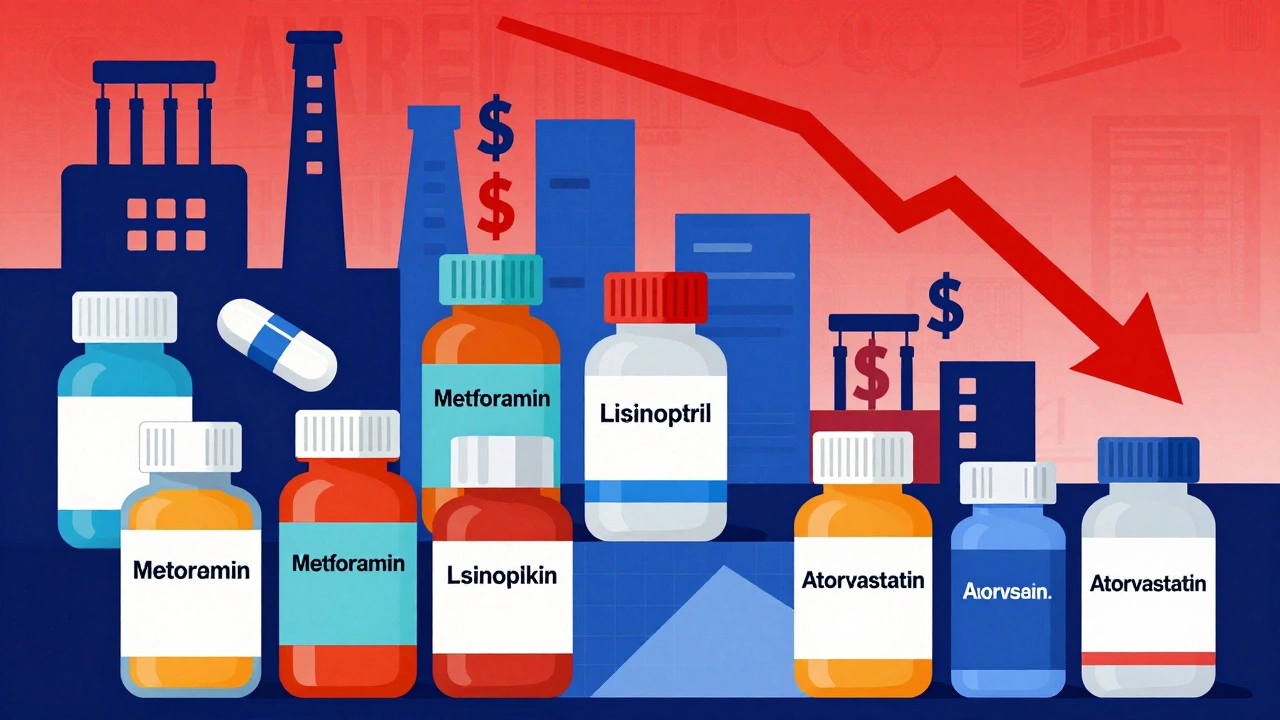
When you pick up a prescription for metformin, lisinopril, or atorvastatin, you might pay less than $10 for a 90-day supply. That’s not luck. It’s the result of generic drug competition-when multiple companies make the same medicine after the brand-name patent expires. The more makers there are, the lower the price drops. It’s simple economics, but it’s also one of the biggest reasons the U.S. spends far less on drugs than other countries, even though we buy more of them.
Why More Manufacturers Mean Lower Prices
Imagine you’re buying toilet paper. If only one brand is available, they can charge whatever they want. But if five brands show up on the shelf, suddenly you’ve got choices. You’ll pick the cheapest one. The others have to lower their prices to stay in the game. That’s exactly what happens with generic drugs.When the first generic version of a drug hits the market, prices usually drop by about 17%. With two manufacturers, that jump to nearly 40%. Add a third, and you’re looking at over 50% off the original brand price. Once four or more companies are making the same pill, prices often fall by 70% or more. A 2021 study in JAMA Network Open tracked 50 brand-name drugs and found that when eight or more generics were available, prices dropped to just 20-30% of what the brand once charged.
This isn’t theory. It’s real data from Medicare spending between 2015 and 2019. The FDA confirmed it: more competitors = deeper discounts. And those savings add up fast. Over the decade ending in 2019, generic drugs saved the U.S. healthcare system $1.7 trillion. In 2022 alone, 742 new generic approvals were expected to save $14.5 billion in a single year.
Not All Generics Are Created Equal
But here’s the catch: not every drug sees this kind of price drop. The rules change depending on the type of medicine.Oral pills-like antibiotics, blood pressure meds, or diabetes drugs-are the easiest to copy. That’s why you’ll often find eight or nine makers for drugs like levothyroxine or simvastatin. The manufacturing process is well understood. The ingredients are cheap. So competition thrives.
Now look at injectables, like insulin or chemotherapy drugs. These are harder to make. The equipment is expensive. The quality control is stricter. Fewer companies want to enter that market. So even if a generic version exists, you might only have one or two options. Prices stay higher.
And then there are biologics-complex drugs made from living cells, like Humira or Enbrel. Even when biosimilars (their generic cousins) are approved, they rarely drive down prices the way simple generics do. Why? Because they’re harder to produce, harder to get approved, and insurance systems often don’t push them as hard. A 2021 study found that if biosimilars were treated like regular generics in Medicare, spending on those drugs could’ve dropped by nearly 27%.
The Dark Side of Too Few Competitors
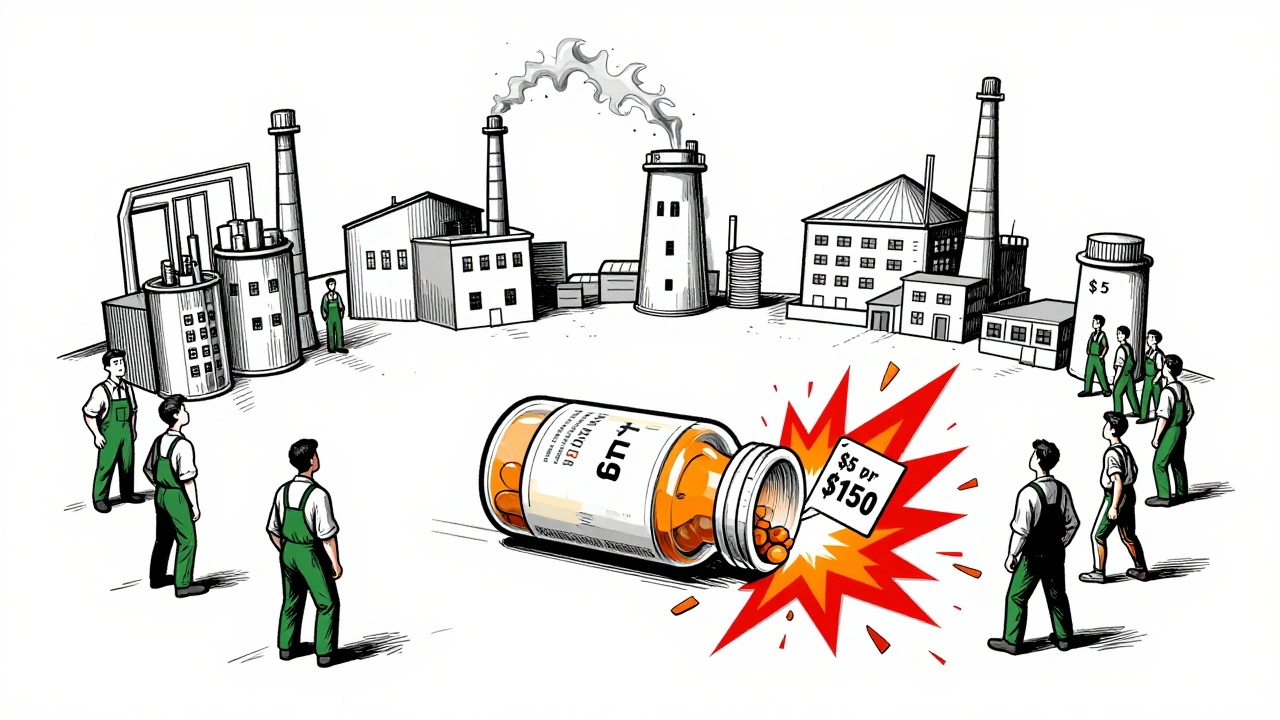
Here’s where things get dangerous. When only one or two companies make a generic drug, prices don’t fall-they spike.In 2021, a drug called levetiracetam (used for seizures) went from having five manufacturers down to two. Within months, the price jumped 300%. Patients had to switch medications or pay hundreds more per month. That’s not an outlier. Reddit threads from pharmacy workers and patients are full of stories like this: one manufacturer exits, prices triple, shortages hit, and people suffer.
Why does this happen? Because when competition disappears, so does pressure to keep prices low. A 2017 study by researchers from MIT, the University of Chicago, and the University of Maryland found that over half of all generic drugs in the U.S. had at most two manufacturers. Forty percent had just one. That’s not a market-it’s a monopoly waiting to happen.
And it’s getting worse. Between 2014 and 2016, nearly 100 small generic drug makers were bought up by larger companies. These mergers fly under the radar. The FTC doesn’t always block them because the companies are small. But the result? Fewer choices. Higher prices. And less accountability.
Who’s Winning and Who’s Losing
The winners? Patients who get their meds for $5 instead of $50. Taxpayers who don’t pay for inflated drug costs through Medicaid and Medicare. Employers who see lower insurance premiums.The losers? Patients stuck with drugs made by a single manufacturer. People who can’t afford to switch medications even when prices spike. And communities hit by drug shortages when one factory shuts down and there’s no backup.
Even the brand-name companies aren’t always the villains. Sometimes, they launch their own “authorized generic”-the exact same pill, just sold under a different label. When that happens, the brand’s price drops by 4-11%. But if they’re the only one making the generic? Their price can actually go up by 22% because they’re the only game in town.
How to Use This to Your Advantage
You don’t need to be an economist to save money on your prescriptions. Here’s how to use competition to your benefit:- Check GoodRx or SingleCare before filling a prescription. These sites show prices across hundreds of pharmacies and often reveal which generic brand is cheapest.
- Ask your pharmacist if your drug has multiple manufacturers. If it does, they can usually switch you to the lowest-cost version.
- Use the FDA’s Orange Book to see which generics are rated “AB”-meaning they’re truly interchangeable with the brand.
- If your drug has only one maker and the price jumps, talk to your doctor. There might be a similar drug with more competition.
- For chronic conditions like high blood pressure or diabetes, stick with generics that have five or more makers. They’re the most stable and cheapest.
Don’t assume all generics are the same. Some are made in the same factory as the brand. Others are made overseas with less oversight. The FDA inspects all of them, but if a drug has only one supplier, you’re trusting that one company to keep quality high. More makers means more checks and balances.
The Bigger Picture
The U.S. spends about 23% of its total drug budget on generics-but those generics fill 90% of all prescriptions. That’s the power of competition. Without it, we’d be paying three to four times more for basic medicines.But the system is under strain. Mergers are reducing competition. Small manufacturers are getting squeezed out. And when prices fall too far, some companies quit the market entirely because they can’t make a profit.
The FDA’s Drug Competition Action Plan and the CREATES Act were designed to fix this. They try to stop brand companies from blocking generics from getting the ingredients they need. They try to speed up approvals. But enforcement is weak. And without more oversight, we’re heading toward a future where common drugs become unaffordable again-not because they’re rare, but because too few people are allowed to make them.
For now, the rule still holds: more makers = lower prices. But that rule only works if the market stays open. And that’s something we all need to watch.



iswarya bala December 10, 2025
omg this is so true!! i got my metformin for $3 at walmart and almost cried 😭
Courtney Black December 11, 2025
It’s not just economics-it’s a moral imperative. When a life-saving drug becomes a commodity traded by oligarchs in white coats, we’ve lost something deeper than money. The pill doesn’t care if you’re rich or poor, but the system sure does. And yet, we act surprised when someone skips doses because they can’t afford the $80 version when the $5 one vanished overnight. This isn’t capitalism. It’s market manipulation dressed in FDA approval.
Simran Chettiar December 13, 2025
It is an undeniable fact that the pharmaceutical industry operates under a paradoxical framework wherein competition is both incentivized and systematically undermined. The existence of multiple generic manufacturers inherently reduces pricing pressure, yet structural barriers-such as regulatory delays, supply chain consolidation, and patent evergreening-create artificial scarcity. This phenomenon is not merely economic; it is sociopolitical in nature, reflecting broader systemic failures in public health governance. The FDA’s role, while ostensibly protective, often functions as a gatekeeper rather than a liberator, inadvertently enabling monopolistic behavior under the guise of quality control.
Philippa Barraclough December 13, 2025
Interesting how the data shows such a clear correlation between manufacturer count and price reduction, yet the policy responses remain fragmented. The CREATES Act and Drug Competition Action Plan sound good on paper, but without real enforcement mechanisms-like mandatory ingredient access timelines or penalties for anti-competitive behavior-they’re just bureaucratic noise. I wonder if anyone’s tracked how many generic approvals get delayed because brand companies refuse to supply samples for bioequivalence testing. That’s the real bottleneck, not the FDA’s backlog.
Olivia Portier December 13, 2025
you guys are so right!! i work at a community pharmacy and i see this every day-people crying because their $4 levothyroxine suddenly jumped to $47 because the other two makers stopped producing it. but here’s the thing: YOU CAN DO SOMETHING. ask your pharmacist to switch brands, check GoodRx, tell your rep to fix this. we’re not powerless. change starts with one person asking ‘why?’
Brianna Black December 14, 2025
Let me be perfectly clear: the American healthcare system is a grotesque theater of exploitation masquerading as innovation. We celebrate generics as a victory while ignoring the fact that 40% of them are produced by a single, often offshore, manufacturer with zero transparency. We applaud price drops while turning a blind eye to the factories that shutter when margins fall below 3%. This is not free market-it is corporate feudalism with a prescription pad. And yes, I am furious.
Shubham Mathur December 16, 2025
Look if you're paying more than $10 for a 90-day supply of lisinopril you're being scammed period no excuses the system is rigged and the FDA is asleep at the wheel and if you're not screaming about this you're part of the problem
Ruth Witte December 17, 2025
YES YES YES!!! 🙌 This is why I always check GoodRx before I leave the house! 💊✨ And if my pill looks different? I ask my pharmacist ‘which factory?’ because I learned the hard way that one brand made my anxiety worse-turns out, the filler was different! More makers = more safety nets 🌍❤️ #GenericRevolution
Lauren Dare December 18, 2025
It’s fascinating how we’ve elevated ‘affordability’ to a moral crusade while simultaneously ignoring the fact that the entire generic manufacturing ecosystem is built on the backs of underpaid labor in countries with minimal regulatory oversight. We celebrate the $3 pill but refuse to ask who made it, under what conditions, or whether the ‘AB’ rating means anything beyond regulatory checkbox compliance. The real scandal isn’t the price-it’s our collective amnesia about the cost behind the cost.