Brand-name drugs can cost hundreds-even thousands-of dollars a month. If you’re insured but still struggling to afford your medication, you’re not alone. Many people don’t realize that the drug manufacturer itself may offer a savings program that cuts your out-of-pocket cost by 70% to 85%. These programs aren’t charity-they’re business tools-but for you, they’re a lifeline.
What Are Manufacturer Savings Programs?
Manufacturer savings programs are financial assistance tools created by pharmaceutical companies to help patients pay for brand-name drugs. The two most common types are copay cards and patient assistance programs (PAPs). Copay cards work like coupons: you sign up online, get a digital or physical card, and use it at the pharmacy to reduce your immediate cost. PAPs are often for people with very low income, but many copay programs are open to anyone with private insurance.These programs exploded in the 2000s as insurance plans started shifting more costs to patients. Today, nearly one in five prescriptions for privately insured patients uses a manufacturer coupon. In some areas-like diabetes, asthma, and blood clot treatments-more than one-third of all brand prescriptions rely on these discounts.
Who Can Use These Programs?
You’re eligible if you have private health insurance. That means coverage from an employer, a plan bought on the marketplace, or a private insurer like Blue Cross or UnitedHealthcare. If you’re on Medicare, Medicaid, or any other federal program, you’re not eligible. This is by law. The federal anti-kickback statute blocks drug makers from giving discounts to people on government plans because it could push them toward more expensive brand drugs instead of cheaper generics.Even if you have private insurance, not all plans work with every program. Some insurance companies use what’s called an accumulator adjustment program. This means the manufacturer discount doesn’t count toward your deductible or out-of-pocket maximum. So you pay less today, but you still have to hit your full deductible later. Check your plan documents or call your insurer to find out if they use accumulators.
How to Find Your Drug’s Savings Program
Start with the drug’s manufacturer. Go to their official website and search for “patient assistance” or “savings program.” Most big brands-like Humira, Jardiance, Ozempic, or Advair-have a dedicated page for this. If you’re not sure who makes your drug, look at the label or ask your pharmacist.Alternatively, use a trusted aggregator like GoodRx or Patient Access Network Foundation. These sites let you enter your drug name and instantly show you available savings options, including manufacturer programs and pharmacy discount cards. A 2022 review found that 73% of major drug makers have their own savings portal online.
How to Sign Up and Use the Program
Signing up is quick and usually free:- Visit the manufacturer’s savings program website.
- Fill out a short form with your name, date of birth, insurance info, and prescription details.
- Upload a copy of your insurance card and prescription (some sites do this automatically through your pharmacy).
- Get approved-most decisions are instant.
- Receive a digital card via email or text, or a physical card in the mail.
When you go to pick up your prescription, give the pharmacy your savings card along with your insurance card. The pharmacy’s system connects to a third-party administrator (like ConnectiveRx or Prime Therapeutics), which applies the discount right at checkout. You pay only your reduced copay. The manufacturer pays the rest.
Some programs require you to reapply every year. Others last 12 to 24 months. Keep track of expiration dates-some patients get hit with a surprise $1,200 bill when their coupon suddenly ends.
What You Can Save
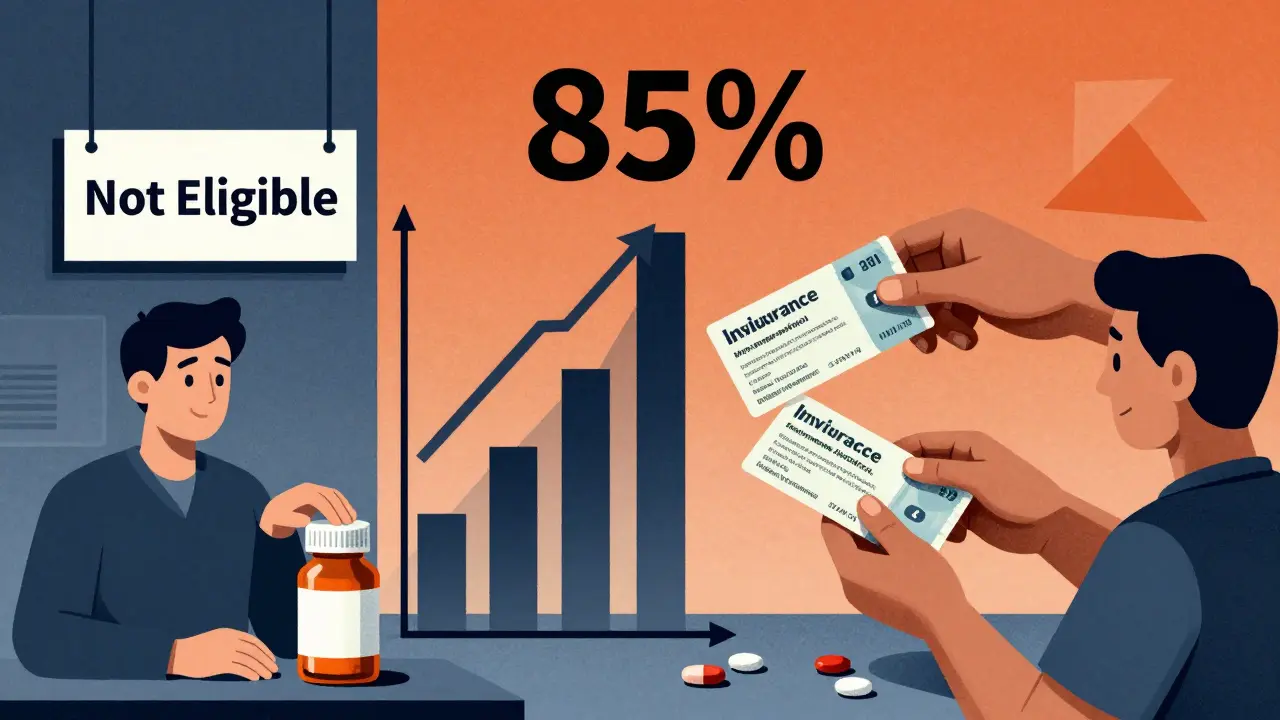
The savings are real. A 2022 study in the Journal of Managed Care & Pharmacy found copay cards cut patient costs by nearly 85%. For example:- A diabetes patient on Jardiance paid $562.50 a month before the coupon. After using the manufacturer’s card, they paid $100.
- Someone on Humira dropped from $4,500 a month to $150 with the savings program.
Most programs cap annual savings between $5,000 and $15,000 per person. That’s a huge difference if you’re on a high-cost drug all year. For many, it’s the only way they can afford their medication.
What You Can’t Do
These programs have limits:- No Medicare/Medicaid: Federal law blocks these discounts for government program enrollees.
- Accumulator programs: Your discount might not count toward your deductible. You still owe the full amount later.
- Not for generics: These programs only work for brand-name drugs. If a generic is available, the coupon won’t apply.
- Not always available: Programs can end without warning. Companies change pricing, or new generics enter the market.
Some patients report their programs were canceled after just a few months. Others found out too late that their insurer didn’t accept the card. Always confirm with your pharmacist before filling your prescription.
Manufacturer Savings vs. Pharmacy Discount Cards
You might see ads for GoodRx, SingleCare, or RxSaver. These are different. Pharmacy discount cards are not tied to manufacturers. They work for both brand and generic drugs and typically save you 30% to 60%. But they’re not as deep as manufacturer coupons.Here’s the key difference:
| Feature | Manufacturer Savings Program | Pharmacy Discount Card (e.g., GoodRx) |
|---|---|---|
| Works for brand drugs? | Yes | Yes |
| Works for generics? | No | Yes |
| Typical savings | 70%-85% | 30%-60% |
| Eligibility | Private insurance only | Anyone, no insurance needed |
| Counts toward deductible? | Usually not (if accumulator program) | No |
| Expiration | Often 12-24 months | No expiration |
If you’re eligible, use the manufacturer program first-it saves more. If you’re not eligible, or if your program ends, switch to a discount card.
Real Problems People Face
It’s not always smooth. A 2023 survey found that 65% of patients need help from their pharmacist just to sign up. Why? The rules vary wildly by drug and manufacturer. Some require income verification. Others ask for your doctor’s signature. Some only work with certain pharmacies.Accumulator programs are the biggest hidden trap. If your insurance blocks the discount from counting toward your deductible, you’re paying less now-but you’ll still owe thousands before your insurance fully kicks in. Ask your insurer: “Do you have an accumulator program?” If they say yes, ask if they’ll waive it for your specific drug.
Also, programs can disappear. When Humira’s coupon ended in 2022, some patients went from paying $150 a month to $1,200 overnight. That’s why it’s smart to check for generic alternatives or talk to your doctor about switching if your drug is about to lose its coupon.
What’s Changing in 2025?
The landscape is shifting. The Inflation Reduction Act capped insulin costs at $35 for Medicare patients-cutting the need for coupons for many. Some states have passed laws forcing insurers to count manufacturer discounts toward deductibles. As of 2025, 32 states have such rules.But big changes are still coming. The 2023 Fair Deal for Patients Act, currently under review, would require all insurance plans to count manufacturer savings toward deductibles. If it passes, the whole system could change. Drug makers might reduce their coupons, or insurers might raise prices to compensate.
The FDA also issued new guidance in 2023 telling manufacturers to clearly state the limitations of their coupons-no more hiding the fine print.
What You Should Do Now
1. Check if your drug has a manufacturer program-visit the drug maker’s website or use GoodRx. 2. Confirm you have private insurance-no Medicare, Medicaid, or VA. 3. Ask your insurer: “Do you use accumulator adjustment programs?” 4. Sign up early-don’t wait until your last refill. 5. Save your card-take a screenshot or print it. 6. Set a reminder-check expiration dates every 6 months. 7. Talk to your pharmacist-they know which programs work with your plan.If you’re paying over $200 a month for a brand drug, this could save you thousands. Don’t assume you can’t afford it. The discount is there-you just have to claim it.
Frequently Asked Questions
Can I use a manufacturer savings program if I have Medicare?
No. Federal law prohibits drug manufacturers from offering discounts to people on Medicare, Medicaid, or other government programs. This is to prevent financial incentives that could push patients toward more expensive brand drugs. If you’re on Medicare, look into the $35 insulin cap or ask your doctor about lower-cost alternatives.
Why doesn’t my manufacturer discount count toward my deductible?
Many insurance plans use what’s called an accumulator adjustment program. This means the manufacturer’s discount doesn’t count toward your deductible or out-of-pocket maximum. You still have to pay the full cost yourself before your insurance starts covering more. Check your plan documents or call your insurer to confirm if they use accumulators.
Can I use a manufacturer coupon with a generic version of my drug?
No. Manufacturer savings programs only apply to brand-name drugs. If a generic version is available, the coupon won’t work. Generics are usually much cheaper, so if you’re eligible for the generic, it’s often the better choice-unless your doctor says the brand is medically necessary.
What if my manufacturer program suddenly ends?
It happens. When a drug loses patent protection or a generic enters the market, manufacturers often stop their coupons. If your program ends, talk to your doctor about switching to a generic or another brand with an active savings program. You can also use pharmacy discount cards like GoodRx as a backup.
Are these programs safe and legal?
Yes, they’re legal for people with private insurance. But they’re controversial. Critics say they keep drug prices high by reducing competition from generics. Supporters say they help patients afford life-saving medications. As long as you’re eligible and follow the rules, using them is perfectly legal and widely accepted by pharmacies and insurers.
Do I need to reapply every year?
Many programs require annual renewal. Some last 12 months, others 24. You’ll usually get an email or text reminder, but don’t rely on it. Set a calendar reminder to check your program status every 6 months. If you miss the renewal, you could face a big price jump.
Can I use more than one manufacturer coupon at a time?
No. You can only use one manufacturer coupon per prescription, and only one per drug. You can’t stack discounts. But you can use a manufacturer coupon for one drug and a pharmacy discount card for another.





Kitty Price December 15, 2025
I used this for my Ozempic and saved like $400 a month 😭 Thank you so much for sharing this! I was about to quit taking it until I found the coupon.
Colleen Bigelow December 15, 2025
Of course Big Pharma wants you to use these. They’re the same companies that jack prices up 200% every year. This is a trap. They know you’ll get hooked on the brand and then when the coupon expires, you’re stuck paying $1200/month. It’s a racket disguised as help.
Randolph Rickman December 17, 2025
This is gold. I work in pharmacy and see people cry because they can’t afford their meds. These programs are legit - but the real issue is insurance companies playing games with accumulators. If you’re on a high-deductible plan, call your insurer and ask if they’ll waive the accumulator for your drug. Sometimes they will if you explain it’s life-saving. Don’t take no for an answer.
sue spark December 18, 2025
I found my Jardiance coupon on GoodRx but my insurance said it doesnt count toward my deductible so I paid the same amount anyway I just dont understand why they do this
Arun ana December 19, 2025
This is super helpful. I’m from India and we don’t have these programs here, but I’m sharing this with my cousin in Texas. She’s on Humira and was crying about the cost. Thank you for breaking it down so clearly.
Dave Alponvyr December 19, 2025
So you’re telling me I need to spend 20 minutes signing up for a coupon so I don’t go broke? Cool. I’ll just take the generic. Or maybe I’ll just not take the drug. Win win.
Kim Hines December 21, 2025
I didn’t even know these existed. I’ve been paying $600 a month for my asthma inhaler. I’m going to check right now. Hope it’s not too late.
Cassandra Collins December 22, 2025
They’re lying. The government is in on it. The coupons are a distraction so you don’t notice they’re poisoning the water supply with the same chemicals they put in your meds. I checked my blood after using the card - my iron levels dropped. Coincidence? I think not.
Joanna Ebizie December 23, 2025
If you’re still on brand drugs in 2025 you’re doing it wrong. Just switch to generic. Or better yet - stop being a lazy patient and fix your lifestyle. You think a coupon fixes diabetes? LOL.
Elizabeth Bauman December 25, 2025
I love how this article doesn’t mention that these programs are only available to Americans. Other countries have universal healthcare and don’t need to beg drug companies for scraps. We’re so broken here. But hey, at least we get to use our coupons, right? 😒
Dylan Smith December 25, 2025
I tried signing up for my Humira card and they asked for my tax return and my doctor’s signature and then said I had to use a specific pharmacy that’s 45 minutes away. I gave up. This system is designed to fail people who are already overwhelmed
Mike Smith December 26, 2025
The information presented here is both accurate and commendable. It is imperative that individuals possessing private health insurance leverage these manufacturer-sponsored financial assistance mechanisms to mitigate the exorbitant out-of-pocket expenditures associated with brand-name pharmaceuticals. Furthermore, it is advisable to maintain diligent records of program expiration dates and to proactively engage with both pharmaceutical representatives and insurance providers to ensure uninterrupted access to these critical benefits.
Ron Williams December 26, 2025
This is why I love how diverse our healthcare system is. I’m from the US but I’ve lived in Japan and Canada - no one here has to choose between rent and insulin. But I get it, for now, this is the best we’ve got. Thanks for the practical guide. I’ll pass this to my nephew who’s on Jardiance.
Aditya Kumar December 26, 2025
Meh. I’ll just pay for it. Not worth the hassle.
Billy Poling December 27, 2025
It is of paramount importance to recognize that the proliferation of manufacturer copay assistance programs has, in fact, contributed to the systemic inflation of drug pricing structures by artificially sustaining demand for higher-cost brand-name therapeutics at the expense of generic substitution. This phenomenon represents a market distortion that undermines the fundamental principles of pharmaceutical competition and consumer cost-efficiency. Furthermore, the legal prohibition of such programs for Medicare beneficiaries, while ostensibly designed to prevent kickbacks, inadvertently exacerbates healthcare inequities by creating a two-tiered system wherein privately insured patients receive preferential financial relief while publicly insured patients are denied equivalent access. The pending Fair Deal for Patients Act, if enacted, may provide a necessary corrective mechanism, but only if it mandates full accumulator integration across all payers - a condition currently unmet by state-level legislation.