Imagine needing a life-saving drug for HIV or cancer, but the price is so high that your government cannot afford it for its citizens. This was the reality for millions of people in developing nations when international trade rules changed how medicines are patented. The TRIPS Agreement is an international legal framework that sets minimum standards for intellectual property protection among WTO member states. Signed in 1994 and enforced from 1995, this deal reshaped the global pharmaceutical landscape. It forced countries to grant patents on drugs, which previously were often treated as public knowledge. For many, this meant higher prices and less access to generic medicines is biologically equivalent copies of brand-name drugs that are sold after the original patent expires.. But for others, it promised better innovation and quality control. Understanding this balance is key to grasping why some medicines cost thousands while others cost pennies.
The Core Conflict: Innovation vs. Access
At its heart, the debate over patent policy is the set of laws and regulations governing the exclusive rights granted to inventors for their creations. revolves around two competing values. On one side, you have pharmaceutical companies. They argue that without strong patent protection, they cannot recoup the billions spent on research and development. According to industry groups like the International Federation of Pharmaceutical Manufacturers & Associations (IFPMA), strong IP protection drives innovation. They point out that 70% of new molecular entities between 2010 and 2020 came from regions with strict IP laws.
On the other side, you have public health advocates. Organizations like Médecins Sans Frontières (MSF) argue that the current system prioritizes profits over people. Dr. Ellen 't Hoen, a leading expert in this field, has stated that TRIPS imposes significant obstacles to ensuring the production and export of generic medicines. The tension is real. When a patent expires, generic manufacturers can step in and produce cheaper versions. This competition usually drives prices down by 80-90%. But if patents last too long, or if additional barriers exist, that competition never arrives.
Key Provisions That Impact Generic Drugs
To understand how global generics is the market for affordable copycat medications produced worldwide, primarily in India and China. are affected, we need to look at specific rules within TRIPS. These aren't just abstract concepts; they directly dictate what a country can do with its healthcare system.
- Minimum Patent Term: Article 33 mandates a 20-year patent protection period from the filing date. This is non-negotiable for all WTO members. Before TRIPS, many developing countries did not recognize product patents for pharmaceuticals at all.
- Product vs. Process Patents: Previously, some countries only protected the manufacturing process. If a generic maker found a different way to make the same drug, it was legal. TRIPS requires protection for the product itself, closing this loophole.
- Data Exclusivity: This is a hidden barrier. Even after a patent expires, regulators might be banned from using the original company's clinical trial data to approve a generic. This can add 5-10 years of monopoly power beyond the patent term.
These provisions created a uniform global standard. In 1995, only 23 of 102 developing countries recognized pharmaceutical product patents. By 2010, that number had jumped to 147 of 151 developing countries. This rapid shift fundamentally altered the economic model of healthcare in the Global South.
Flexibilities: Tools for Public Health
It is important to note that TRIPS is not absolute. It includes "flexibilities" designed to protect public health. However, using these tools is politically and legally complex.
Compulsory Licensing
Compulsory licensing is a government authorization allowing third parties to produce patented products without the patent holder's consent. Under Article 31, a government can issue a license to produce a generic version of a patented drug during a national emergency or for public non-commercial use. The catch? The licensee must first try to get voluntary permission from the patent holder (unless it's an emergency). Also, the generic drugs must be predominantly for the domestic market.
This "domestic market" rule created a major problem. Many poor countries lack the factories to make drugs. They need to import generics made under compulsory license elsewhere. But the exporting country also needs to issue a license. This bureaucratic hurdle made cross-border licensing nearly impossible for years.
The Doha Declaration and Paragraph 6
In 2001, the Doha Declaration is a WTO statement affirming that TRIPS should be interpreted in a manner supportive of WTO members' right to protect public health. clarified that countries have the right to prioritize health over IP. It affirmed the use of compulsory licensing. To fix the export issue, the WTO adopted the "Paragraph 6 Solution" in 2005. This allowed countries without manufacturing capacity to import generics under compulsory license. Despite this, by 2016, only one shipment of malaria medicine had been facilitated through this mechanism. The process was simply too slow and complex for urgent health crises.
Real-World Impact: Case Studies
How does this play out in practice? Let's look at three key players in the global generic market.
| Country | Key Action/Event | Outcome/Impact |
|---|---|---|
| India | Transitioned from process to product patents in 2005 | Initial price spikes of 300-500% for patented cancer drugs. However, India retained Section 3(d) of its patent law, which prevents "evergreening" (patenting minor tweaks to existing drugs). |
| South Africa | Passed the Medicines Act in 1998 to facilitate imports | Faced a lawsuit from 40 pharmaceutical companies. The case was dropped in 2001 due to global pressure, setting a precedent for defending public health flexibilities. |
| Brazil | Issued compulsory licenses for antiretrovirals in 2007 | Successfully reduced costs for AIDS treatment. The US initially threatened trade sanctions but withdrew them, showing the political risks involved. |
These examples show that while TRIPS creates barriers, determined governments can still navigate them. Brazil and Thailand were among the few countries to successfully issue compulsory licenses between 2001 and 2010. Both faced intense political pressure, highlighting the geopolitical weight of IP issues.
The Rise of "TRIPS Plus" Agreements
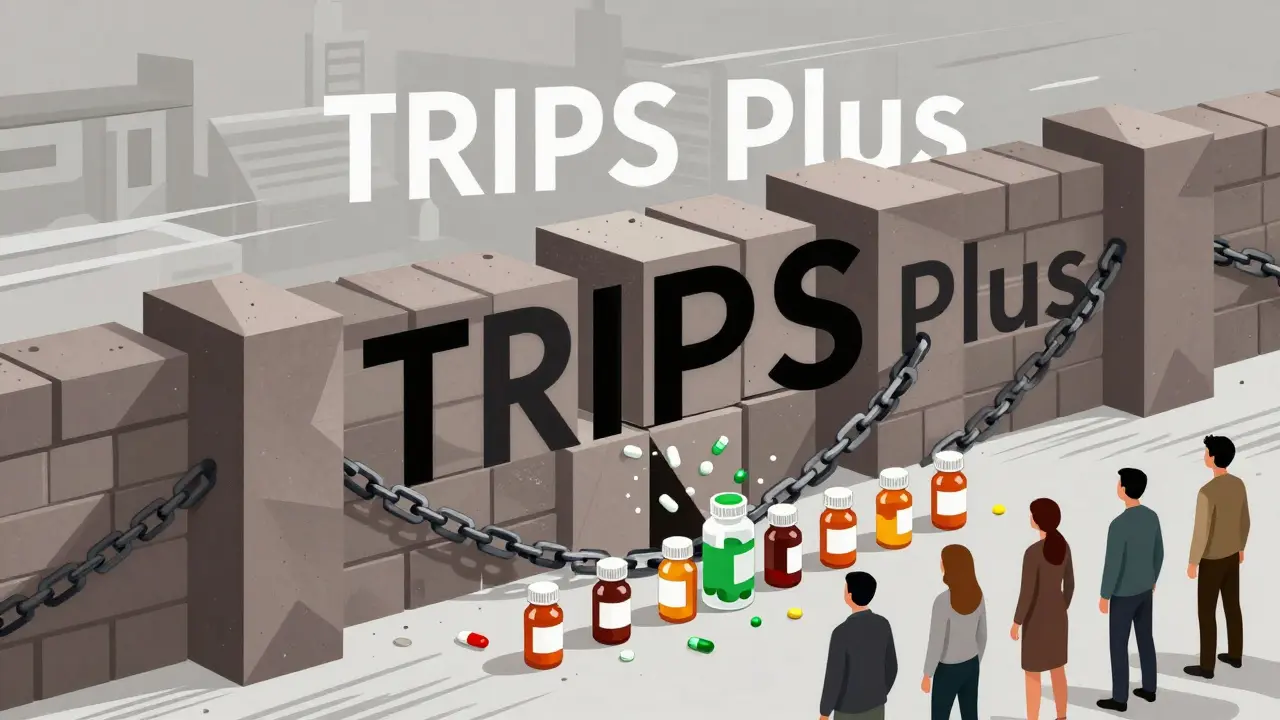
If TRIPS was tough, "TRIPS Plus" is tougher. Developed nations often push for stricter IP rules in bilateral free trade agreements. These provisions go beyond what TRIPS requires. Common TRIPS Plus features include:
- Patent Term Extensions: Adding time to patents to compensate for regulatory approval delays.
- Data Exclusivity: Banning regulators from relying on originator data for 5-10 years, regardless of patent status.
- Patent Linkage: Requiring drug regulators to check patent databases before approving generics, effectively giving patent holders veto power over generic entry.
By 2020, 85% of US free trade agreements contained such provisions. The EU-Vietnam Free Trade Agreement, for instance, established eight years of data exclusivity. These deals erode the flexibilities that TRIPS originally intended to preserve. A 2019 report by the Access to Medicine Foundation found that 65% of low-income countries reported delays in generic registration due to these extra-harmonized rules.

Recent Developments: The COVID-19 Waiver
The pandemic reignited the debate. In October 2020, India and South Africa proposed a waiver of certain TRIPS obligations for COVID-19 vaccines, diagnostics, and treatments. They argued that the crisis required unprecedented global cooperation and technology sharing. Over 100 countries supported this move. However, the EU, US, and Switzerland opposed it, fearing it would undermine the entire IP system.
In June 2022, the WTO reached a partial agreement. It waived liability for vaccine manufacturers supplying low- and middle-income countries. While a historic moment, critics argued it was too narrow and came too late. It excluded therapeutics and diagnostics, which remain crucial for managing the disease. This episode highlighted the fragility of the current system and the difficulty of achieving consensus on IP waivers.
The Role of Voluntary Licensing
Not all solutions come from conflict. The Medicines Patent Pool is a nonprofit organization that negotiates voluntary licenses with patent holders to promote generic competition. (MPP), established in 2010, offers a collaborative approach. The MPP negotiates with patent holders to license their technologies to generic manufacturers. As of 2022, the MPP had secured licenses for 16 HIV medicines, 6 hepatitis C medicines, and 4 tuberculosis medicines. This approach has reached 17.4 million patients in low- and middle-income countries. It shows that voluntary mechanisms can work, but they rely on the goodwill of patent holders and do not address the structural issues of the IP system.
Looking Ahead: Balancing the Scales
The future of global generics depends on how well countries can balance innovation incentives with access needs. MSF projects that without reform, TRIPS will continue to delay generic entry by 10-15 years in developing countries. Conversely, the IFPMA argues that stronger IP protection will boost R&D investment in emerging markets by 15-20% by 2030.
For policymakers, the challenge is clear. They must implement TRIPS-compliant laws while maximizing the use of flexibilities. This means building strong regulatory systems, investing in local manufacturing capacity, and resisting pressure to adopt TRIPS Plus provisions that unnecessarily restrict competition. For patients, the outcome determines whether medicine is a right or a privilege.
What is the main goal of the TRIPS Agreement?
The main goal of the TRIPS Agreement is to establish minimum standards for intellectual property protection globally. It aims to create a predictable environment for trade and innovation by requiring all WTO member states to enforce patents, copyrights, and trademarks in a consistent manner.
How does TRIPS affect the price of generic medicines?
TRIPS affects prices by extending patent monopolies. During the patent term, only the originator company can sell the drug, keeping prices high. Once the patent expires, generic competitors enter the market, typically reducing prices by 80-90%. However, provisions like data exclusivity can delay this competition, keeping prices elevated for longer.
What is compulsory licensing?
Compulsory licensing is a legal tool that allows a government to authorize a third party to produce a patented product without the consent of the patent holder. This is usually done in cases of national emergency, public health crisis, or anti-competitive practices. The patent holder is entitled to adequate remuneration, but the state prioritizes access over exclusive rights.
Why are "TRIPS Plus" provisions controversial?
TRIPS Plus provisions are controversial because they impose stricter IP requirements than the baseline TRIPS Agreement. These are often included in bilateral trade deals and can limit a country's ability to use public health flexibilities like compulsory licensing. Critics argue they undermine sovereignty and increase healthcare costs by delaying generic entry further.
Did the COVID-19 TRIPS waiver succeed?
The WTO reached a partial waiver in June 2022, focusing only on vaccine manufacturing and liability protection. It excluded therapeutics and diagnostics. While it marked a historic shift in consensus, many experts felt it was too limited and arrived too late to significantly impact vaccine equity during the peak of the pandemic. It remains a subject of ongoing debate for future health emergencies.
What role does India play in the global generic market?
India is known as the "pharmacy of the developing world." Before fully implementing product patents in 2005, India relied on process patents, allowing its industry to manufacture cheap generics. Even after adopting product patents, India maintained strict criteria for patentability (Section 3(d)), preventing evergreening. This has allowed Indian companies to supply affordable medicines for HIV, cancer, and other diseases globally.