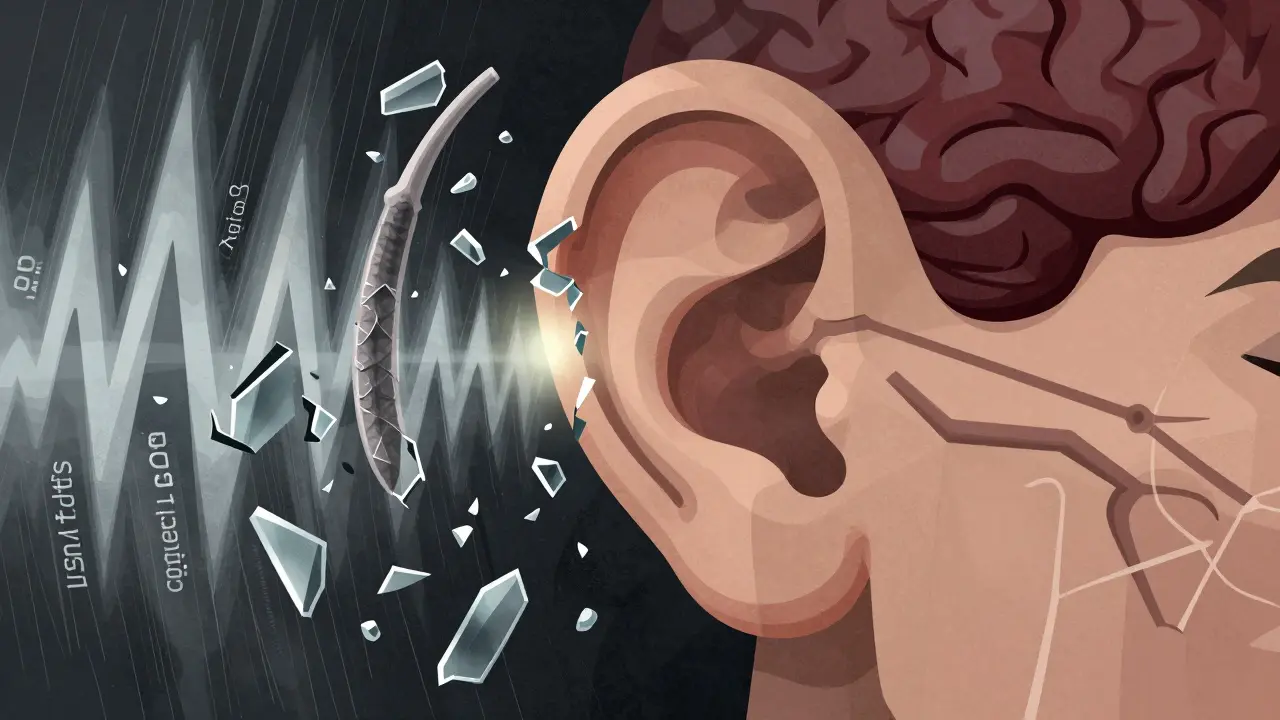
When you can hear the TV but not someone speaking right next to you, or when background noise turns a simple conversation into a puzzle, it’s not just frustration-it might be sensorineural hearing loss. This isn’t a temporary issue like earwax buildup or an ear infection. It’s damage deep inside your inner ear, often permanent, that changes how sound reaches your brain. And it’s more common than most people realize.
What Exactly Is Sensorineural Hearing Loss?
Sensorineural hearing loss (SNHL) happens when the tiny hair cells in your cochlea-the spiral-shaped part of your inner ear-or the auditory nerve that carries signals to your brain get damaged. These hair cells, called stereocilia, are like microscopic antennas. They move with sound vibrations and turn them into electrical signals your brain understands. Once they’re gone, they don’t grow back. That’s why SNHL is usually permanent.Unlike conductive hearing loss, which is caused by blockages in the ear canal or middle ear problems (like fluid or a perforated eardrum), SNHL isn’t fixable with surgery or medicine in most cases. It’s a neurological issue, not a mechanical one.
About 90% of all hearing loss cases that require hearing aids are sensorineural. It’s the most common type of hearing loss in adults, especially as people age.
Why Do the Hair Cells Die?
There are several reasons these delicate cells get damaged:- Noise exposure-Listening to loud music, power tools, or machinery over time. Damage starts at 85 decibels (about the level of heavy city traffic). After 8 hours at that volume, permanent harm can occur.
- Aging-Known as presbycusis, this is the #1 cause of SNHL. About 25% of Americans between 65 and 74 have it. By age 75, that number jumps to 50%.
- Genetics-Some people inherit a higher risk for early hearing loss.
- Medications-Certain antibiotics, chemotherapy drugs, and high-dose aspirin can be toxic to the inner ear.
- Illnesses-Diabetes, Meniere’s disease, and autoimmune disorders can attack the inner ear.
- Trauma-Head injuries or sudden pressure changes (like scuba diving accidents) can rupture inner ear structures.
Outer hair cells usually go first. These cells amplify quiet sounds. When they’re gone, you lose sensitivity to soft voices and high-pitched tones-like children’s voices, birdsong, or the letters “s” and “th” in speech.
What Does It Feel Like?
People with SNHL don’t just hear less-they hear differently.- You understand speech in quiet rooms but struggle in restaurants, family gatherings, or meetings.
- People seem to mumble-even when they’re speaking clearly.
- You hear ringing, buzzing, or hissing in your ears (tinnitus). Around 80% of people with SNHL experience this.
- Sounds might seem too loud or painfully sharp (a condition called recruitment).
- You might feel off-balance or dizzy, especially if the damage affects the vestibular system too.
A 2023 study from Mass Eye and Ear found that 87% of SNHL patients reported trouble following conversations with multiple people talking. That’s not just inconvenient-it’s isolating.
How Is It Diagnosed?
You can’t diagnose this yourself. You need a hearing test.An audiologist will do a pure-tone test, playing tones at different frequencies through headphones. They’ll also test bone conduction-sending sound through a device behind your ear that bypasses the outer and middle ear. If your bone conduction thresholds are normal but your air conduction (through the ear canal) are worse, that’s SNHL.
No air-bone gap? That’s the hallmark. If there’s a gap, it’s likely conductive. If not, the problem is inside the inner ear or nerve.
Can It Be Cured?
For most people, no. But there are two exceptions.Sudden sensorineural hearing loss (SSHL) is rare-only 5 to 20 cases per 100,000 people each year-but it’s an emergency. If you lose hearing suddenly, even over a few hours, see a doctor within 48 to 72 hours. Steroids (oral or injected into the ear) can help recover hearing in 32% to 65% of cases-if given fast. After two weeks, the chance of recovery drops sharply.
For chronic SNHL, there’s no pill, no shot, no surgery to restore the hair cells. Not yet. Researchers at Stanford are testing stem cell therapies to regrow them, but clinical use is still 5 to 10 years away.
What Are the Real Solutions?
Since you can’t fix the damage, you learn to work around it. The tools are better than ever.Hearing Aids
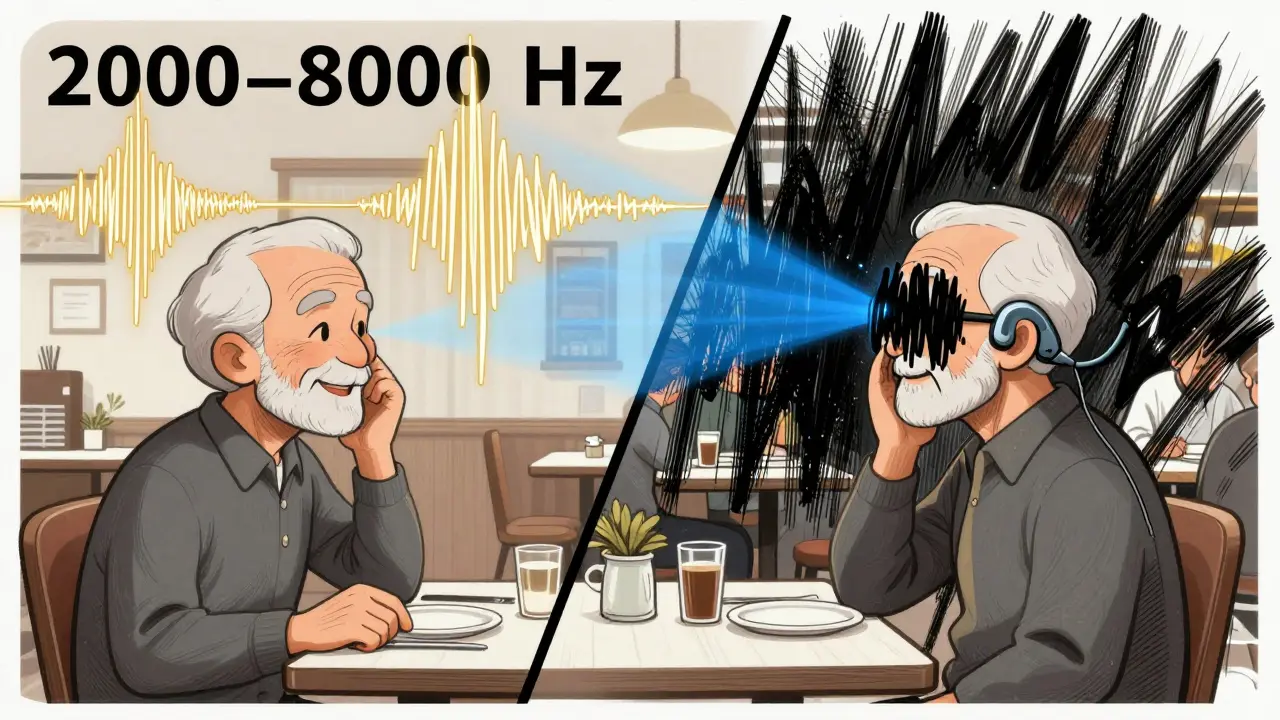
Modern digital hearing aids don’t just make everything louder-they’re smart. They can focus on speech in noise, reduce wind, and even adjust automatically when you walk from a quiet room to a busy street.They’re programmed to match your specific hearing loss. If you struggle with high pitches (common in age-related SNHL), the device boosts frequencies between 2,000 and 8,000 Hz. Many users report 78% improvement in speech clarity.
But they’re not perfect. In noisy places, they only improve understanding by 30% to 50%. That’s why many people still feel left out at parties or family dinners.
Brands like Widex Moment and Phonak Paradise get high ratings for natural sound. Costco’s Kirkland Signature models are popular for affordability, averaging $1,500 per pair without insurance. But most hearing aids cost $2,500 to $7,000 per pair. That’s a huge barrier.
Cochlear Implants
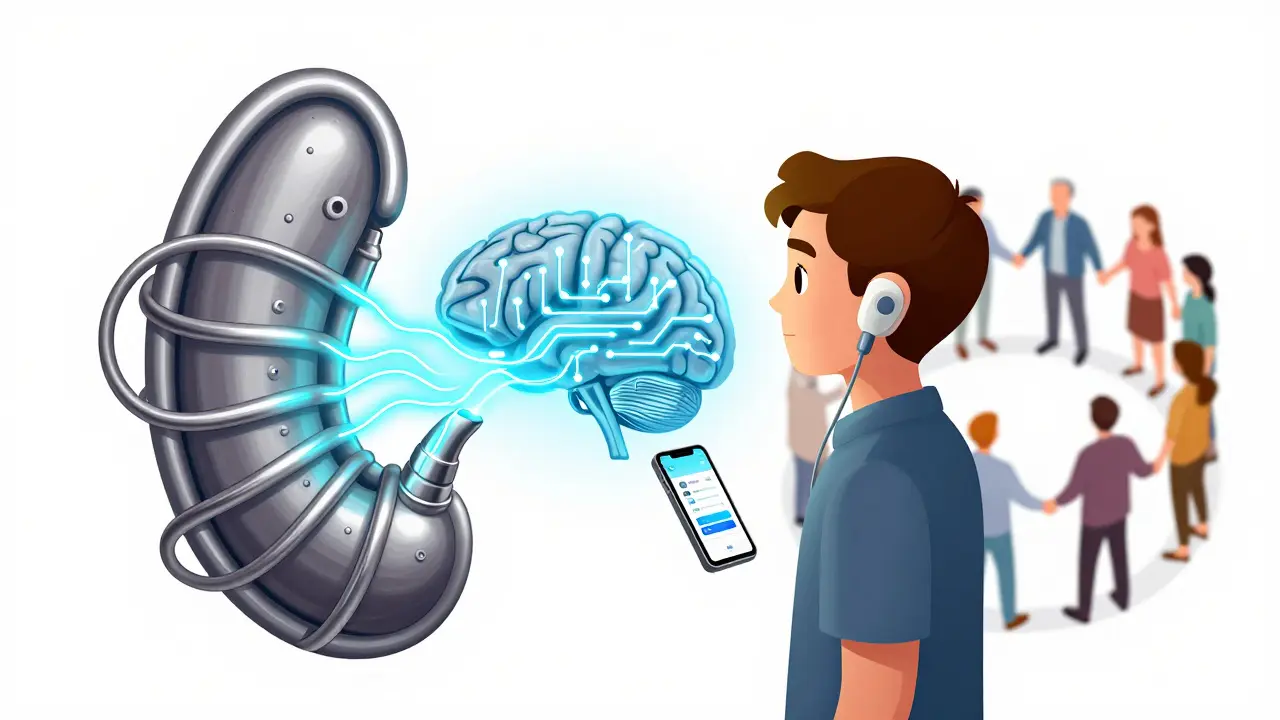
If your hearing loss is severe to profound-pure-tone averages above 90 dB-you may be a candidate for a cochlear implant.This device bypasses the damaged hair cells entirely. A surgeon places an electrode array into your cochlea. An external processor picks up sound and sends electrical signals directly to your auditory nerve.
82% of recipients can understand speech without lip-reading. But it’s not magic. It takes months of rehab. Your brain has to relearn how to interpret these new signals. Some users describe the first activation as overwhelming-every sound feels too loud, even footsteps or a refrigerator humming. It takes 6 to 12 months to adapt fully.
What Helps Beyond Devices?
Technology helps, but so do habits and support.- Use captioning on TV and videos.
- Ask people to face you when they speak.
- Choose quiet spots in restaurants.
- Use apps like Bose Hearing Aid (FDA-approved) to adjust settings on your phone.
Support groups matter. The Hearing Loss Association of America (HLAA) has over 300 local chapters and runs workshops that help 15,000 people a year. Many users say talking to others who “get it” reduces the loneliness that comes with hearing loss.
Why So Few People Get Help?
Only 16% to 20% of adults in the U.S. who need hearing aids actually use them. Why?- Cost-Most insurance doesn’t cover them. Medicare doesn’t. Even with discounts, $3,000 to $6,000 is a lot for a device that needs replacing every 5 to 7 years.
- Stigma-People still associate hearing aids with old age or weakness.
- Delayed diagnosis-Many wait years before getting tested, thinking it’s just “getting older.”
The 2017 Over-the-Counter Hearing Aid Act helped. Now, you can buy basic hearing aids without a prescription-ideal for mild to moderate SNHL. Companies like Eargo and Lively are growing fast, with 8% of the market share since 2019.
What’s Next?
The future isn’t just better hearing aids. It’s integration.By 2027, the global hearing aid market is expected to hit $11.3 billion. Devices are getting smaller, smarter, and more connected. New models can track heart rate, detect falls, and even monitor cognitive load-all through your hearing aid.
Researchers are still chasing the holy grail: regenerating hair cells. Stem cells, gene therapy, and regenerative drugs are in early trials. But even if a cure comes, it won’t help millions who already lost their hearing.
Right now, the best thing you can do is act early. If you’re noticing trouble with speech in noise, ringing in your ears, or feeling like people are mumbling, get tested. Don’t wait. The sooner you use the tools available, the better your quality of life will be.
Permanent doesn’t mean powerless. With the right support, technology, and mindset, you can still hear what matters most-your loved ones, your favorite music, the sound of your own voice.
Can sensorineural hearing loss be reversed?
In most cases, no. Once the hair cells in the inner ear are damaged, they don’t regenerate. The only exception is sudden sensorineural hearing loss (SSHL), which can sometimes be reversed if treated with steroids within 48 to 72 hours. For chronic SNHL, the damage is permanent, but hearing aids and cochlear implants can restore function.
Are hearing aids the only option for sensorineural hearing loss?
No. For mild to moderate SNHL, hearing aids are the first step. For severe to profound loss, cochlear implants are often more effective. There are also assistive listening devices, captioning, and apps that help with speech clarity. The key is matching the tool to the severity and lifestyle needs.
Why do I hear better in quiet rooms but not in noisy places?
Sensorineural hearing loss often affects your ability to pick out speech from background noise. Your inner ear loses sensitivity to high frequencies, which carry consonants like “s,” “t,” and “k.” In quiet rooms, your brain can fill in the gaps. In noisy places, competing sounds overwhelm your ability to separate speech from the rest.
Can loud music cause permanent hearing loss?
Yes. Exposure to sounds above 85 decibels for 8 hours or more can cause permanent damage. A concert can hit 110-120 decibels. Even short exposure at that level can harm hair cells. Using earplugs at concerts or lowering volume on headphones helps prevent this.
How do I know if I need a cochlear implant?
If your hearing test shows you can’t understand speech even with powerful hearing aids-especially if your pure-tone average is above 90 dB-you may be a candidate. A specialist will evaluate your hearing history, speech recognition scores, and overall health. Cochlear implants are not for everyone, but they can restore speech understanding in severe cases where hearing aids no longer help.
Is sensorineural hearing loss hereditary?
Yes, genetics play a role. Some people inherit gene mutations that make their inner ear more vulnerable to damage from noise or aging. If multiple family members have hearing loss, especially at a young age, it’s worth discussing with a genetic counselor or audiologist.
What Should You Do Next?
If you suspect sensorineural hearing loss:- Get a hearing test from an audiologist-no referral needed.
- Don’t wait. Early intervention improves outcomes with hearing aids and rehab.
- Explore options: hearing aids, OTC devices, or cochlear implants if needed.
- Connect with support groups. You’re not alone.
- Protect your other ear. Use ear protection in loud environments.
The goal isn’t to restore perfect hearing. It’s to reconnect-with your family, your work, your life. And that’s possible, even with permanent damage.




blackbelt security January 25, 2026
Just got my first pair of hearing aids last month. Life changed. My kid’s laugh? Clear again. Coffee shop chatter? Not a blur anymore. I used to fake nodding through dinners. Now I actually hear my wife tell me to take out the trash. Worth every penny.
Don’t wait till you’re drowning in silence. Get tested.
Patrick Gornik January 26, 2026
Let’s be real-this whole ‘permanent damage’ narrative is a corporate psyop. Hair cells don’t regenerate? Says who? The same pharmaceutical cartels that profit off $6K hearing aids and cochlear implants that ‘retrain your brain’ like it’s some kind of glitchy Android update.
Meanwhile, in 1978, a Soviet neurologist published a paper on endogenous cochlear stem cell activation using low-frequency vibrational therapy. Buried. Suppressed. Classified under ‘audiological heresy.’
We’re not victims of biology-we’re victims of capitalism’s refusal to let us hear the truth. Literally.
Tommy Sandri January 28, 2026
While the article provides a clinically accurate overview of sensorineural hearing loss, it is worth noting that the socioeconomic barriers to intervention remain under-addressed. In many developing nations, access to audiological services is limited by infrastructure, cost, and cultural stigma. The global disparity in hearing healthcare access is not merely a technical issue-it is a public health equity crisis.
Further research into scalable, low-cost diagnostic tools and community-based rehabilitation models is urgently needed.
Luke Davidson January 28, 2026
I never thought I’d say this but… my hearing aids are my favorite tech gadget. Seriously. They auto-adjust when I walk into my noisy office, they sync with my phone so Zoom calls don’t feel like underwater Morse code, and they even remind me to drink water because dehydration makes tinnitus worse (who knew?).
And yeah, they’re expensive-but think of it like glasses for your ears. You wouldn’t skip an eye exam because you’re scared of buying contacts, right?
Also, if you’re reading this and you think you’re just ‘getting old’-please go get tested. You’re not alone, and you don’t have to suffer in silence. I promise, it gets better.
Karen Conlin January 30, 2026
My mom lost her hearing slowly-over 10 years. We thought she was just being stubborn. Turns out she was terrified of being labeled ‘old’ or ‘broken.’ She hid her hearing loss like it was a secret shame.
When she finally got hearing aids? She cried. Not from sadness-from relief. She heard her grandson say ‘I love you’ for the first time without having to ask him to repeat it five times.
Stop waiting for ‘perfect’ solutions. Start with what works. Get tested. Get help. Your family deserves to hear you too.
asa MNG January 31, 2026
ok so i just got my hearing aids and they sound like a robot narrating a documentary in a tin can?? like wtf??
also why does my fridge sound like a jet engine??
and why does my wife sound like she’s talking through a kazoo??
pls help im crying in my earbuds 🤯😭🎧
Sushrita Chakraborty February 2, 2026
While the article is comprehensive, it overlooks the cultural dimension of hearing loss in non-Western societies. In India, for instance, hearing impairment is often attributed to karma or divine will, leading to delayed medical intervention. Furthermore, the stigma associated with hearing aids is amplified by the association of assistive devices with disability rather than with technological empowerment.
Community education, culturally adapted awareness campaigns, and integration of audiological services into primary healthcare systems are critical steps toward equitable access.
Shanta Blank February 3, 2026
Ugh. I hate how everyone’s acting like hearing loss is just some ‘quirk’ you can fix with a $5K gadget. It’s not a lifestyle upgrade. It’s a slow, silent death of connection.
I used to be the life of the party. Now I sit in the corner, smiling like a mannequin while everyone laughs at jokes I didn’t hear. My friends say ‘it’s just age’-but they don’t see me crying in the bathroom after Thanksgiving dinner.
And don’t even get me started on how hearing aids make me look like a 1980s tech nerd. I’d rather be deaf than wear those ugly beige shells.
Why can’t we just… fix this? Like, for real?
Vatsal Patel February 4, 2026
Oh, so now we’re supposed to believe that evolution didn’t design us to survive loud cities and earbuds at 100% volume? What a shock.
You think your cochlear implant is ‘advanced’? It’s just a glorified speaker jammed into your skull. The real problem? We stopped listening to silence. Now we’re paying the price with our ears and our souls.
Maybe the cure isn’t in labs-it’s in turning off the noise.
Kat Peterson February 6, 2026
Okay but like… hearing aids are so unglamorous. I mean, I’d rather be the mysterious quiet girl who never says much than the woman with the beige ear-bud that beeps when she sneezes. 😩
And why do they all look like they were designed by someone who hates beauty? Can’t we have one that’s like… rose gold? With a tiny diamond? I’ll pay double.
Also, why is everyone so obsessed with ‘recovery’? I’m not broken. I’m just… selectively tuned.
✨ #HearingLossIsAesthetic ✨
Himanshu Singh February 6, 2026
I lost my hearing after a fever at 12. Grew up in rural India with no access to testing. Learned to read lips, write notes, and live in silence.
At 34, I got my first hearing aid. First time I heard rain on the roof. First time I heard my daughter’s giggle without guessing.
You don’t need to be fixed. You just need to be heard.
And if you’re reading this and you’re scared? I was too. But I’m here. So are you.
❤️