If you've ever looked at a skincare shelf and felt overwhelmed by the word "retinoid," you're not alone. These powerhouse ingredients are the gold standard for clearing acne and erasing fine lines, but they aren't all created equal. Picking the wrong one can lead to a face that feels like a sandpaper desert, while the right one can literally transform your skin's texture. The real challenge is deciding between the heavy hitter-Tretinoin is a potent first-generation retinoid derived from vitamin A, used to treat severe acne and photoaging-and the gentler, more modern Adapalene, a third-generation synthetic retinoid specifically designed for acne with a lower irritation profile.
Depending on whether you're fighting stubborn breakouts or trying to reverse a decade of sun damage, your choice will change your results. Most people expect a miracle overnight, but the reality is a learning curve called "retinization." If you don't know how to navigate the first six weeks of peeling and purging, you'll likely quit before the magic happens. Here is exactly how these two work and how to choose the one that fits your skin type.
The Core Difference: Power vs. Precision
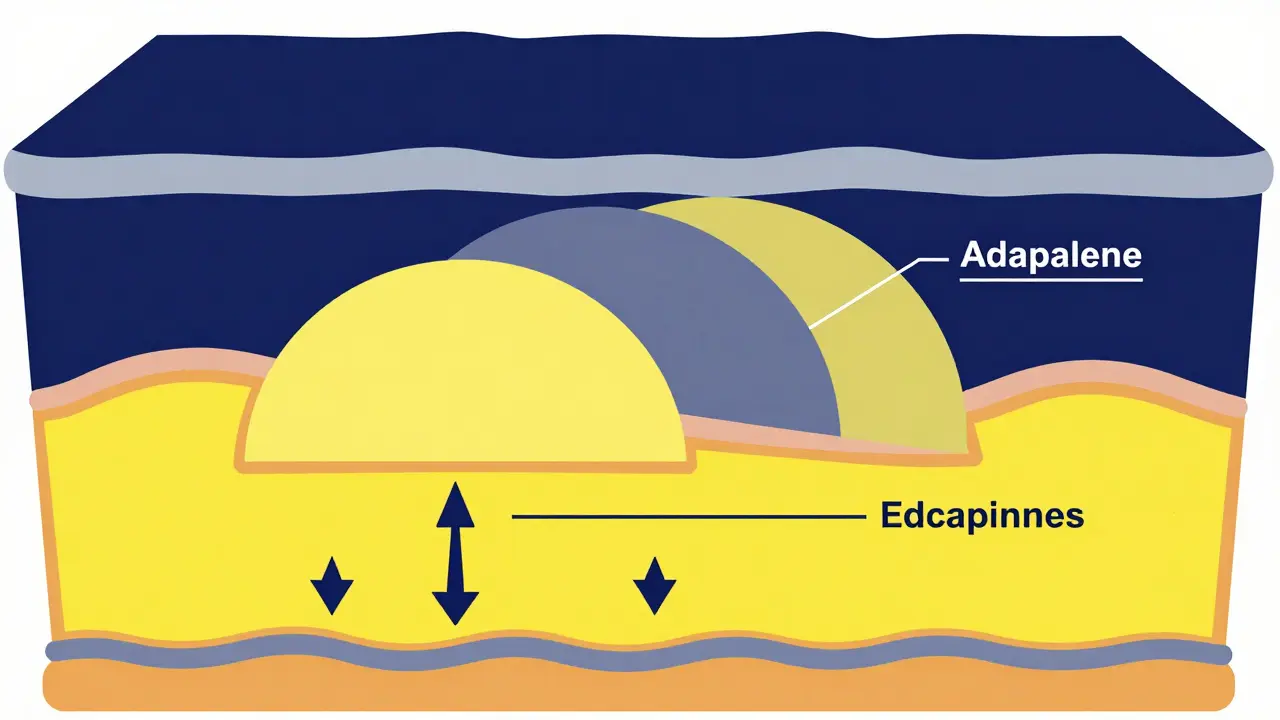
Tretinoin is essentially the "original" prescription strength retinoid. It is a carboxylic acid form of vitamin A that binds to multiple retinoic acid receptors in your skin. Because it works on both the surface and the deeper dermal layers, it is incredibly effective at remodeling collagen and fading deep wrinkles. However, this broad-spectrum power comes with a price: it is notoriously unstable. Tretinoin degrades quickly when exposed to air or UV light, which is why you only ever apply it at night.
Adapalene takes a different approach. As a naphthoic acid derivative, it is chemically more stable and more selective. Instead of hitting every receptor, it targets specific ones, primarily in the epidermal layer. This precision makes it much kinder to sensitive skin. Unlike its predecessor, Adapalene doesn't break down in the sun, meaning it can be safely combined with other acne fighters like benzoyl peroxide without losing its punch.
| Feature | Tretinoin | Adapalene |
|---|---|---|
| Primary Use | Severe acne & Photoaging | Mild to moderate acne |
| Stability | Low (Light/Air sensitive) | High (Stable) |
| Irritation Level | High (Scaling, stinging) | Low to Moderate |
| Availability | Prescription Only | OTC (0.1%) & Prescription (0.3%) |
| Dermal Depth | Surface & Deep Layers | Primarily Epidermal |
Choosing Based on Your Skin Goals
If your primary goal is clearing acne, Adapalene is often the smarter starting point. Clinical data shows that 0.1% Adapalene can reduce acne lesions by up to 74% after eight weeks. While Tretinoin is technically just as effective for breakouts, it causes significantly more redness and peeling. For someone with sensitive skin, the "purge"-that period where your skin pushes out trapped gunk and breaks out more before getting better-is usually shorter and less intense with Adapalene.
However, if you are over 35 and your main concern is "photoaging" (sun damage, fine lines, and mottled pigmentation), Tretinoin is the undisputed king. It outperforms Adapalene in deep dermal remodeling. One double-blind study showed that 0.05% Tretinoin cream improved fine wrinkles by 42% over 24 weeks, whereas Adapalene 0.3% only hit 35%. If you have deep-set lines, Adapalene's surface-level action simply won't be enough to trigger the collagen production you need.
Managing the "Retinization" Period
The biggest reason people fail with Retinoid Therapy is that they treat it like a standard moisturizer. It isn't. When you first start, your skin goes through a phase of increased cell turnover that can cause dryness, flaking, and stinging. To survive this, you need a strategy. The "sandwich method" is a lifesaver here: apply a thin layer of moisturizer, then your retinoid, then another layer of moisturizer. This buffers the active ingredient, reducing irritation by nearly 50% without killing the results.
You also have to respect the "pea-sized rule." Using more product won't make you get results faster; it will just burn your skin barrier. Start slowly-two or three nights a week-and gradually increase the frequency over two months. If you jump straight into nightly use, you're likely to end up with a chemical burn rather than a glow.
Crucial Safety and Side Effects
There is one non-negotiable rule with any retinoid: you must use a broad-spectrum SPF 30+ every single day. Retinoids make your skin significantly more photosensitive. If you skip sunscreen, you aren't just risking a sunburn; you're potentially causing more hyperpigmentation and damage than the medication is fixing. Research shows that users who neglect SPF experience over three times more adverse events.
Another critical warning involves pregnancy. Both Tretinoin and Adapalene are classified as Category C medications, meaning they should not be used during pregnancy. If you're planning to conceive or are currently pregnant, you must stop these treatments immediately and consult your doctor. The risk of fetal harm is why prescriptions always require a confirmation of contraception or a negative pregnancy test.
Advanced Formulations and Future Options
The gap between "powerful but irritating" and "gentle but slow" is closing thanks to new delivery systems. For those who find standard Tretinoin too harsh, micronized versions like Altreno (0.05% tretinoin lotion) have entered the market. These formulations release the drug more slowly, maintaining the anti-aging power of Tretinoin while mimicking the tolerability of Adapalene.
We are also seeing the rise of combination therapies. Products like Epiduo combine Adapalene with benzoyl peroxide. This creates a dual attack: the benzoyl peroxide kills acne-causing bacteria, while the Adapalene unclogs pores. This combination has shown significantly higher acne clearance rates than using Adapalene alone, making it a powerhouse for inflammatory acne.
How long does it take to see results?
Patience is key. While some people see a glow early on, significant clinical improvement typically takes 8 to 12 weeks. For anti-aging and deep wrinkles, you may need 6 to 12 months of consistent use to see a dramatic difference in skin elasticity and pigmentation.
Can I use Adapalene if I have sensitive skin?
Yes, Adapalene is generally the best choice for sensitive skin because it is more selective in which receptors it binds to and is less likely to cause the intense erythema (redness) and scaling associated with Tretinoin.
What is the "purge" and is it normal?
The purge is a temporary increase in breakouts that happens as the retinoid speeds up cell turnover, pushing existing clogs to the surface faster. It usually lasts 2 to 6 weeks. If breakouts continue beyond 8 weeks or occur in areas where you never usually get acne, you may be reacting poorly to the product.
Can I use these with Vitamin C?
Yes, but don't apply them at the same time. Use your Vitamin C serum in the morning to protect against free radicals and apply your retinoid at night. Using both at once can destabilize the ingredients and severely irritate your skin.
Do I really need a prescription for Tretinoin?
In most regions, yes. Tretinoin is a prescription-only medication because of its potency and the need for medical supervision to manage side effects. Adapalene 0.1% is available over-the-counter as a safer, accessible alternative for those who don't want to see a doctor first.
Next Steps for Your Skin Journey
If you're a total beginner with sensitive skin or just want to clear up some breakouts, start with 0.1% Adapalene. It's available over-the-counter and provides a gentle introduction to retinoids without the high risk of a "skin meltdown." Focus on the sandwich method and daily SPF for the first three months.
If you've already tried Adapalene and felt you hit a plateau, or if your main goal is erasing sun spots and wrinkles, it's time to visit a dermatologist for a Tretinoin prescription. Ask about micronized formulations or the 0.025% starting strength to avoid the worst of the peeling. Remember, the goal isn't to achieve the fastest result, but the most sustainable one. Slow and steady wins the glow.







Catherine Mailum April 16, 2026
oh sure because we all just love peeling like a cheap sticker for six weeks lol
Tabatha Pugh April 16, 2026
Actually, the 0.1% Adapalene is only effective for a very specific type of comedonal acne. If you're dealing with cystic issues, you're wasting your time with OTC stuff. I've seen enough clinical trials to know that the receptor affinity is just not there compared to Tretinoin, and frankly, most people don't even know how to properly prep their skin barrier before introducing an acid.
Jasmin Stowers April 17, 2026
agree with the spf part
Mary Johnson April 19, 2026
It's funny how they push these 'pharmaceutical' solutions when they really just want us addicted to expensive chemicals that thin our skin so we have to buy more products to 'repair' it. Have you noticed how these prescriptions always coincide with new legislation? It's a cycle designed to drain your wallet while you're too busy worrying about a 'purge' to see the bigger picture of what's actually being put into your bloodstream.
Clint Humphreys April 20, 2026
Now, while I completely agree with the chemical instability of Tretinoin mentioned here, we have to wonder why the medical establishment prefers the higher-irritation route for older patients. It feels like a calculated move to keep people in a loop of dermatological visits, which is honestly quite fascinating if you analyze the profit margins of the clinics that push the 0.05% cream over the safer synthetic alternatives that might actually work more sustainably without destroying the stratum corneum.
Rim Linda April 20, 2026
OMG my skin literally exploded when I tried Tret!!! 😱 I thought I was dying!!!
Princess Busaco April 20, 2026
I simply cannot believe some of you are actually falling for the 'sandwich method' as if it doesn't fundamentally alter the pharmacokinetic delivery of the active ingredient to the receptors, which frankly makes the entire process a redundant exercise in vanity if you aren't even willing to brave a little peeling for the sake of actual results, and honestly, the obsession with 'gentle' skincare is just a symptom of a generation that can't handle a single flake of dry skin without having a complete emotional meltdown over it.
Olivia Lo April 21, 2026
The discourse here is quite polarized. We must consider the epidermal homeostasis and how the selective binding of Adapalene serves as a pragmatic approach to therapeutic intervention without inducing excessive systemic inflammation, though the assertive push toward Tretinoin for photoaging is logically sound given the collagen synthesis parameters.
Shaylia Helland April 23, 2026
i remember reading about how different cultures approach these ingredients and it's always so interesting how some people just use natural oils and end up with amazing skin while we're over here stressing about which synthetic acid will burn our faces off the least amount of time... it really makes you think about the beauty standards we've been conditioned to follow in the west
john chiong April 25, 2026
stop treating your face like a science experiment and just use a damn moisturizer you cowards
melissa mac April 25, 2026
If you're feeling overwhelmed, just remember that everyone's skin is different and it's okay to take it slow. Whatever you choose, just be kind to yourself during the process!