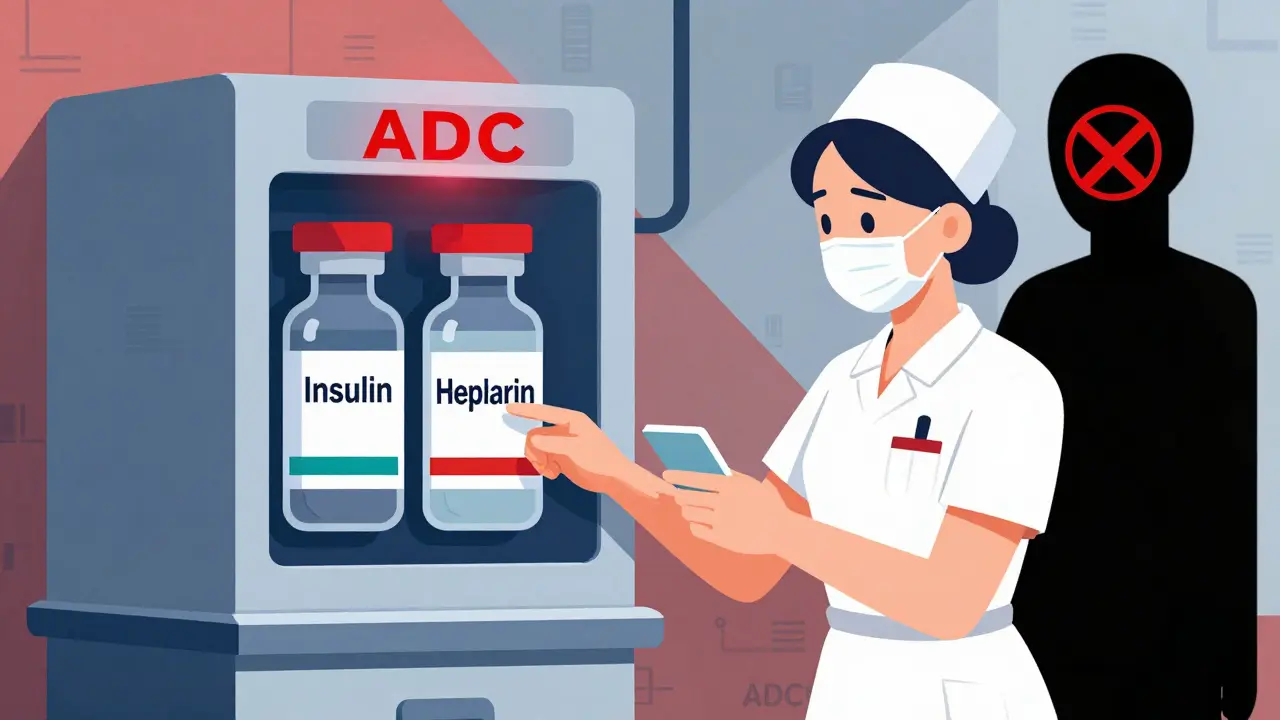
Automated Dispensing Cabinets (ADCs) are meant to make medication delivery faster and safer in clinics and hospitals. But they don’t automatically prevent errors. In fact, if used wrong, they can make mistakes more likely. A 2022 study found that in six out of seven nursing units, ADCs led to a 30% or higher increase in medication errors-not because the machines failed, but because the people using them weren’t trained properly or the cabinets were set up poorly.
What Exactly Is an Automated Dispensing Cabinet?
An Automated Dispensing Cabinet (ADC) is a locked, computer-controlled device that stores medications at the point of care-like a nurse’s station or ICU bay. Instead of walking to the pharmacy for every pill, nurses pull medications directly from the cabinet after scanning their badge and a patient’s barcode. Popular models include BD Pyxis MedStation, Omnicell XT, and Capsa Healthcare’s NexsysADC. These systems track every pill taken, who took it, and when. They’re connected to the hospital’s electronic health record (EHR) and pharmacy system, so they can flag dangerous drug interactions or wrong doses before they’re given.But here’s the catch: ADCs only work as well as the rules around them. If you don’t configure them right, or if staff skip steps, the system becomes a liability. The Institute for Safe Medication Practices (ISMP) says ADCs are not safety tools by default-they’re safety tools only when designed and managed with care.
Why ADCs Can Increase Errors Instead of Reducing Them
It sounds backward, but it’s true. A 2019 study from Johns Hopkins showed that after installing ADCs, medication administration timing errors dropped by 27%. But another study, published by the National Center for Biotechnology Information, found that in some units, error rates went up by over 30%. Why?- Overriding safety checks: Nurses can bypass alerts if they press “override.” In facilities with no limits on overrides, error rates jump 2.3 times higher. One nurse on Reddit shared how she once scanned fentanyl instead of naloxone because the two were placed side by side in the cabinet-she caught it just in time.
- Look-alike, sound-alike drugs: If insulin and heparin are stored next to each other, and the barcode labels are similar, it’s easy to grab the wrong one. The ISMP recommends placing these drugs far apart and using color-coded labels.
- Bad ergonomics: If the cabinet is too high, too low, or too cluttered, nurses have to twist, reach, or rush. A 2022 ASHP survey found 31% of pharmacists reported physical strain from using ADCs daily.
- No pharmacist review: If the ADC isn’t linked to a pharmacy system that checks each order before it’s dispensed, nurses get no warning about allergies, duplicate prescriptions, or dangerous doses. This is one of the biggest reasons ADCs fail.
The 9 Core Safety Rules from ISMP (2019 Guidelines)
The Institute for Safe Medication Practices laid out nine non-negotiable safety steps for ADC use. These aren’t suggestions-they’re the baseline for preventing harm. If your clinic isn’t following all of them, you’re at risk.- Environmental setup: Place cabinets away from heat sources, sunlight, and high-traffic areas. Don’t put them next to computer monitors-heat can damage medications.
- Access control: Only licensed staff should be able to access the cabinet. Use biometric scans or PINs, not just ID badges.
- Medication configuration: Only approved medications should be loaded. No random drugs. Every drug must be pre-approved by pharmacy.
- Barcode scanning: Every medication added to the cabinet must be scanned with a patient- and drug-specific barcode. Every dose pulled must be scanned against the patient’s wristband.
- Temperature control: Refrigerated meds (like insulin or certain antibiotics) must be stored in temperature-monitored compartments with clear beyond-use dates labeled on each vial.
- Override limits: Override functions must be restricted. Only allow overrides for specific drugs on specific units. Document why the override happened. Require a second staff member to witness the override.
- Drug placement: Keep look-alike/sound-alike drugs (like morphine and hydromorphone) far apart. Use color-coded bins or physical barriers.
- Training and competency: Every nurse and pharmacist must complete a 4-6 week training program before using the ADC. Test them on real scenarios-not just a PowerPoint.
- Regular audits: Pharmacy staff must review ADC logs weekly. Look for override patterns, incorrect restocking, or delays in restocking high-risk meds.
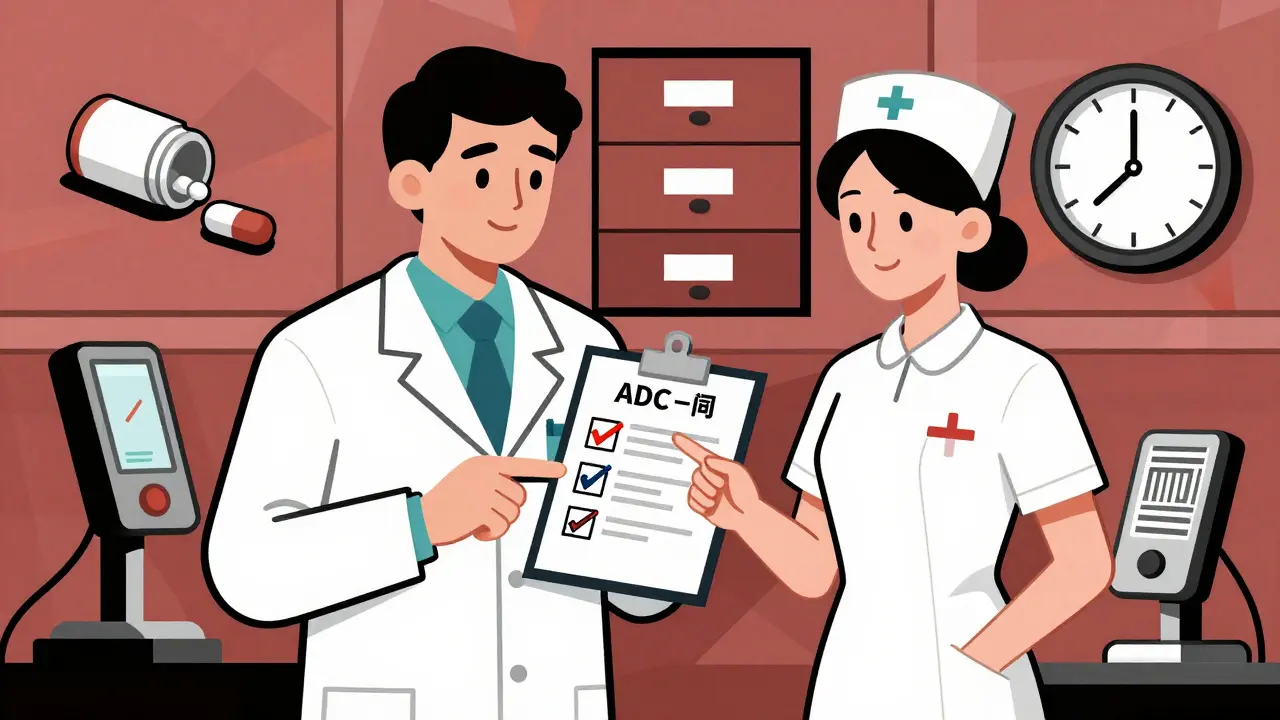
How to Set Up an ADC Right (Step-by-Step)
Starting an ADC program isn’t just buying a machine. It’s redesigning your medication workflow. Here’s how to do it right:- Form a team: Get pharmacists, nurses, IT staff, and infection control on the same page. No single department should decide this alone.
- Map your workflow: Walk through how meds move from pharmacy to patient. Where do errors happen now? Use that to design cabinet layout and access rules.
- Configure the cabinet: Work with the vendor to set up drug limits, override rules, and temperature zones. Don’t accept default settings.
- Label everything: Every drawer, every vial, every barcode must be clear. Use large fonts, color coding, and dual labeling for high-risk drugs.
- Train with real cases: Don’t just show the screen. Give nurses a scenario: “Your patient needs insulin. The cabinet shows two vials. Which one do you pick?”
- Start small: Pilot the system on one unit first-say, the cardiac floor. Fix problems there before rolling out to the whole hospital.
- Monitor and adjust: Track override rates, restocking errors, and near-misses. If override use spikes in one unit, investigate why.
Top 3 Mistakes Clinics Make (And How to Avoid Them)
- Mistake: Letting nurses override alerts without reason
Fix: Create a unit-specific override list. Only allow overrides for drugs like pain meds or sedatives in emergencies. Require a second person to witness every override. Document the reason in the EHR. - Mistake: Not linking to pharmacy review
Fix: Make sure the ADC talks to your pharmacy system. If it doesn’t, you’re missing alerts for allergies, interactions, and duplicate orders. This is non-negotiable. - Mistake: Ignoring restocking errors
Fix: Have pharmacy staff check restocking every shift. If someone puts 100 mg of metoprolol into a drawer meant for 5 mg, it’s a disaster waiting to happen. Use barcode scanning for restocking too.
What Happens When ADCs Are Done Right?
At Mayo Clinic, they created unit-specific override lists and reduced override-related errors by 63% in critical care units. At Johns Hopkins, medication administration timing errors dropped by 27%. At a VA hospital in 2021, wrong-drug errors fell by 41% after they moved look-alike drugs apart and required dual verification for opioids.The data is clear: when ADCs are set up with safety as the priority, they cut errors by 35-50%. But when they’re treated like a vending machine, they become a source of risk.
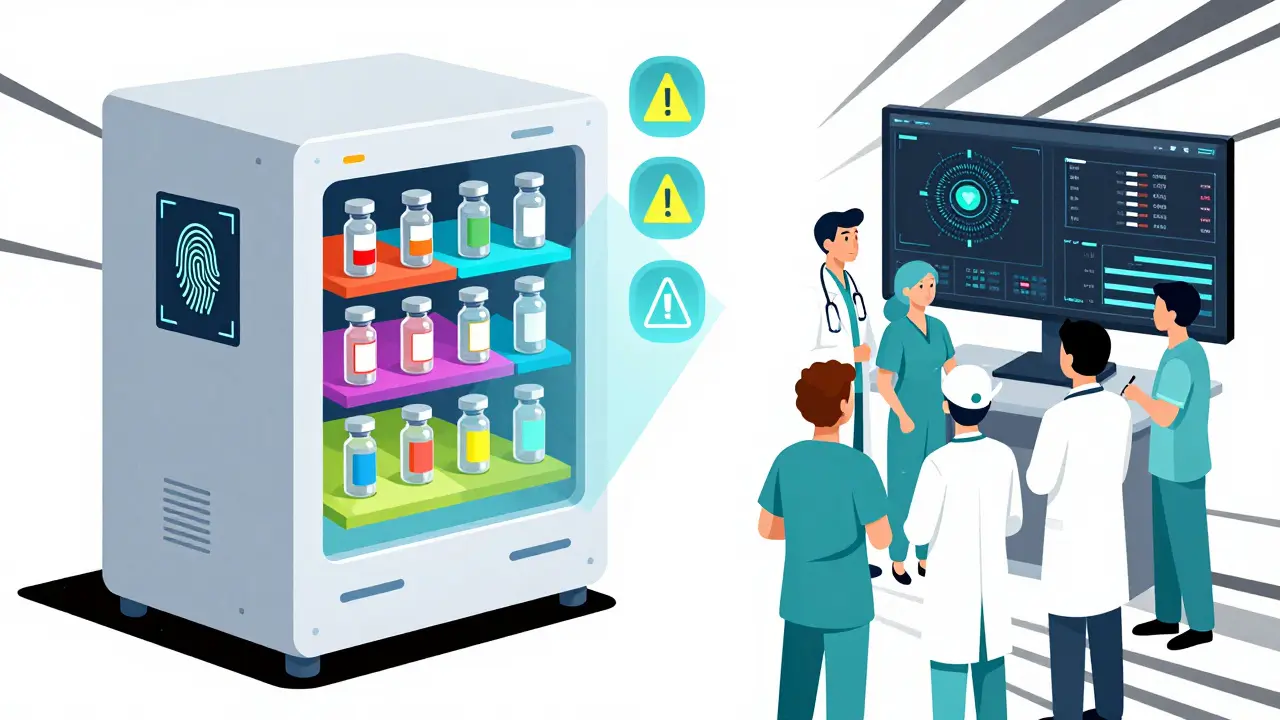
What to Look for in a Vendor
The market is dominated by three players: Omnicell (42% share), BD Pyxis (38%), and Capsa Healthcare (12%). But don’t just pick the cheapest one.- Integration: Does it connect to your EHR via HL7 or FHIR? If not, skip it.
- Override controls: Can you lock down override quantities? Can you require witness signatures?
- Support: Omnicell’s support responds to critical issues in 2.1 hours on average. Smaller vendors? Often over 6 hours.
- Training: Does the vendor offer hands-on training with real clinical scenarios? Or just a 30-minute video?
Price ranges from $15,000 for a small countertop unit to $45,000 for a full-size cabinet. But the real cost isn’t the machine-it’s the cost of a single wrong dose. One insulin error can kill a patient. That’s why spending on setup and training isn’t an expense-it’s insurance.
Future Trends in ADC Technology
The next few years will bring big changes:- AI-powered diversion detection: Omnicell’s new system can spot unusual patterns-like a nurse taking 10 doses of fentanyl in 20 minutes-and flag them without false alarms.
- Biometric access: BD Pyxis plans to roll out fingerprint and facial recognition by 2025 to replace PINs and badges.
- Voice commands: Omnicell is testing voice-activated dispensing for hands-free use during emergencies.
- Real-time EHR sync: By 2026, 78% of ADCs will use FHIR standards to pull live patient data-like weight, kidney function, or recent labs-to auto-adjust dose limits.
These features help-but they won’t fix bad habits. Technology can’t replace good training, clear rules, and a culture that puts safety over speed.
Final Thought: It’s Not the Machine. It’s the Mindset.
Automated Dispensing Cabinets are powerful. But they’re not magic. They don’t prevent errors-they just give you a better chance to catch them. The real safety tool is the team that uses them. If your staff sees the ADC as a time-saver, they’ll cut corners. If they see it as a safety net, they’ll use it right.Start with the ISMP guidelines. Train like your life depends on it-because it does. And never, ever skip the override documentation.
Can nurses override ADC alerts without approval?
Yes, but they shouldn’t. Most ADCs allow overrides for emergencies, but without controls, this becomes dangerous. Best practice requires a second licensed provider to witness the override, document the reason, and limit the number of overrideable drugs per unit. Facilities with unrestricted overrides have 2.3 times more errors.
Do ADCs reduce medication errors?
They can-by 35-50%-but only if configured and managed correctly. Studies show that in poorly set-up systems, error rates increase by 30% or more. The key is linking the ADC to pharmacy review systems, limiting overrides, placing look-alike drugs apart, and training staff thoroughly.
What’s the most common cause of ADC-related errors?
The most common cause is poor configuration-especially placing similar-looking or sounding drugs next to each other, and allowing unrestricted override access. Other top causes include skipping barcode scans during restocking and not linking the ADC to the pharmacy system for safety alerts.
How often should ADCs be audited?
Weekly audits by pharmacy staff are recommended. Look for patterns: excessive overrides, incorrect restocking, or delays in restocking high-risk drugs. Monthly reviews should include nurse feedback and incident reports. The ISMP says unmonitored ADCs are more dangerous than no ADC at all.
Are ADCs required by law in clinics?
No, they’re not legally required-but they are strongly recommended by the Joint Commission and CMS. Facilities using ADCs must comply with medication safety standards, including secure storage, accurate documentation, and pharmacist oversight. If you use one, you’re held to the same safety rules as if you were manually dispensing.
Can ADCs store controlled substances like opioids?
Yes, but with strict rules. DEA requires that controlled substances in ADCs be tracked in real time, with two-person verification for removal in many cases. The cabinet must have separate, locked compartments for controlled drugs, and all removals must be logged with user ID, time, and patient. Override access for opioids should be extremely limited and always documented.
What’s the difference between ADCs and traditional unit-dose carts?
Traditional carts are manually filled by pharmacy staff and stored on the unit. They have no electronic tracking, no barcode scanning, and no safety alerts. ADCs are computerized, track every interaction, require user authentication, and can block unsafe doses. ADCs reduce dispensing errors by 15-20% compared to carts-but only if used properly.
How long does it take to train staff on ADCs?
Most facilities need 4-6 weeks of hands-on training before staff are certified. Training should include simulated scenarios, not just software demos. Competency checks must be documented. Rushing training leads to mistakes-like scanning the wrong barcode or missing an override alert.











Annette Robinson January 8, 2026
Just saw this and had to speak up. I’ve worked in three different hospitals, and the one thing that always broke my heart was seeing nurses rush through ADC scans because they were behind. One time, a patient got the wrong antibiotic because the cabinet didn’t alert them-turns out, the pharmacy hadn’t updated the drug profile in months. It’s not the machine’s fault. It’s the system that lets people skip steps.
Luke Crump January 9, 2026
Let me get this straight-you’re telling me we’ve built a robot that dispenses life-saving drugs, and the real danger isn’t the robot… it’s the humans? Shocking. I mean, who could’ve predicted that putting fallible people in charge of complex machines would lead to chaos? Next you’ll tell me fire is hot and water is wet. The real question is: why do we keep pretending technology can fix human laziness?
Molly Silvernale January 10, 2026
It’s not about the cabinet-it’s about the soul of the system. You put a machine between a tired nurse and a terrified patient and suddenly you’ve got a ritual instead of a relationship. The barcode scan becomes a checkbox. The override becomes a rebellion. The audit becomes a performance. And somewhere in between-the patient forgets they’re supposed to be the reason this all exists. We’re automating compassion out of care-and then wondering why things go wrong.
Kristina Felixita January 11, 2026
OMG yes!! I work in a small clinic and our ADC is basically a glorified vending machine with a fancy screen. We had a nurse grab hydromorphone instead of morphine last month-same color, same label, same place. We fixed it by putting red tape on the hydromorphone drawer and making everyone do a 30-second pause before pulling anything. It’s dumb, but it works. Also, training should be like a video game, not a powerpoint. Like, ‘you have 10 seconds to pick the right drug before the patient codes.’
Joanna Brancewicz January 12, 2026
Override limits. Dual verification. Pharmacy integration. Non-negotiable. If your facility doesn’t have all three, you’re not safe-you’re lucky.
Evan Smith January 13, 2026
So… the machine’s fine, it’s the people? Wow. That’s the most revolutionary thing I’ve heard all week. Also, why does every hospital think they’re the first to use this thing? The ISMP guidelines have been around since 2019. If you’re still putting insulin next to heparin, maybe you shouldn’t be touching meds at all.
Lois Li January 14, 2026
I’ve seen ADCs save lives and I’ve seen them almost kill people. It all comes down to culture. If your team talks about safety like it’s a checklist, it’s going to fail. But if they talk about it like it’s their responsibility to protect someone’s mom, dad, or kid-that’s when it works. We started having weekly 10-minute huddles where nurses shared near-misses. No blame. Just stories. And guess what? Overrides dropped by 40% in six months.
christy lianto January 15, 2026
Enough with the theory. I’ve been on the floor for 14 years. We had a nurse override 17 times in one shift-17!-and no one said a word. Why? Because the supervisor was too busy doing paperwork. So I went to admin. I said, ‘either you fix this or I’m walking out.’ They changed the override rules within 48 hours. If you’re not willing to fight for safety, you’re part of the problem.
Ken Porter January 15, 2026
Why are we spending $45,000 on a fancy box when we could just hire more nurses? This is just corporate waste dressed up as innovation. We don’t need AI or voice commands-we need more staff and less bureaucracy.
swati Thounaojam January 16, 2026
in india we dont even have adc in most hospitals. we use paper lists and hope for the best. but when i worked in a private hospital with one, i saw how easy it is to mess up. the barcode scanner was broken but they still used it. no one checked. scary.
Manish Kumar January 17, 2026
Let’s step back and consider the metaphysical implications of automated dispensing. The ADC is not merely a device-it is a mirror reflecting our societal obsession with efficiency over humanity. We outsource not just labor, but moral responsibility. The nurse who scans a drug is no longer a caregiver but a data point. The override becomes an act of existential defiance against a system that demands compliance over conscience. Are we saving lives-or are we just making the paperwork prettier while the soul of medicine decays?
Aubrey Mallory January 17, 2026
My unit had a nurse accidentally give a double dose of insulin because the cabinet didn’t flag it. The system said it was fine. But the pharmacy hadn’t updated the patient’s weight in the EHR. That’s the real failure-not the nurse, not the machine. It’s the silence. No one checked. No one asked. No one cared enough to connect the dots. We fixed it by making every dose over 10 units require a second signature. Simple. Effective. Human.
Dave Old-Wolf January 19, 2026
My wife’s a nurse. She told me about this exact thing last week. Said the worst part isn’t the machine-it’s how fast people forget why they’re there. She said she used to talk to patients while pulling meds. Now she’s just scanning and rushing. She misses the human part. I told her to keep talking. Even if it’s just ‘I’m giving you your insulin now.’ That matters. More than any barcode.