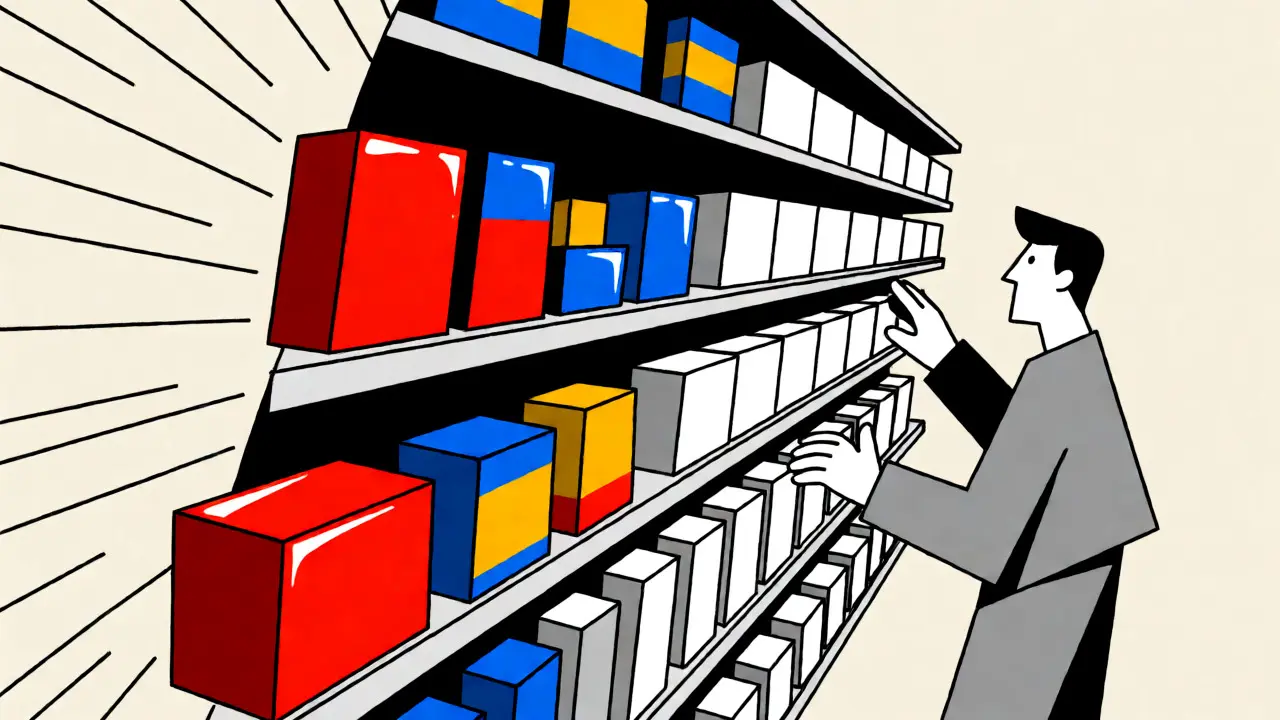
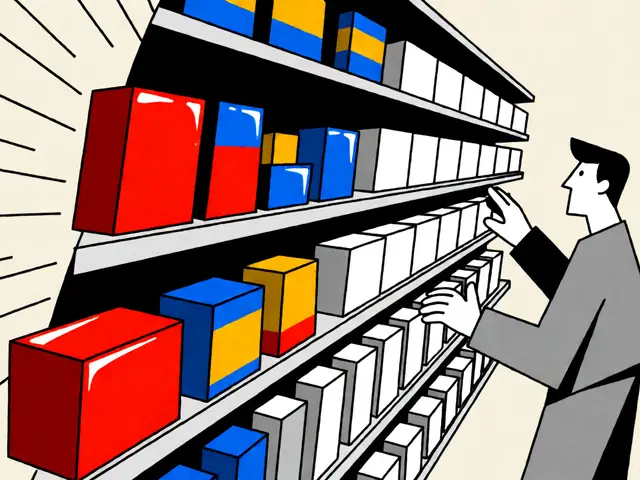
You walk into a pharmacy, and the shelf is lined with boxes. Some are bright blue, others stark white. One costs $40, another costs $4. You know they contain the same active ingredient, yet your brain hesitates. Why? Because for decades, pharmaceutical companies have spent billions convincing you that the shiny box is better than the plain one. This isn't just about packaging; it's about brand psychology at work in healthcare.
In the United States and New Zealand, a unique legal framework allows pharmaceutical companies to advertise prescription drugs directly to consumers (DTC). While most of the world bans this practice, Americans are bombarded with emotional narratives featuring happy couples hiking or energetic seniors playing golf. The result? A massive disconnect between clinical reality and consumer perception. Patients often view generic medications as "second-rate" alternatives, even though they are bioequivalent to their branded counterparts. This article breaks down how advertising distorts our understanding of generics, influences doctor visits, and ultimately impacts health outcomes.
The Billion-Dollar Influence on Perception
Let's look at the numbers. In 1996, U.S. pharmaceutical companies spent roughly $550 million on DTC advertising. By 2020, that figure had skyrocketed to over $6.5 billion. That’s a tenfold increase in spending aimed squarely at influencing patient behavior. This money doesn't just buy airtime; it buys narrative control.
When a company advertises a new branded drug, they aren't just selling a pill. They are selling an identity, a solution, and a sense of modernity. Generic drugs, which typically enter the market after patent expiration, rarely receive comparable marketing budgets. Consequently, they lack the "story" that patients associate with healing. Research from the Wharton School highlights that a 10% increase in advertising exposure leads to a 5% increase in prescriptions. But here’s the twist: much of this effect spills over into the entire class of drugs. If you see an ad for Lipitor, you might ask for a statin. Your doctor might prescribe a generic atorvastatin. The ad worked, but not necessarily for the product advertised.
Direct-to-Consumer Advertising is a marketing strategy where pharmaceutical companies promote prescription medications directly to patients rather than healthcare providers. It is currently legal only in the United States and New Zealand, creating a distinct market environment compared to the rest of the world.
The Spillover Effect: Helping Generics, Hurting Wallets
It sounds counterintuitive, but advertising for expensive brands actually boosts generic sales. Researchers call this the "spillover effect." When patients see a commercial for a high-profile drug, they become aware of a medical condition they may have ignored. They visit their doctor, request treatment, and often leave with a generic version because it’s cheaper and covered by insurance.
However, this dynamic creates a psychological hierarchy. The branded drug is positioned as the "gold standard," while the generic is seen as the "budget option." Even when clinically identical, the generic lacks the perceived value. This perception affects adherence-the likelihood that a patient will actually take the medication as prescribed. Studies show that patients who initiate treatment due to advertising often show lower compliance rates. They were captured by the promise of the brand, not the necessity of the treatment. Once they realize they are taking a generic, some feel disappointed, leading to skipped doses or early discontinuation.
How Ads Distort Risk and Benefit Awareness
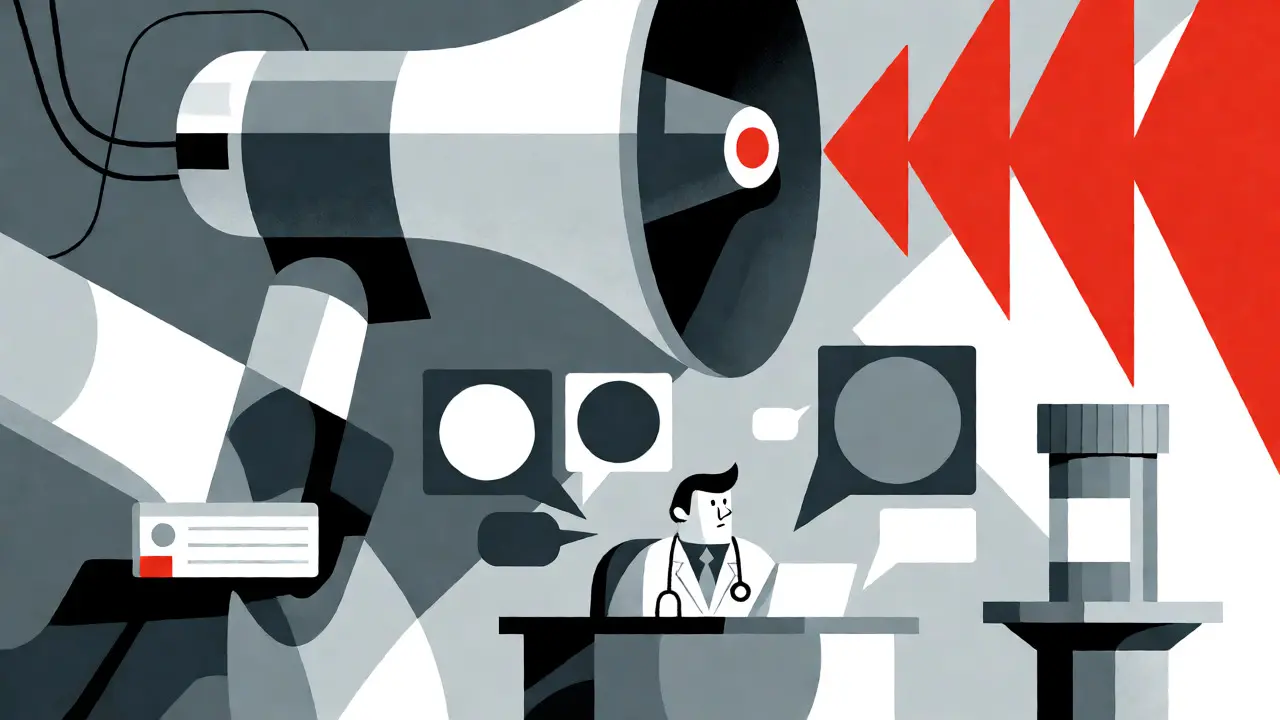
Have you ever tried to read the fast-talking side effects list at the end of a drug commercial? Most people can’t. The FDA conducted a study in 2018 examining how well viewers retain risk information from these ads. The findings were sobering: even after four exposures to the same ad, retention of both risks and benefits remained low. More critically, risk information required significantly more repetitions to be remembered than benefit information.
This asymmetry favors branded drugs. Brands spend heavily to highlight lifestyle benefits-"get back to feeling like yourself"-while burying risks in rapid-fire audio. Generics, lacking this glossy presentation, don't suffer from the same "benefit bias." But because patients don't recall the risks of either, they rely on heuristics. The heuristic here is simple: "If it was in the commercial, it must be important." This leads to inappropriate prescribing. A survey cited by the University of Montana found that physicians filled 69% of patient requests for interventions they considered medically inappropriate. Patient pressure, driven by advertising, overrides clinical judgment.
| Attribute | Branded Drugs | Generic Drugs |
|---|---|---|
| Marketing Spend | High (Millions/Billions annually) | Low to None |
| Patient Perception | Superior, Modern, Safer | Cheaper, Inferior, "Old" |
| Adherence Rate | Higher initially due to expectation | Lower if substituted unexpectedly |
| Risk Recall | Low (Benefits dominate memory) | Low (Lack of exposure) |
| Physician Pressure | High (Patients request by name) | Low (Patients rarely request) |
The Doctor-Patient Dynamic Under Pressure
Doctors are human. They want to help their patients, and they want to maintain trust. When a patient walks in saying, "I saw an ad for Drug X, can I try it?", the physician faces a dilemma. Saying no might make the patient feel unheard. Saying yes satisfies the patient but might not be the most cost-effective or clinically appropriate choice.
A classic study published in JAMA demonstrated this powerfully. Standardized patients asked doctors for specific antidepressants. Those who requested the brand-name drug received it significantly more often than those who didn't ask. This suggests that the mere act of requesting a branded drug shifts the prescription away from potentially equally effective generics. The advertising doesn't just inform; it commands. It turns passive patients into active consumers who believe they know what's best for them based on a 30-second spot, not a comprehensive medical evaluation.

Why Generics Struggle Despite Clinical Equivalence
Generics are required by the FDA to have the same active ingredient, strength, dosage form, and route of administration as the brand-name drug. They are also proven to be bioequivalent, meaning they deliver the same amount of active ingredient into the bloodstream in the same amount of time. So why do we distrust them?
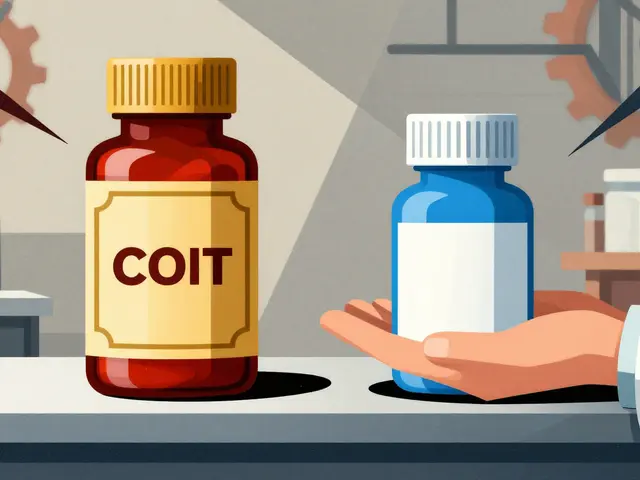
It comes down to visual cues and social proof. Branded drugs come in distinct shapes and colors, protected by trademark laws. Generics vary by manufacturer, often looking different each time a patient refills a prescription. This inconsistency breeds uncertainty. Furthermore, branded drugs are surrounded by testimonials and celebrity endorsements. Generics are sold in plain boxes with chemical names. Our brains are wired to equate effort and expense with quality. We assume that if a company spent millions on R&D and marketing, the product must be superior. We forget that much of that cost goes toward marketing, not necessarily better science.
Navigating the Noise: What Patients Should Do
If you're tired of being sold to during your healthcare journey, there are practical steps to reclaim control. First, ignore the brand name in the ad. Focus on the condition being treated. Second, ask your pharmacist specifically about generic availability. Pharmacists are often the most knowledgeable sources on cost and equivalence. Third, question the necessity. Just because a drug is advertised doesn't mean you need it. Many conditions can be managed with lifestyle changes or older, cheaper medications.
Remember, the goal of advertising is profit, not public health. While increased awareness of diseases like diabetes or depression has its merits, the method of delivery often skews choices toward higher-priced options. Understanding this bias helps you make decisions based on efficacy and cost, not just clever storytelling.
Are generic drugs less effective than brand-name drugs?
No. The FDA requires generic drugs to be bioequivalent to brand-name drugs, meaning they have the same active ingredient, strength, and dosage form. They work the same way in the body. Differences in inactive ingredients (like color or fillers) rarely affect effectiveness.
Why do doctors sometimes prescribe brand-name drugs over generics?
Doctors may prescribe brand-name drugs due to patient requests driven by advertising, concerns about switching formulations (though rare), or specific insurance requirements. However, studies show that many brand-name prescriptions are written simply because the patient asked for them, not because of clinical necessity.
Does advertising improve medication adherence?
The evidence is mixed. While advertising increases overall utilization, research indicates that patients who start treatment because of ads often have lower adherence rates. They may be less committed to the treatment regimen since the motivation came from external marketing rather than internal health needs.
Which countries allow direct-to-consumer drug advertising?
Currently, only the United States and New Zealand permit direct-to-consumer advertising for prescription drugs. Most other countries restrict such advertising to healthcare professionals to prevent consumer confusion and unnecessary spending.
How does the "spillover effect" impact generic drug sales?
The spillover effect occurs when advertising for a branded drug raises awareness of a disease class, leading patients to seek treatment. Doctors often prescribe generic alternatives within that class. Thus, branded advertising indirectly boosts generic sales, even if the patient initially wanted the brand.






Tara Smith September 6, 2026
It is pathetic that we are the only developed nation stupid enough to allow this garbage. Everyone else has their heads on straight except us. We let corporations brainwash us into paying triple for the same chemical compound just because they bought a Super Bowl ad. It’s not healthcare, it’s a scam designed to drain our wallets while we clap like seals. The rest of the world laughs at us and rightly so.
Josie Parry September 7, 2026
it’s fascinating really 🤯 how much our brains can be tricked by packaging... we think shiny = better but science says otherwise?? 💡
i feel like we’ve lost the ability to trust plain things anymore 😔
the marketing spend numbers are insane though 💸💸💸
Ankur Saini September 9, 2026
as someone from india where generics are standard i find this whole debate weird. here nobody cares about brand name if generic works. maybe you guys need to see more ads to realize how silly it is? also doctors here rarely get pressured like that. its all about cost effectiveness for us. sad that money drives health choices in us.
Taylor Tomita September 10, 2026
I appreciate the nuance here. While the spillover effect is real, we shouldn't dismiss the psychological comfort some patients derive from brand consistency. For elderly patients or those with cognitive decline, seeing the exact same pill shape and color every month reduces anxiety significantly. Generics changing manufacturers often leads to confusion, which can indeed lower adherence. It's not just about greed; sometimes visual stability aids mental well-being during treatment. I've seen cases where switching to a generic caused unnecessary panic for no clinical reason.
Sayan Kanjilal September 11, 2026
Man, this article hits me right in the soul. It’s like we’re all puppets dancing on strings made of neon lights and catchy jingles. You pay extra for the 'story' instead of the substance. It makes me want to scream into the void because we know better but we still buy the shiny box. It’s emotional manipulation disguised as medical care, and honestly, it’s heartbreaking how vulnerable we make ourselves for a few dollars less peace of mind. We are literally buying placebo effects with our hard-earned cash.
Manish Kumar September 11, 2026
haha yeah the fast talking side effects part is always funny 🙄 i never hear half of it anyway. usually just "may cause death" lol. but seriously the price difference is crazy these days. hope people start reading labels more 📝👀
Nathan Rock September 12, 2026
One must consider the broader epistemological implications of consumer-driven healthcare decisions. When we allow advertising to dictate medical choices, we effectively outsource our autonomy to corporate entities whose primary fiduciary duty is shareholder value rather than patient welfare. This creates a paradoxical situation where increased access to information actually decreases informed consent, as the information provided is curated specifically to elicit an emotional response rather than a rational analysis. Furthermore, the erosion of physician authority in favor of patient preference driven by media narratives fundamentally alters the therapeutic alliance. We are moving away from evidence-based medicine toward narrative-based consumption, which may have long-term detrimental effects on public health outcomes despite the short-term satisfaction of the individual consumer. It is imperative that we critically examine this shift before it becomes irreversible.
Katie Evans September 14, 2026
We are trapped in a matrix of our own making. The brand isn't the drug; the brand is the illusion of control. By choosing the generic, we reject the spectacle, but do we reject the system? Or do we just choose a cheaper cage? It's all performance art really. The pharmacy aisle is a stage, and we are the audience who forgot the play was over years ago. Existential dread sold in blister packs.